Sunday 7/26/15
When you give the music a chance, it takes you somewhere.
It’s as simple as cause and effect. That should be a general theory of jazz relativity or something. Now whether or not you’ll like where you went is entirely up to you and your tastes, but at least you can say the music didn’t bore you.
In the moments leading up to this concert, I got the feeling the night was going to be a let down. It was a Sunday evening and the vibe was excessively low key. The room – which isn’t very big to begin with – was filled only 1/3rd to capacity. Of the audience that was present, there were some scattered regulars and a pair of older couples. Thankfully, despite my unintentional day-to-day efforts to the contrary, I was not the most awkward person in the room.
Behind me was the obligatory underage teenager musician studiously checking out his heroes as well as the local scene. I could tell he was underage by the timid eight seconds it took to order his “water…that’s it”, and I could tell he was a musician because he had gone by himself. I could also make him out to be an awkward dweeb from his stance, haircut, attire, lankiness and barely-there facial hair all screaming “WAITING FOR THAT ACCEPTANCE LETTER”.
Also because that was me to a “T” two years ago in this very venue. Hang in there guy. We’ll never be cool, but we do get less lame. It’s a very cathartic feeling when you realize it.
I turned around and attempted to make some small talk with him before the band took the stage, partly because I want to believe I’m not afraid of people, but mostly so I could honestly tell you that I tried. I got as far as a greeting and his instrument – trumpeter, like Wilkes – but after that I could tell he was completely focused on what was about to unfold on the bandstand.
I can’t blame him. Because even with a weak room, there was going to be a lot to take in from that stage.
The Players
Corey Wilkes (t)
Justefan Thomas (v)
Junius Paul (b)
Greg Artry (d)
From the moment the quartet took the three foot elevation that was the Showcase stage, I got the sense that it didn’t matter to them if more people were showing up or not. We were getting an overdose of jazz music tonight.
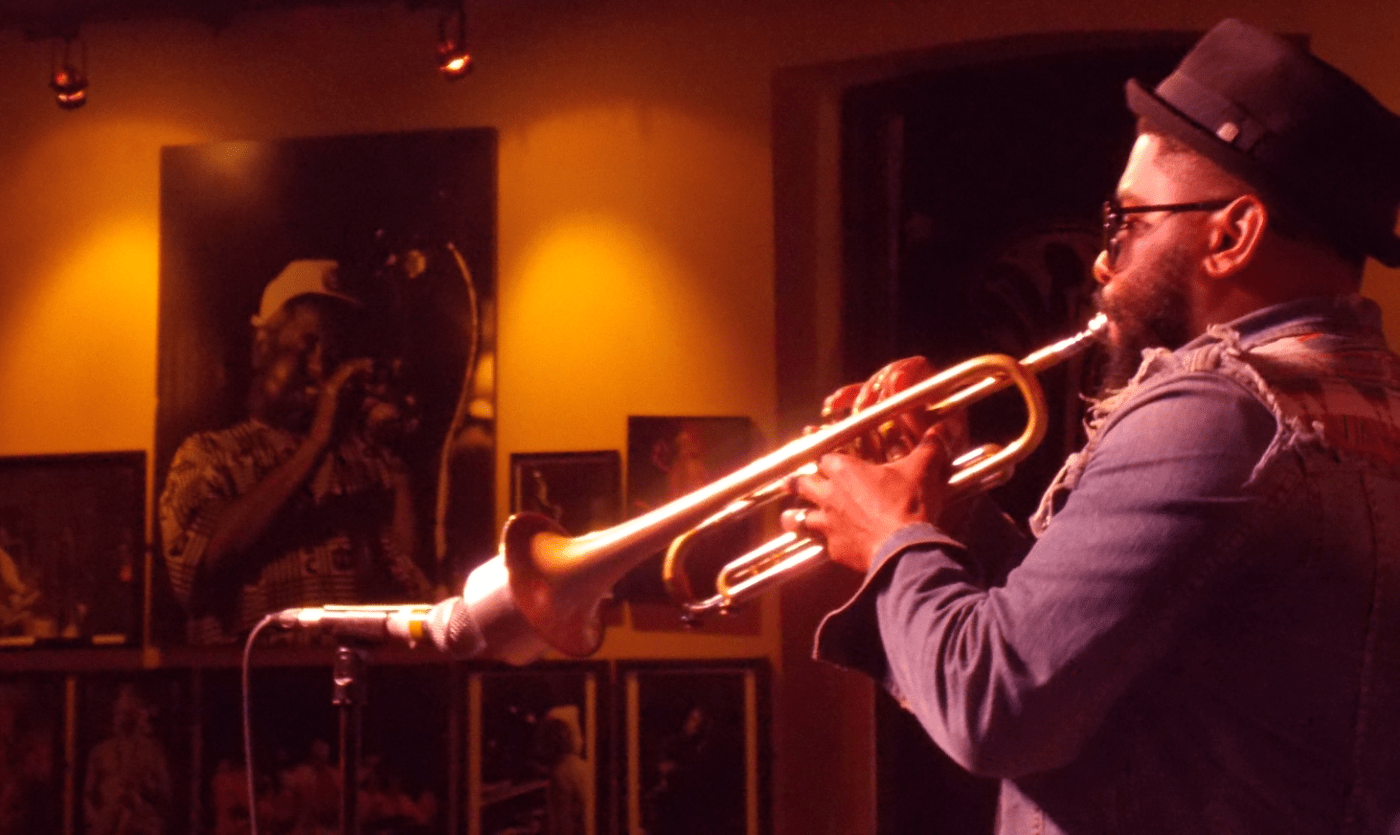
Corey Wilkes’ on stage persona can best be described as completely self-encapsulating. It’s about as “in the zone” as you one can get. Take care not to read that as pompous or pretentious. If you give him the room to work – and there was a lot of extra room at the club that night – he’ll come down hard on the solo with conviction. It probably helps that he looked like he was about to pounce on a II-V any second.
And pounce he did.
Almost immediately the group came out of the gate swinging. 16th note runs, 32nd note bursts for Greg Artry’s drums, and in/out playing galore. I guess that’s what happens when it’s the last day of your residency and most of the room are ghosts. I was about as close to press as they were going to get anyway, so they had little to worry about in that regard. The point is, these guys had chops and it looked like they wanted to establish immediately. Mission accomplished.

Bleeding out of that opener however, came Ornette Coleman’s free jazz classic “Lonely Woman” as ominous and sublime as I’ve ever heard it. After a long, drawn out intro by the drums going what must have been at least four minutes of unrelenting intensity, the melody came into play. I’ve never actually had the pleasure of hearing this song live. I’m most familiar with the original as well as Brad Mehldau’s take on it, but hearing it with Justefan Thomas’ vibraphone created a unique sound because of the darkness of the composition coupled with the brightness of that instrument. The interweaving, give-and-take textures between vibes and trumpet during the melody and behind each other’s’ solos were exceptionally engaging.
Wilkes went all out for his solo – as if there was any other way for him to improvise – complete with exaggerated wails and bends. At times he would feverishly attack his trumpet valve and his own embrasure. Other times he would bring his trumpet 90o all the way up, down, left, and right quickly past the microphone. All of this with the rhythm section visibly and audibly responding. I swear I could also feel Junius Paul’s bass pulses ride the ebb and flow of the solos yet somehow stay consistent, although I will readily admit that could just be an inaccuracy in my reminiscing.

I’m slowly figuring out that it takes a certain mindset to successfully experience a free jazz piece. The common misconception from the public – me included – is that it’s a green light for the musicians to play whatever the hell they want. It may be the ultimate rule-breaking subgenre, but it’s still jazz. I’m discovering that free jazz is a conscious effort to remove as many of the conventions from the typical standard while placing even more emphasis on the most basic of jazz necessities: communication and collaboration. No matter the song, when a musician stops listening to what’s going around them, then it fails to be jazz.
Really, just give the music a chance. Anyone is capable of being “smart enough” or “weird enough” to hear it. If the kid raised on Carole King, America, and The Beatles – hint, me – can hear this stuff, so can you.
In this regard, I think it’s actually easier to absorb a song like “Lonely Woman” live because you can visually engage yourself with the music. Truth be told I’m still new to the subgenre, but I’ve found this song in particular to a great place to start. It’s a striking emotional statement that immediately grabs you and has a melody that is comparatively easier to absorb. It’s also the epicenter of the movement from a historical standpoint.

It really is difficult to not compare Wilkes’ style to Miles Davis’. Playing? No. Wilkes’ sound is too aggressive for that. But stylistically and atmospherically, the two ring much closer. I’ve done my best to avoid it this whole article since nearly everyone else has made the same comparison, but it’d be dishonest of me at this point if I didn’t.
The shiny Adidas sneakers with unnecessarily large flaps. The denim jacket with strategically fashionable rips and tears. The pair of gold chain necklaces. The dark brown shades despite night. The spiked hair under the crookedly-worn trilby. The incessant side-to-side body movements that got so low and exaggerated, I’d swear he missed his daily squat quota and was doubling down. It may not be quite what Miles wore, but the spirit of the pronounced individuality is there.
It probably helps Wilkes released an album in 2011 entitled Kind of Miles: Live at the Velvet Lounge. Containing four tracks of Miles-influenced arrangements, it has a distinct soul and groove tinge Wilkes seems to be partial to. It’s also an excellent snapshot of the atmosphere filling the room that night.

Another highlight of the evening was Wilkes’ funk arrangement of “Nardis/So What” (I thought August was supposed to be Charlie Parker month?). “Nardis” is one of my all-time favorites due in part to its gorgeous melody and cathartic resolutions. “So What” is…do I really need to explain the gravitas of “So What”?
Again, I cannot stress how well Justefan Thomas’ vibes work complemented Wilkes’ sound, at least with darker modal tunes. All of the soloists seemed particularly aware about the pacing of their improvisations. As I mentioned earlier, they wielded great technical prowess, but chose their moments very well. It was a slow burn juxtaposed with unrelenting drive from bass and drum, and fulfillment was the result. Thomas appeared to agree – he had this habit of casually raising his sticks seemingly in victory after every solo.
Even with the funk pocket, “Nardis” still retained a bit of its fragile atmosphere a la the seminal Bill Evans version. That’s a testimony either to the strength Davis‘ compositional skills, Evans’ staying power on the tune, or Wilkes’ smart sense to exploit the emotions that already come with the song. ”So What” on top of that just felt exciting to hear.

There were other songs on both sets that I couldn’t name, but not many because of the prolonged length of each song. Wilkes also made the creative decision to not talk until the very end of the sets, and he bled several songs together with Paul or Artry setting up vamps. While a boon to rookie writers trying to recall details, even the lack of talking underpinned the night with a sense of cool and modern mystique not easily found. Say what we all might about the Davis-Wilkes connection, but the latter really has forged something unique.
If Wilkes wanted to name his quartet something else, he might try the “Catharsis Quartet” or something way hipper than anything I can imagine. In the meantime, we’ll just have to settle for his excellent brand of extended hard bop soul.
Article and all pictures by Dominic Guanzon.


 Blue Collar Jazz
Leave a comment