
I love La La Land. At first viewing, it’s a classic Hollywood musical, but after the lovey-dovey opening act, it manages to refresh itself via an injection of realism. It’s seemingly the perfect escape and the perfect capture of essence of what it feels like to live in today’s world.
It’s a film that adores and showcases Los Angeles, the movie business, and jazz. It’s also a movie about none of those things, but rather uses these periphery topics to advance the true meaning. At its core, the movie is about dreamers, and the highs and lows of attaining their dream – the mythical La La Land.
Yet in the past month, a flurry of articles by jazz critics featured on various online publications throughout the web have come out apprehensive – and sometimes outright appalled – by the movie’s depiction of the jazz scene and its place in America’s culture. Or rather, director Damien Chazelle’s supposed declarations made on behalf of jazz fans everywhere. I jumped to the same conclusions too, at first.
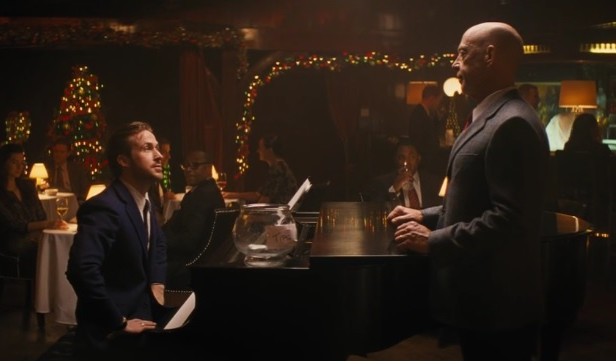
I have a working theory J.K. Simmons plays a pair of twin brothers in La La Land and Whiplash, thereby establishing the Chazelle Cinematic UniverseTM.
When jazz ceased to be America’s pop music in the late 1940s, it was doomed to never re-enter the absolute height of mainstream ever again, save for special occasions like this movie. So when jazz finally does get to be in the national spotlight for a brief moment, jazz lovers tend to pour a lot of hope into that mainstream depiction.
They may not be actively thinking it, but they’re secretly hoping some cultural touchstone launches their beloved music back into the mainstream – a la la land of their own where Hank Mobley gets a statue (deserved), Art Blakey gets a documentary (he’s PERFECT for it), and Herbie Hancock gets to perform at the Super Bowl so children everywhere can have their eyes opened. And finally, someone at the coffee shop can casually ask their friend “why was Charlie Parker so important?” just loud enough for Birdbrains like myself to explain.
Okay maybe not to that extreme, but it’s the gut feeling. And I know this feeling because that’s precisely how I feel deep down inside whenever something like Whiplash, Miles Ahead, or Born to Be Blue comes out to mass audiences, or when Esperanza Spalding gets a surprise Grammy win over Justin Beiber. From devotees of The Book of Mormon to actual Mormons, we all have this knee jerk reaction to share our passions and enlighten the unenlightened. It’s in our nature as jazz enthusiasts, as comic book nerds, as film buffs, as evangelicals, as communists, as railfans, or whatever the hell we’re devoted to.
Ryan Gosling’s character Sebastian wants to do just that with jazz. However, he has a very traditionalist, conservative view of the genre. That’s fine if you’re assembling a playlist for yourself. The problems arise when traditionalists start to impose – not just share, impose – on others. That conflict is portrayed very clearly between Sebastian and John Legend’s character, Keith.
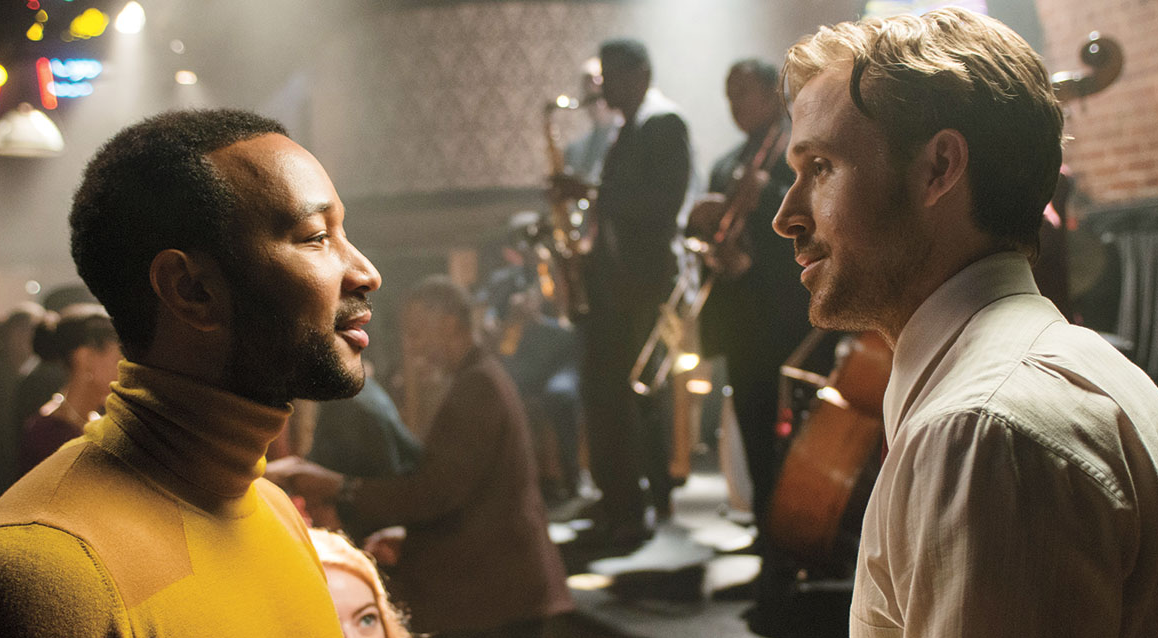
The moment when all the jazz nuts like myself started to lean in closer to the screen.
Here’s where I think a lot of those jazz critic articles start to lose focus and fall for the classic story trap: viewing the protagonist as the author’s voice simply because they’re the protagonist. Likewise, Keith is somehow the bad guy the director is chastising for “selling his soul”. Cue articles streaming in about how jazz is poorly represented in the movie, how the reality is much more diverse and not at all dying.
“It’s hard not to detect a whiff of ideological snobbery to La La Land. The movie will undoubtedly continue to rack up awards, and introduce newer generations to jazz. It’s just unfortunate that, as parts of the jazz world have finally ditched rigid definitions of what the genre should be, the conservative vision is now being pushed to global audiences again.”
“Maybe Chazelle’s depiction of a jazz club will compel a few La La Land audience members to visit their local jam session, where they may just do something Seb couldn’t: get hooked on the diverse, youthful, and endlessly compelling world of jazz that exists right here in 2017.”
“I’ve met a few musicians who could be caricatured into Sebastian. It would be a drag if he became as real and commonplace as the joke about hating jazz.”
And again, I shared some of these initial reactions. Even now, I’ll concede the film does portray Keith a little too lopsidedly commercial. His electronic surprise in the recording studio really was an ambush considering who he was playing with, Sebastian biting his lip was indeed ridiculous, and out of the many jazz performances I’ve seen in Chicago, I’ve yet to see backup dancers. Also, Keith’s performance of “Start a Fire” was way too R&B to be jazz, which I have no problem with except when the movie makes it out to be the bastard cousin of jazz progressivism, or something.
But what cannot be forgotten is Chazelle and his team do all this intentionally. Jazz fans know jazz isn’t dying, but Seb’s character in the film still thinks it is. This can be backed up in an article by The Independent, La La Land’s musical director Marius de Vries describes the process behind John Legend’s concert scene:
“This is very much the black swan of the sequence, and necessarily so. We had to set John Legend the challenge of writing and performing a piece which would be different enough from the main thrust of the music to make it clear that Sebastian is being diverted from the path of his musical dream, yet sophisticated enough for him to feel it worth his time.
This is fed by Damien’s nuanced presentation of the issue of Jazz Purity vs Jazz Evolution that clearly becomes a pivotal issue in Mia and Sebastian’s relationship – but the storytelling of La La Land is rich enough not to come down on one side or the other.” [Emphasis added.]
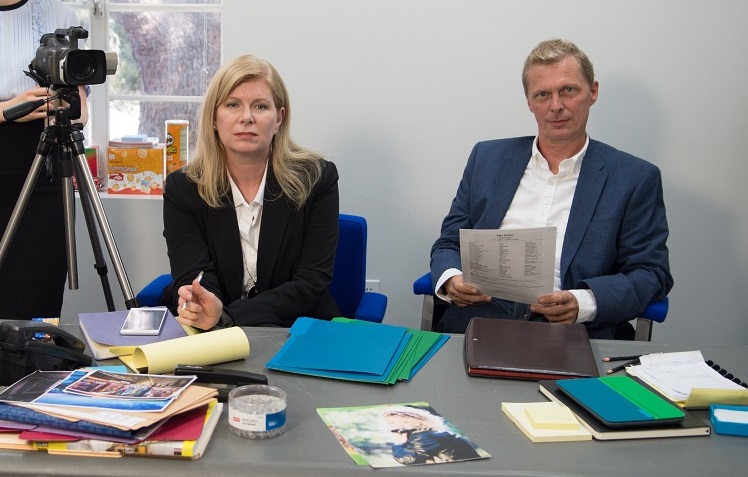
Musical Director Marius de Vries (right) in a soul-crushing cameo.
If you’re a jazz fan who thinks Sebastian is backwards in his thinking, Chazelle played you (and me, don’t forget) harder than a Jean Luc-Ponty electric fiddle. The Purity vs. Evolution issue is simply a vehicle to give the movie its conflict-ridden second act. It’s just such an issue that hits so deep for us jazz nerds who have nothing else better to do than to write articles about La La Land, a lot of us got distracted by it.
To reinforce that point, Sebastian is written to be a flawed character from the beginning. An extremely likable, good-looking flawed character. He showcases this early on when he brings Emma Stone’s Mia to a club and passionately paints jazz as “conflict and compromise”, reveling in the genre’s unique trait of spontaneous composition as the screen churns out hot notes and sleek edits ala Whiplash.
Only, he contradicts himself later when he refuses to compromise any bit of the music. In live music, a fluid relationship of give-and-take is key. When he finally does compromise later in the second act, he does so in the worst possible way – out of self-spite, money, and with a selfish delusion that all of it was somehow motivated by Mia’s desires.
A great John Legend blooper from Zach Galifinakis’ Between Two Ferns sums up the feeling:
“Would you say that your work in La La Land really helped pave the way for white people to explain jazz to black people?”
Seb is a self-fulfilling prophecy, and a well-written one at that. The problem is most jazz fans seem to have taken the character a little too far, that is, out of the pages of script and into the real-world debate about what’s really going on in jazz music. Like Sebastian shoving motives into Mia’s face, jazz critics seem to be doing the same for Chazelle, the same way they did when Whiplash came out two Oscar seasons ago. It’s as if they all assumed the audience would all catch Literally Me Syndrome upon completing the film. I mean, I’m sure a lot of them did, but it’s a little irresponsible to assume so.
“The pop-rock drum-bashing of that film’s overwrought protagonist, as well as the preposterousness of its plot — complete with truck crash, vats of fake blood and a make-or-break Carnegie Hall showdown — illuminated how little Chazelle either knew or cared about what jazz is. To him, it was but a vehicle for adrenaline-pumping hysterics.” [Emphasis added]

THAT’S THE POINT!
Both Sebastian and Keith have their arguments to make, and while I think Chazelle could have put a little more grey between the contrasting characters for the sake of the jazz argument that he had to have known he would stoke, it would’ve been a pointless move anyway.
La La Land, at its core, isn’t a “jazz” movie, and Whiplash isn’t either. As Adam Neely explains, the latter is a sports movie.
As one of my jazz professors once told me after I had just finished a timid, wooden jury, Round Midnight is the “jazz movie” to watch if you’re looking for an authentic feel, as gloomy as it portrays the scene.
But Mia and Seb’s story is about dreamers, all the dreams both fulfilled and broken, and looking back with the wisdom of finally knowing which is which. The jazz enthusiasts honing in on the Sebastian-Keith dynamic are really just letting their inner Herbie Hancock-at-the-Super Bowl fantasy talk for them. Hell, the fact I’ve written this much about a minor side plot means I’m in the exact same camp as well. We’ve all gotten carried away at some point.
And we do so because as jazz lovers, that’s our dream.
Article by Dominic Guanzon
![[2/2] BROADVIEW, IL, 2/28/26, 1PM-2:30PM – After their scheduled program, ~50 protesters moved from the designated protest zone on Beach St, down 25th Ave, and to the Harvard St approach to the ICE facility in a seemingly impromptu occupation of the intersection.](https://scontent-iad3-1.cdninstagram.com/v/t51.82787-15/641803666_17981473718968438_580148578517965678_n.jpg?stp=dst-jpg_e35_tt6&_nc_cat=109&ccb=7-5&_nc_sid=18de74&efg=eyJlZmdfdGFnIjoiQ0FST1VTRUxfSVRFTS5iZXN0X2ltYWdlX3VybGdlbi5DMyJ9&_nc_ohc=2uh27-B_QokQ7kNvwHzPq7k&_nc_oc=Adken5x1hmbOidGuT58ZkD4yJjzW0sVBeXX1pQfMcOSs5JwJYeyCb_IZFFKC-yFdTTg&_nc_zt=23&_nc_ht=scontent-iad3-1.cdninstagram.com&edm=ANo9K5cEAAAA&_nc_gid=bWvV8hxUeCIFWXq-UvEMmA&_nc_tpa=Q5bMBQGyjNNGhaqa097RgrRD794xwuIxGFxzp68i_Mjk4iqRdz3HXyGGZpTrGkrtsp34HqpvHLcMLae5kQ&oh=00_Afz6GemkCbL1Qd31UJUgTTwrus3wV4VKl250b0UXXxcVcw&oe=69AD7CDF)
![[1/2] BROADVIEW, IL, 2/28/26, NOON-1PM – About 75 protesters came out for the “Salt Melts ICE” rally within the designated protest zone of the ICE Staging Area/de facto detention center. The theme centered around the salt/ice pun heavily, making extensive use of Morton Salt imagery, a company founded in Chicago.](https://scontent-iad3-2.cdninstagram.com/v/t51.82787-15/642548769_17981419820968438_7452416072177783532_n.jpg?stp=dst-jpg_e35_tt6&_nc_cat=103&ccb=7-5&_nc_sid=18de74&efg=eyJlZmdfdGFnIjoiQ0FST1VTRUxfSVRFTS5iZXN0X2ltYWdlX3VybGdlbi5DMyJ9&_nc_ohc=c2SoueHleUcQ7kNvwGzU4qA&_nc_oc=AdlSnRstbqF2wwZoYghEHQO29_TCkkBdNajoMeIjtt8CaGIpLz8VSxmhwbrw5kaBZcA&_nc_zt=23&_nc_ht=scontent-iad3-2.cdninstagram.com&edm=ANo9K5cEAAAA&_nc_gid=bWvV8hxUeCIFWXq-UvEMmA&_nc_tpa=Q5bMBQH9Hy9k6ITASm6FjJ0CyIWXiwDKn8F1f9lPiYEh7aQoZMLreQ-0OWarZ0Y57GNg1hgASyLxWkHaqQ&oh=00_Afz8DqH_05yc_AR2CGrGvw56LMGGcCe8SogvaJ5a_r2tbA&oe=69AD9F96)


 Blue Collar Jazz
Leave a comment