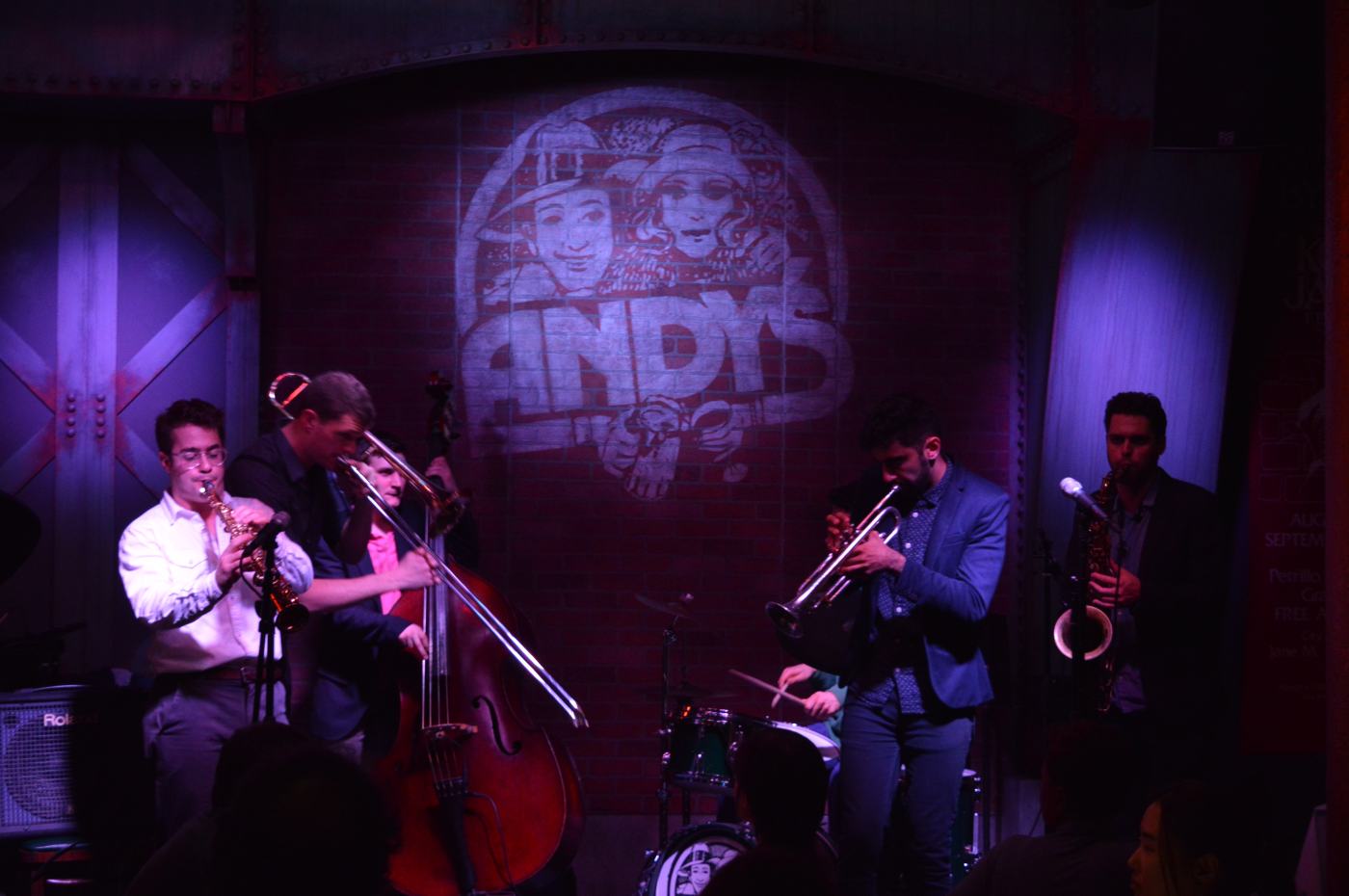
Featured Image: Sammy Miller and the Congregation
Andy’s Jazz Club & Restaurant is one of Chicago’s most popular hotspots for jazz music. Nestled just a bridge away from The Loop and a couple blocks from the Magnificent Mile, it’s easy to say Andy’s is one of the brightest jazz stages in the city.
Behind the glitz and glamour of the River North spot is the Chisholm family. In spite of a busy schedule one might expect from running a Chicago club, Co-Manager Chris Chisholm was gracious enough for an email interview and some insight into the venue.
Blue Collar Jazz [BCJ]: When was the club founded? Is its current location the original?
Chris Chisholm [CC]: Andy’s 11 E. Lounge was founded in 1950-1951 by Andy Ruzzuto who at the time was the owner of the building (11. E. Hubbard). Andy sold the building in 1975 to a group of investors from the NW Suburbs and decided to leave the bar business at the same time.
The bar commonly known as Andy’s focused on catering to the newspaper industry that took up space all along the neighborhood along the Chicago River and was basically a “shot and beer joint” that served very simple food. The group of investors didn’t have understanding/interest in running a bar and got in touch with Scott Chisholm, current owner of Andy’s Jazz Club and whom was a recent college grad and nephew of one of the investors, and asked him to run the bar on their behalf. A year later Scott acquired ownership and the investors sold the building to another entity.
Around 1977-1978 a group was working on revitalizing the Jazz scene in Chicago that had dissipated with the onset of Blues and Rock in the 50’s-70’s. This group was spearheaded by Penny Tyler and John DeFauw. They presented the idea of offering Jazz to the clientele of Andy’s and started performing lunch sets on Fridays with the hope that Scott would see increased business and continue the happening. Sure enough business warranted additional bookings and performances. This is when Andy’s first began to be referred to as a jazz club.
BCJ: Who runs the club today? How did the club get passed down to you?
CC: The venue is still owned by the entire Chisholm Family. Myself and my two younger brothers are driving the business’ day to day operations with our father still heavily involved with major decisions on club matters.

BCJ: Who are some of your personal favorite artists to have graced the Andy’s stage? Favorite jazz standards you like to hear?
CC: I have booked all performing artists at the venue for almost ten years now. I find I enjoy all performances in one facet or another and believe that I have an ear for what the casual listener will find appealing.
Many of our visitors are experiencing a live music venue – specifically a jazz venue – for the first time. So we find it important to make sure that the music can come across appealing to many different palates. Jazz is improvisational music, so in that regard I do not have any favorite specific songs or standards – I enjoy the creativity of solos and how they meld within the tune at hand. Originality is key to getting the audience to want to remember you.
BCJ: When did you establish the Wall of Fame? How does one get on the Wall? Who decides who gets on?
CC: The wall of fame was established for the movie Continental Divide starring John Belushi from 1980-1981. The movie was about a sports writer from Chicago whose regular bar/hang was supposed to be the original Billy Goat Tavern (located just down the street from us on Hubbard). The Billy Goat has their walls adorned with writers photos in their own version of a wall of fame…but decided not to work with the production crew on the film. The crew walked down the street and found Andy’s and presented the idea of filming. They wanted a Wall Of Fame mirroring the concept and so we worked with them on creating the vibe they wanted and kept the concept going with our performers gracing the wall.
Only those that have performed on our stage are gracing the Wall of Fame right now. We recently went through a slight remodel and freshened up those that are posted. The Wall of Fame itself isn’t a ranking of who we feel is best or who have performed longest at the venue by any means as we appreciate and adore all those performers that are framed throughout the entire club, though we have put a slight emphasis to make sure some of the more well-known are under the Wall Of Fame neon’s.
Artists need only to have performed on our stage and provide us with a great photo to be in consideration for any wall spot in the club!
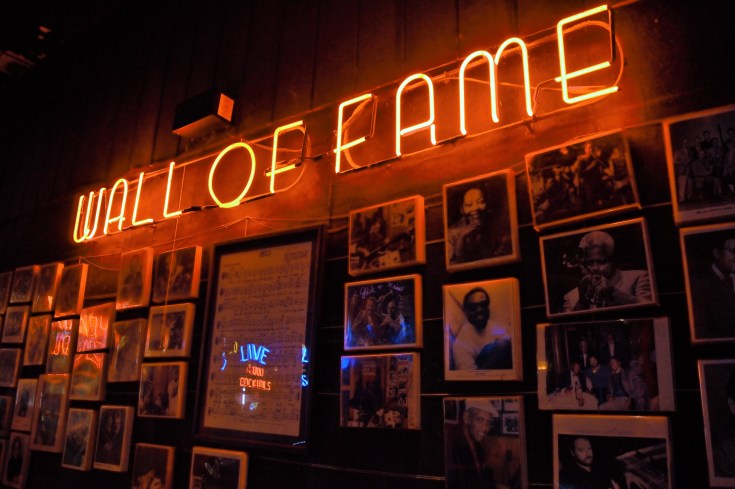
The Wall of Fame pre-renovation.
BCJ: You’re one of the few, if not the only, jazz club in Chicago to offer food, let alone full course meals. How well has it served the business?
CC: Full dining has always been a part of Andy’s regular day to day operations. Really wouldn’t have any way to compare how running our venue would be without offering dining.
Our overall vibe within the club is casual. We like to refer to ourselves as a cross between an old Juke-Joint of the 20s-30s to the supper clubs of the 40s-50s in atmosphere. Lively, jovial atmosphere with sophisticated casual dining and a focus on performances. Dining adds an element to this experience as dining is a very social experience. Camaraderie and conversation are associated with dining. We present our music in a conversation-friendly environment (not typical for non-dining jazz venues worldwide, most more than not are quiet listening rooms). We have presented a few shows over the years where artists requested quiet listening rooms for their performances and found that it wasn’t the atmosphere or vibe we enjoyed presenting to the public.
Jazz as a genre was once POP music of its time where people danced and cheered along with the band’s performances in a lively environment. Now that music genres have adapted over the decades, presentation of Jazz has come across and being this elitist genre that requires ultimate focus to appreciate and we disagree. We believe that it can still be presented in a the way it was when it was POP music and be interacting with the audience members in front of which it is being performed.
BCJ: Running a business in Chicago can be cutthroat. What were some some of the tougher decisions in order to keep the club alive?
CC: You could read our fathers book he just recently finished “Scott On The Rocks” and see some of the wild and out of the norm instances that he came across over the years, there are far too many to list.
Like any business, change can be tough. Keeping a focus on your ever changing environment and adapting to the wants/needs of your target market is probably some of the more labor intensive things we have been doing over the last 15 years. Simple to sit back and say things are great and should never change. More difficult to overhaul performance schedules, dining menus, or renovate the club interior all in the hopes that changes improve the customer experience.

The Andy’s house kit, graced by many a great drummer.
BCJ: You recently went through some renovations, including a new stage and light-up menus. What were the thoughts behind those?
CC: Best foot forward! Times change and customers expect certain levels of awe when visiting. All improvements were to make the experience of visiting our venue all the more memorable. The trick was to do said improvements and not lose the atmosphere that our true clientele have come to love and appreciate about their visits to the club.
BCJ: There are at least two songs written about Andy’s with their lead sheets hung on the walls. What are their stories?
CC: The song on our Wall Of Fame is plainly titled “Andy’s” and was written by Johnnie Frigo. Johnnie was a jazz violinist and bassist, artist/poet and composer. Among his many works was the 1969 Chicago Cubs Fight Song “Hey, Hey, Holy Mackerel”. He was a dear friend and regular performer at the club and composed the song so long ago we don’t really have the exact details on it any longer, but we have the song and framed it and have had it on the Wall of Fame as long as I can remember. Johnnie’s grandson recently sent us an original painting Johnnie had done of guitarist John DeFauw that he rightfully titled “Jammin’ At Andy’s”. We thought it fitting to have the painting professionally framed and hung over the sheet music.
The other song posted on one of our wall is title “Mimi & Joe At Andy’s”. This tune was written by bassist John Bany, aka Grampa Bass. John has been a regular performer for us since we started presenting jazz, one of the originals back in the early days of seeing if jazz would work at the club. He has written many songs over the years and performed them for our audiences, all featuring current staff members at the time. “Mimi & Joe” is about Mimi and Joe Maltese, two longtime employees of the club.
Joe was our doorman or “Guy At The Door” that many referred to him as for as long as I could remember he met and married Mimi (bartender/host/manager) at Andy’s. We have had many proposals and wedding parties over the years, but only one ceremony – that of Mimi & Joe. Joe passed away in the first part of 2012. We believe that the song was John Bany’s way of honoring these two dear friends of his in the best way he knew how, in song.
John came in one night and had the sheet music enlarged and framed then asked if we had any room to display the work. We made room.
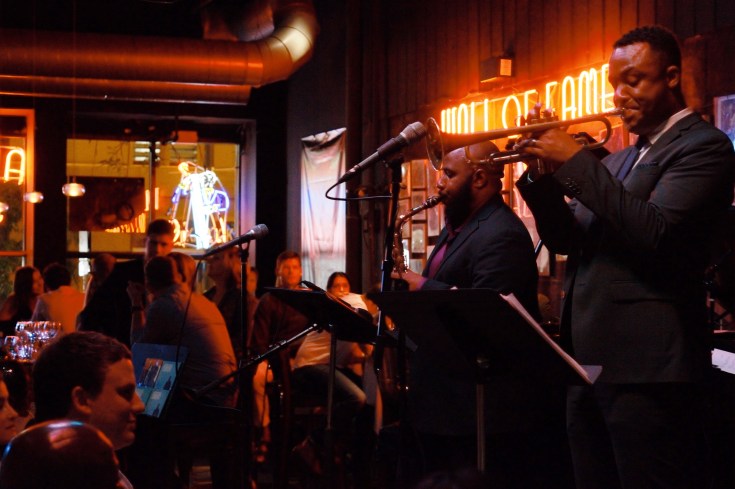
Chicago main-stays Christopher McBride (sax) and Quentin Coaxum (trumpet) on the Andy’s stage.
BCJ: How would you best describe the direction you’re taking the club?
CC: Forward. We move forward with the ever changing scope of our audiences and the times. Forward with the ever changing dynamics we see presented in the new ways in which our musicians are changing and adapting the genre that is the lifeline of the club. Improvising along the way.


 Blue Collar Jazz
Leave a comment