
By Dominic Guanzon
Album art by David J. Woodruff.
Edith Judith is the artistic child of Chicago couple Katie Ernst and Dustin Laurenzi, featuring Ben Lumsdaine on percussion and mixing duty. The name of the duo is much easier to say in your head than it is out loud (try it), but that plays right into the I Spy-esque dreamscape their debut album “Bones & Structure” invokes. That’s not a random name drop too, I actually looked up some old I Spy pages and this album goes great with reading them. It’s also an interesting blend of indie-whimsy with a folk bedding and, somehow, a light coating of a reimagined synthwave that works.
That child-like whimsy is reminiscent of similarly-amorphous artists like The Go! Team, though Edith Judith is more tonally consistent on a song-by-song basis. Perhaps the best example of this is the lead single, “Hot Lava”, which features a music video that gives it a fun twist while driving home the aesthetic. The sound is certainly not veering into Self’s cover of “What a Fool Believes” territory – where the whole album was recorded entirely with children’s toys – but it does introduce new “toys”, textures, and sounds with each new song.
At times the project can sound like the ballads of a more subdued, less country, but equally mystic Neko Case circa 2008-13. Maybe that’s a stretch, and I’m not even going to link it to verify. It’s been a while since my Scott Pilgrim years, but the fact I’m making that comparison at all makes me happy.
“Bones & Structure” may appeal most to the bohemian, the forlorn, the bookstore junkie, the post-grad wanderer, or the messy room chic-ster, (the duo are offering the album on vinyl AND cassette, after all) but really, their music is perfect for any soft, warm night alone, or an evening at home with someone you’re really in tune with. Perhaps, alone together.
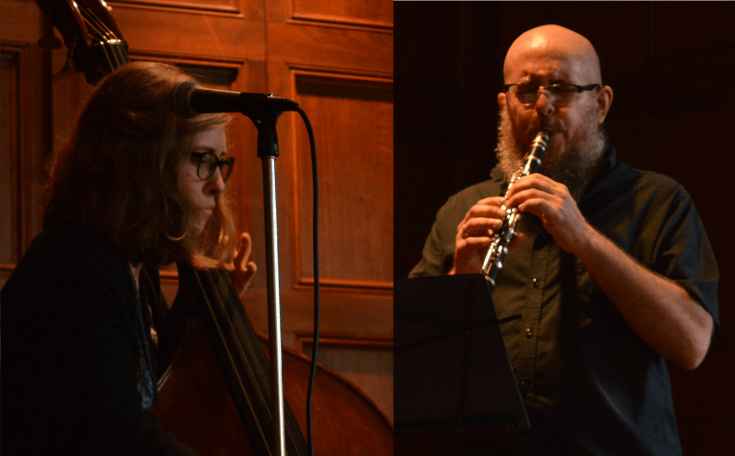
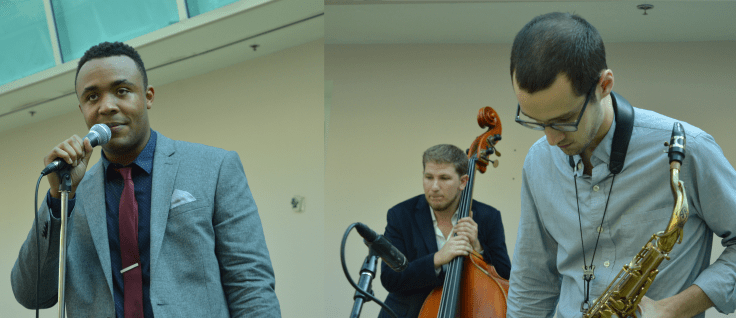
Hyde Park Jazz Festival 2016: Katie Ernst (top left) with Kevin Falzone of “Wayfaring”. Dustin Laurenzi (bottom far right) with Quentin Coaxum and Andrew Vogt. Photos by Dominic Guanzon.
Drones, patterns, and repetitive phrases are brought to the very forefront of many of the songs, leading to a beautiful tension and release that seem so obvious and simple from an audience perspective. Yet for any songwriter, it’s a tough line to tow when you’re trying to compose something that doesn’t become cheesy or gimmicky.
“Sleeping Beast”, with its triplet rhythmic motif and lush flutes. The dark forest intensity of “Luna’s” singular pattern that doesn’t break until 2/3rds of the way in, all layered with a pedal note. We even get microtonal wavering in “Neon Sign”. At no point are we brought close to the avant-garde, it just feels like we’re about to, and it’s that teasing that makes it such low-key fun.
Ernst’s voice is turning out for the occasion, floating between soothing and haunting, as well as making full use of dissonant harmonies, vocal doubling, and her signature empowered tact.
Laurenzi’s instrumental backing (sans bass, Ernst’s instrument of choice) is also impressively multifaceted. That’s not to say there’s any particular sick run of notes that will have you jamming out (you can find that on Twin Talk and other projects he’s done as sideman), but there is a fun pacing with how he busts out the flutes, the reeds, the guitars, and the occasionally aggressive synths. At least, aggressive in the context of this emerging Edith Judith sound.
Combined with Lumsdaine’s percussive support and careful balance of the vocal-instrumental see-saw, this is a complete package, and a marked departure from the duo’s usual jazz outings as Twin Talk, Wayfaring, and more.
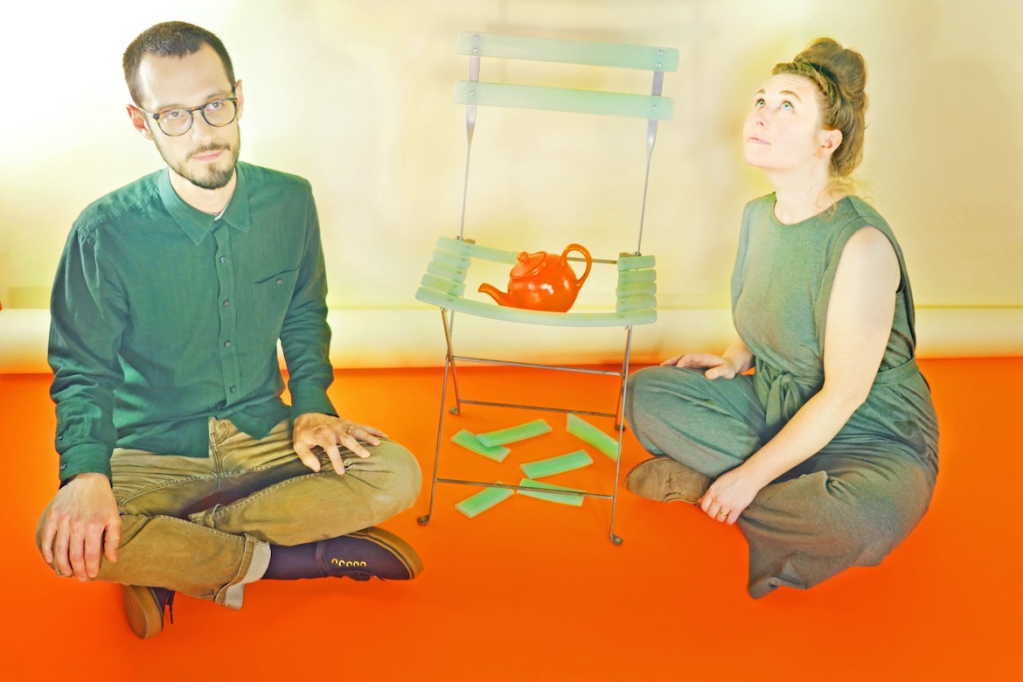
The wife and husband duo of Edith Judith. Photo by Maren Celest.
Their approach is forward and intimate, as if the most interesting person you’ve ever met three weeks ago is confidently showing you something cool in their Oak Park apartment, and you’re not sure if what you’re feeling is love or fascination (to borrow a phrase from “My Foolish Heart”). But it’s not a raw or gruff intimacy. It is squarely, lovingly “artistic”, in the sense that this imaginary person is really proud to live right next to the “Arts District” sign in Oak Park.
Kidding aside, the lyrics of the album are pure poetry. It’s no wonder this is Katie Ernst – the same vocalist that released an album of Dorothy Parker song interpretations on “Little Words“. The alliteration of great lines like “Wondering when we’re done where do we go?” from “Worrisome, Weary”. The comforting structure and patterns of “Heartbreaker”. The use of the cliché “Would you rather see the forest for the trees?” in “Flesh & Bone”, but made beautiful by the subsequent questions that are sung.
The project as a whole is complex and purposeful in presenting a vibe first and foremost, as opposed to any kind of show-off of the artist themselves. “Carry” is an apt opener that previews much of what we’ll hear for the rest of the album: an unsubtle, but still carefully layered approach to the song. Plenty of bones and structure on that one, and all around. You don’t need a jazz background to get this kind of depth with that kind of effect, it just so happens they did so by having one.
If you liked the instrumental adventure of Twin Talk, but need something more in the lane of the singer-songwriter, you’ll enjoy Edith Judith’s “Bones and Structure”. Though I have a suspicion the latter project may eventually find more listeners by way of its accessibility. At least, a widening of their audience. No matter how you enter the world of the Ernst-Laurenzi love story, this is a 10-track project with thought-provoking feels and fun quirks that’s making me excited for what else they have on the messy, scented candle-laden bookshelf they surely have.
Favorite Track: “Sleeping Beast” for its great rhythmic motif and its luscious flute backing.
Favorite Lyric: “Wondering when we’re done where do we go?” from “Worrisome, Weary”. It’s such a stupidly natural alliteration, it’s no wonder it was used repeatedly as a punctuative line. And yet for it to pose such a basic, open-ended question? It made me nostalgic upon hearing it the first time.
Favorite Moment: Hearing the heightened synths on “Bridge” take me by surprise and upend my preconceptions of the album, and then get more and more pronounced with each song.
RATING: Manic pixie dream girl did a lot of self-reflection during 2020, sorted things out, and finally bought her own place in Oak Park/out of 10.
You can find Edith Judith on BandCamp.
A 2016 interview I had with Edith Judith’s Katie Ernst here.
An article I wrote on Ernst and Laurenzi’s separate performances at the 2016 Hyde Park Jazz Festival here.


 Blue Collar Jazz
Leave a comment