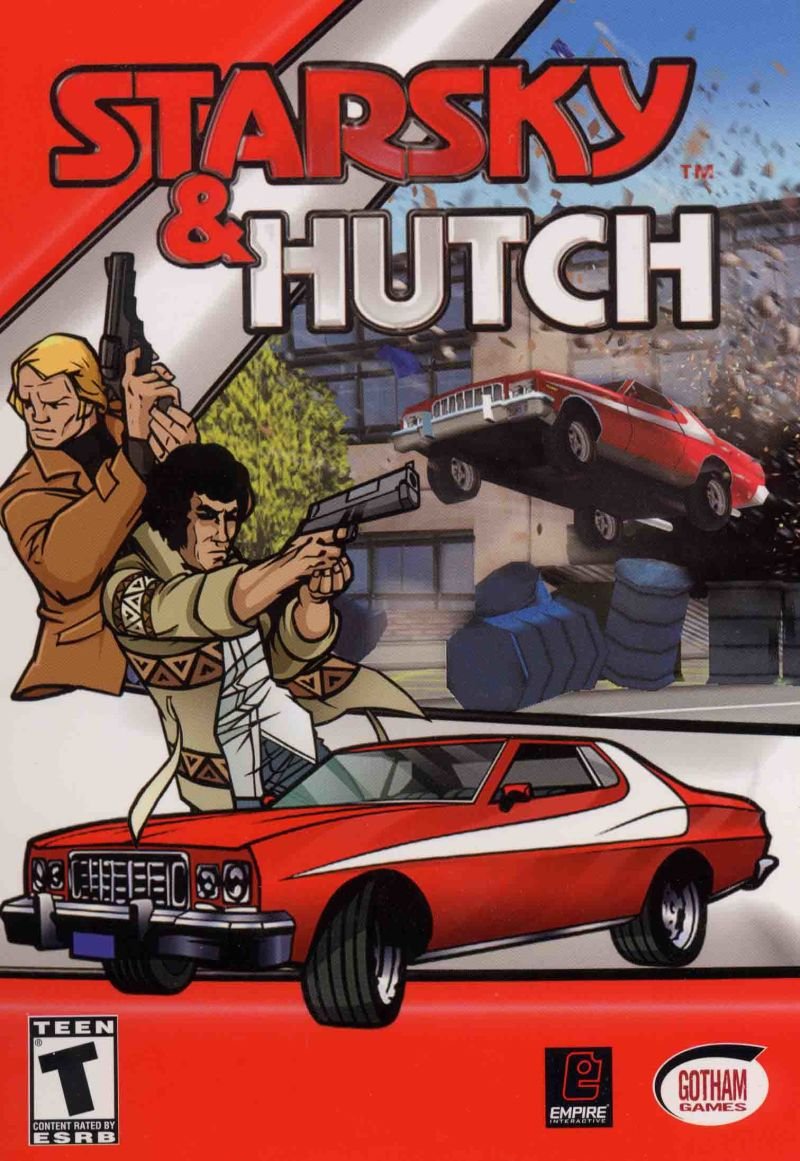
Featured image of the game’s box art courtesy of IMDb.
By Dominic Guanzon
I’ve never been prouder of my infant music media career than joining the ranks of those who deep-dive into obscure media.
The 2003 Starsky & Hutch video game is an arcade-style driving classic I rented a number of times for my original Xbox, and finally bought at Disc Replay as an adult. It was developed by Mind’s Eye Productions in one of their last outings before being acquired in 2005 by Disney. The game has, hands-down-out-the-window, one of the best funk soundtracks in any game I’ve played. Probably helps that it has good source material to bounce off of.
The Starsky & Hutch TV show premiered in 1975, and it became a mainstay of police and crime shows. It’s very much of its time from the pilot I’ve seen, with dangerous car chases, stylish sweaters, and informant roughhousing – all for that sweet, sweet primetime copaganda. Subsequent parody buddy cop shows took clear inspiration from it, especially the car chases.
For the game, British video game composer and arranger Tim Follin appears to have done an almost all-original score from the ground up. Even the one song he didn’t write, the show’s theme, sounds like it was redone by him. Follin is a genuine veteran of the video game industry, composing and arranging music for the one-channel ZX Spectrum as far back as 1985, and as a teenager, no less. He started to peter out around around the 2000s, with “Starsky & Hutch” being one of the last scores he did for other studios. Regardless, his repertoire is impressive and storied, and he even started an indie horror game studio with a release as recent as 2020.
In a 2002 press release from one of the game’s two publishers, the now-defunct Empire Interactive, Follins took on the Starsky & Hutch job as passion project:
“This is the project I had hoped I would get one day. I’ve always loved Starsky & Hutch and its original title music. I’ve tried to make the game music as cool and funky as possible, given the nature of the gameplay and overall franchise. I’ve made a lot of musicians jealous bagging this one!”
The game’s 10-track OST (original soundtrack) is short, which makes sense because the gameplay is effectively an arcade driver with a turret (the eponymous Hutch shooting out the side of the window with what has to be every bullet in southern California stashed in the back seat). You literally do not ever leave the car, and there’s no other gameplay other than driving and shooting from said car.
That probably also explains why the game’s OST is so upbeat, blood-pumping, and funky. In a 2003 interview with Music4Games.net, Follins goes into that choice:
“I didn’t find it daunting initially. I was looking forward to it, but when it came to it I did find myself floundering a bit trying to pin down the right sort of style for it. I kept wanting to do sleazy funk, but it had to be faster – proper funk is too slow for a driving game, which is why I ended up with the sort of ‘techno/funk’ style (so I read in a review recently!). Something eventually clicked into place though.”
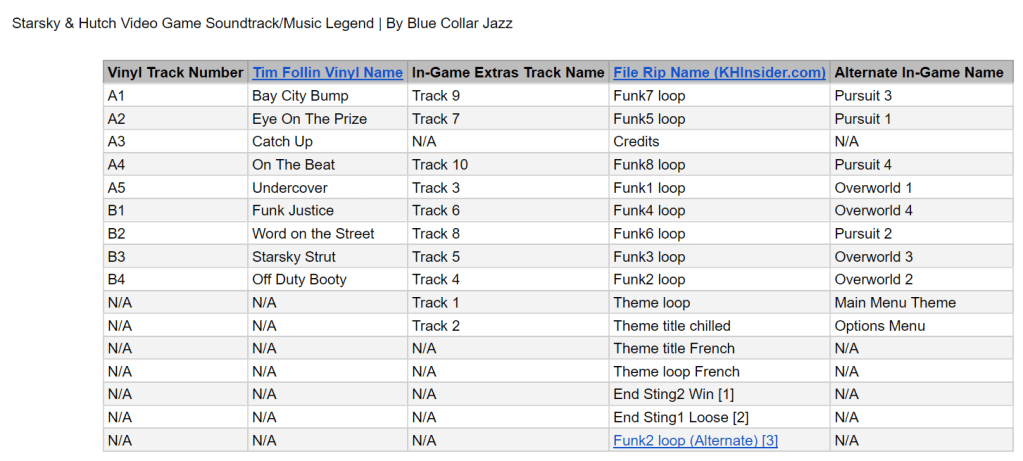
The OST is also a little one-note. So much so, it’s easy to get these tracks mixed up. KHInsider.com hosts many game OSTs ripped directly from the source media, and the music files from the Starsky & Hutch game are mostly titled “Funk[number] loop.” They were also able to rip the unused win/lose tracks, an alternate version of a track, and even the French version of the theme (sadly also unused, even in European versions of the game). They’re also a little degraded on that site, but a number of users have uploaded them to YouTube in much better quality, which is where I suggest listening to them.
Despite hanging out in one part of the emotional spectrum for the entire game, it gets the job done very, very well. That’s because Follin appeared to be concerned with one thing only: Be badass, cool, and funky – from the moment you burn out at the start of a level to the moment the criminal car blows up in over-the-top, copaganda fashion. The soundtrack was apparently so good, the developers put a music-listening section in the Extras menu, where the tracks are instead listed as “Tracks 1-10”
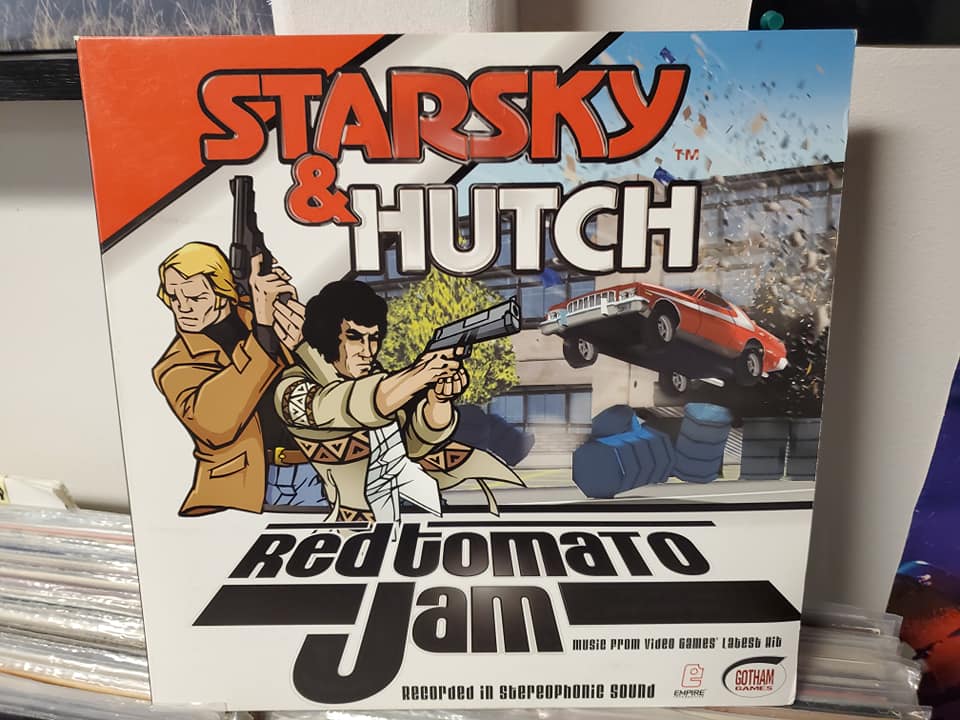
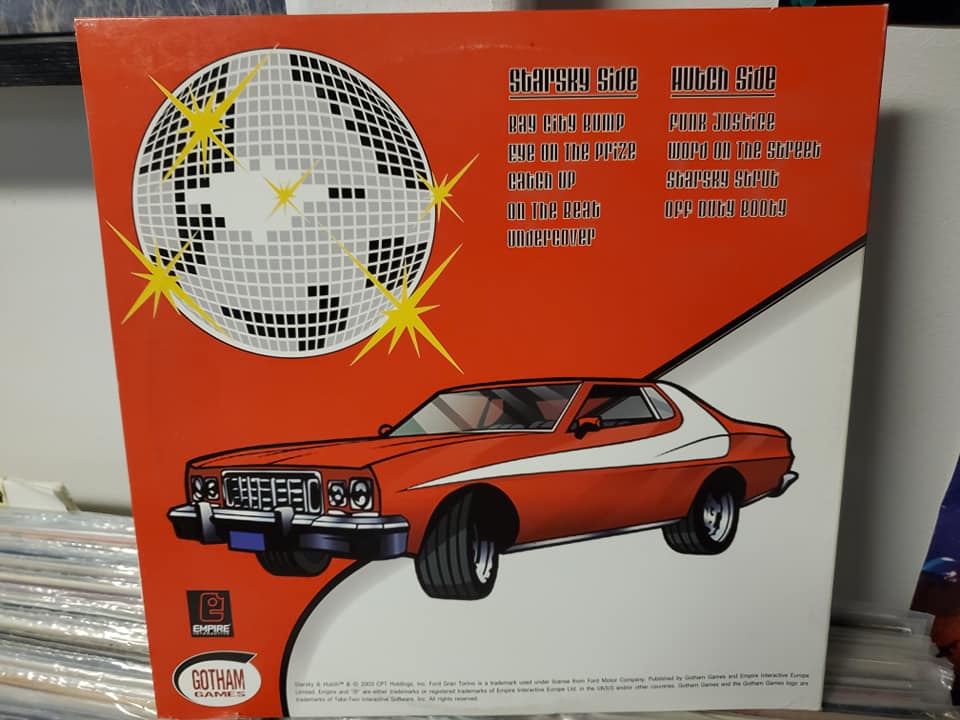
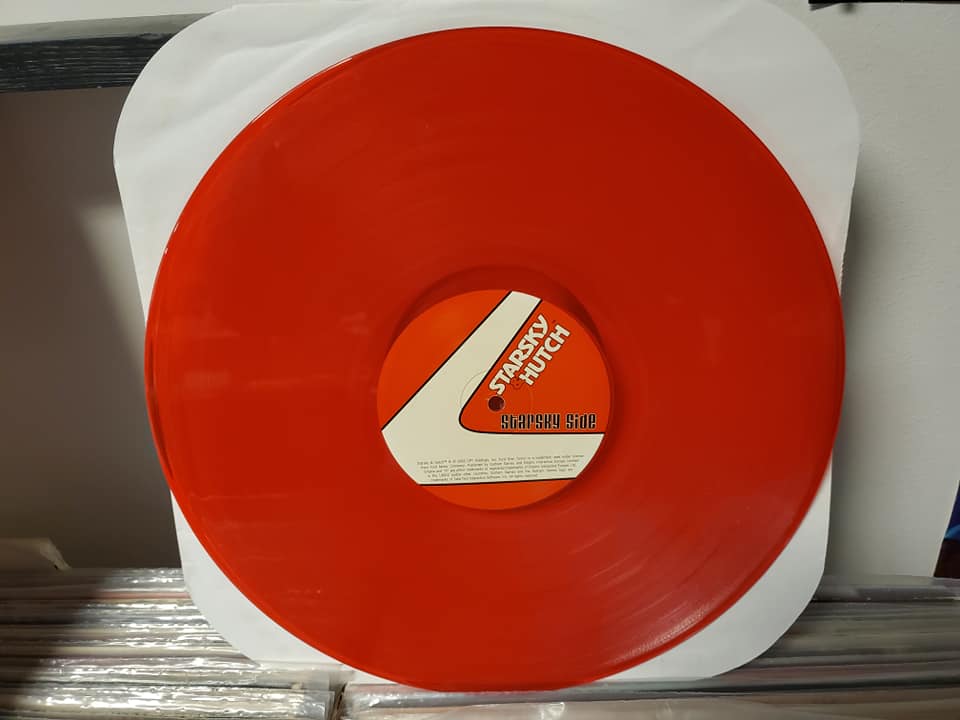
There was also a Europe-only vinyl release as well, called “Starsky & Hutch: Red Tomato Jam” under the Tim Follin name. This is where we finally get real song names for all these disparate titles and files. This intense, investigative journalism led me to the discovery that “Track 4/Funk2 loop,” my favorite song in the entire game I’ve listened to for years, is officially called “Off Duty Booty,” and I think I’m still processing that.
Anyway, here’s a spreadsheet I made organizing all the music, and no, none of this is on streaming services:
The actual TV show had a much broader range of emotions (with season one apparently being composed by bebop legend J. J. Johnson!). It bounces from dark and brooding, to silly and jovial. From the pilot episode I’ve seen, the car chases were more of a highlight, and the majority of the show was your typical TV detective work. If anything, the game has more in common with the Ben Stiller and Owen Wilson movie that came out two years later. They’re both over-the-top highlights of the much more serious, fleshed-out source material. Still, the 2003 Xbox/PS2/GameCube release had a very solid gameplay loop, and it’s impressive how much of it the developers were able to milk out of 18 levels plus special missions.
Above: Vinyl showcases on YouTube tend to have less-than-stellar audio, ironically, since many uploaders record the audio off the camera. Thankfully, user illegalalien2 does the record due diligence.
Below: Starsky & Hutch: Red Tomato Jams. Photos courtesy of VINYL Experience based in Manitoba, Canada.



Every one of the four seasons of the TV show had a different theme song, with the season one theme being composed by the legendary Lalo Schifrin. You’d think he’d have the best one of the lot considering he did the Dirty Harry score that’s right in line with this genre, but my personal favorite has to go to Tom Scott’s season two theme, entitled “Gotcha.” It has a sexy, brash descending line that’s instantly recognizable, and it’s the go-to theme that comes up when you search it on Spotify. Unsurprisingly, it’s also been covered by jazz groups, including Tom Scott and the James Taylor Quartet. In that Empire Interactive press release, Follin said he loved the “original title music,” so there’s also a good chance the “Gotcha” theme is just the default theme in popular culture.
The game may not the most accurate representation of the show (the barely-moving stills and parody-level voice acting of the cutscenes make it seem more like a comic book), but it is a loving one. This is easily shown with the inclusion of Antonio Fargas as the game’s narrator and interview subject in the extras. Fargas played the streetwise informant of “Huggy Bear” on the show, and players could unlock 13 minutes of direct interview with the actor reflecting on the show. The fact the developers took advantage of the voice acting opportunity to set him up in a studio with a chaise lounge sofa and ask questions is the kind of curiosity I strive for.
I’ve been listening to this soundtrack for years, and started writing this article in December of 2023. As of this writing however, Hutch’s actor David Soul passed away on January 4th at the age of 80. A child of Chicago, he was also a balladeer with a surprising tenor voice. I wonder if the show ever had him sing.
Tracks of Note
One of Follin’s three variations on Tom Scott’s “Gotcha” season two TV theme, but it’s the one that goes the hardest simply because it has that crucial mid-tempo funk. It’s what Follin referred to as “sleazy funk,” and it’s the slowest song in the game. I don’t recall it being used in actual gameplay, but rather the Options menu, which makes sense since according to him, “proper funk is too slow for a driving game.” Regardless, it goes hard and deep like any funk should.
The absolute best song in the game. Its ethereal opening is performed by a beautifully reverb-ed saxophone line that’s too good to not be quoted in regular jazz lexicon. I implore any jazz musician reading this to take heed of it.
What puts this opening over the edge to legendary status is the bed of synth strings that’s simultaneously warm and bright and nostalgic. It washes over you so gorgeously as if the wind is flowing through your hair is slow motion. It’s a hype dreamer’s song in a Zedd kind of way.
If you listen to the alternate version of this track without that opening, you can hear right away it’s missing something.
Really fun riffing on the synthesizer in the B section, again buoyed by those string beds. The run of notes at the end of the track are hypnotic. You actually don’t hear any keys in the A section, so you’re hearing something more rock-oriented before BAM: you’re flying into a warm gel of synth.
I’m just really impressed by that warm/bright combination in electronically synthesized music, and
Not in the in-game Extras menu track selector, but is used in the easily-accessible Credits. Just a really bouncy bass line that’s springboarded with the drum hits. Easily the song that hits the “one” beat the hardest.
A great intro that injects a ton of urgency. Probably the most “cop show” track of them all, and it pairs wonderfully with an opening shot of the streets of Bay City before panning over to Starsky & Hutch in their iconic red Gran Torino. The guitar has been doing a lot of work in various solos, especially “Off Duty Booty”, but it gets its licks in here too.
A clear homage to Kool & The Gang’s “Jungle Boogie” with great riffing by the guitar. It’s used so prominently, it might as well be a rip-off. And yet, it’s so blatant and works so well, I can easily forgive it. Not hearing the words “jungle boogie” is actually refreshing in a way, not to diss the original. If you treat this as a jazz cover of Kool & The Gang (there has to be an album of that somewhere), it’s actually really awesome.
![2025: “The State of Police [3/3]”](https://scontent-dfw5-1.cdninstagram.com/v/t51.82787-15/627640066_17978556137968438_2806764077457133725_n.jpg?stp=dst-jpg_e35_tt6&_nc_cat=111&ccb=7-5&_nc_sid=18de74&efg=eyJlZmdfdGFnIjoiQ0FST1VTRUxfSVRFTS5iZXN0X2ltYWdlX3VybGdlbi5DMyJ9&_nc_ohc=TSA6md2PzgMQ7kNvwG1z3Nh&_nc_oc=AdmVomICctu4Hhi6-qsd0UNJnA0lhz2mIjQgxbui3t9_EK07Jfc0bdhst67Y8lkHMdI&_nc_zt=23&_nc_ht=scontent-dfw5-1.cdninstagram.com&edm=ANo9K5cEAAAA&_nc_gid=AATeHK_SixgBM2fyQT4YuA&oh=00_Afvzfqsqjbn2EH0Eefklberi3mGN0azsH3aY5_kiE_UboQ&oe=698D1D4E)

![2025: “The State of Police [2/3]”](https://scontent-dfw5-3.cdninstagram.com/v/t51.82787-15/625263264_17978345426968438_6650543167155262326_n.jpg?stp=dst-jpg_e35_tt6&_nc_cat=108&ccb=7-5&_nc_sid=18de74&efg=eyJlZmdfdGFnIjoiQ0FST1VTRUxfSVRFTS5iZXN0X2ltYWdlX3VybGdlbi5DMyJ9&_nc_ohc=pLHnX7edhy0Q7kNvwHBFBDk&_nc_oc=AdnJIlMZfSI3Q0ofYVF4eIGhH-_H0g0PZZeL_PGHqjAoOKum-y5Em7qx1dvtKgsMmOA&_nc_zt=23&_nc_ht=scontent-dfw5-3.cdninstagram.com&edm=ANo9K5cEAAAA&_nc_gid=AATeHK_SixgBM2fyQT4YuA&oh=00_AfuHhklC7pk6PnfwaLCYzlwQMV5VS3-9G0rqKhUbL2kmOQ&oe=698CF72B)

![2025: “The State of Police” [1/3]](https://scontent-dfw5-3.cdninstagram.com/v/t51.82787-15/625736470_17978294381968438_1658866238848817013_n.jpg?stp=dst-jpg_e35_tt6&_nc_cat=109&ccb=7-5&_nc_sid=18de74&efg=eyJlZmdfdGFnIjoiQ0FST1VTRUxfSVRFTS5iZXN0X2ltYWdlX3VybGdlbi5DMyJ9&_nc_ohc=WwwH2UcXi8AQ7kNvwESN5qJ&_nc_oc=AdnnY4gdm9lCAd4gB6heMQSrtuD_wmcCjcDg5KNB-mBE4SnTrA3G4uo-nBB4gu3sq9w&_nc_zt=23&_nc_ht=scontent-dfw5-3.cdninstagram.com&edm=ANo9K5cEAAAA&_nc_gid=AATeHK_SixgBM2fyQT4YuA&oh=00_Afvka9yckvQza1cO3-zn2QE2U5sIbRQQZyLzSQ5BMsVaNQ&oe=698D1ADD)

![2025: “The Art of the Protest” [4/4]](https://scontent-dfw5-1.cdninstagram.com/v/t51.82787-15/624720468_17978019269968438_3559672502445276893_n.jpg?stp=dst-jpg_e35_tt6&_nc_cat=107&ccb=7-5&_nc_sid=18de74&efg=eyJlZmdfdGFnIjoiQ0FST1VTRUxfSVRFTS5iZXN0X2ltYWdlX3VybGdlbi5DMyJ9&_nc_ohc=ERhoST8NZ5EQ7kNvwGY4cog&_nc_oc=AdnScgb7SUcx0cE5wN6C3KrnN5itIoPLiJjBsDA_XrVrW9aha4tI6BQ5N1eiRr4a4zc&_nc_zt=23&_nc_ht=scontent-dfw5-1.cdninstagram.com&edm=ANo9K5cEAAAA&_nc_gid=AATeHK_SixgBM2fyQT4YuA&oh=00_Aft8qPTPIf66IA04D9u3HlQiNpHx5A_XkzNiQTdKZs12iA&oe=698D0AA6)
![2025: “The Art of the Protest” [3/4]](https://scontent-dfw5-2.cdninstagram.com/v/t51.82787-15/624260646_17977924625968438_1289302925798587658_n.jpg?stp=dst-jpg_e35_tt6&_nc_cat=106&ccb=7-5&_nc_sid=18de74&efg=eyJlZmdfdGFnIjoiQ0FST1VTRUxfSVRFTS5iZXN0X2ltYWdlX3VybGdlbi5DMyJ9&_nc_ohc=xZbR-S6dLMQQ7kNvwGs-hxB&_nc_oc=AdkzPGhcg1j-QY--If1_fpGvUh5aPzrMluQktS2S7FQ9XzFWEBA-A8KDHLh7NZryjso&_nc_zt=23&_nc_ht=scontent-dfw5-2.cdninstagram.com&edm=ANo9K5cEAAAA&_nc_gid=AATeHK_SixgBM2fyQT4YuA&oh=00_AfvgVrbbk96qKsJ4zceBVHcOeNDQLqrwmThnyw7Xca6PeQ&oe=698D0E77)
![2025: “The Art of the Protest” [2/4]](https://scontent-dfw5-2.cdninstagram.com/v/t51.82787-15/622382761_17977712390968438_6643898277803608658_n.jpg?stp=dst-jpg_e35_tt6&_nc_cat=104&ccb=7-5&_nc_sid=18de74&efg=eyJlZmdfdGFnIjoiQ0FST1VTRUxfSVRFTS5iZXN0X2ltYWdlX3VybGdlbi5DMyJ9&_nc_ohc=0wJdMYngAIIQ7kNvwHY9wKT&_nc_oc=AdlaSTDxNm5bmLFptNPgS-webp7I7qgD0LbbqpK9u5w4Ju997i0Cekh7fwYXwNMSCB4&_nc_zt=23&_nc_ht=scontent-dfw5-2.cdninstagram.com&edm=ANo9K5cEAAAA&_nc_gid=AATeHK_SixgBM2fyQT4YuA&oh=00_AfsjJO3Y7LHdG7VsF6xxvRXt6YHZr6zWbgNMCcD8UE6CXA&oe=698D0070)
 Blue Collar Jazz
Leave a comment