
Cover Photo: Reynaldo Certain (left, g) and Livia Gazzolo (right, voc). The Red Room, 8/17/23. Photo by Dominic Guanzon.
Dominic Guanzon
Thursday, 8/17/2023
Just around the alley corner of the Club Lucky Italian restaurant, on the corner of Honore Street and Wabansia Avenue, is The Red Room. It’s a cool little co-op no larger than a modest Wicker Park living room. I’m tempted, immensely, to order the fried calamari from the neighboring restaurant, but I decide to do the responsible content creator thing and talk to tonight’s band sitting in the alleyway.
They’re crowded around the stoop of a stark blue alley door with vocalist Livia Gazzolo among them. She and I catch up a little. Livia has been busy jumping between here and southwest Michigan, and she’s excited to perform her first Chicago show of the year. I’m introduced to the rest of the musicians before she’s quickly called inside. Pianist Pat Leary and I quickly get talking about what it’s like accompanying a vocalist.
“The Tony Bennett and Bill Evans album, just wow. I was actually listening to it in preparation for tonight.”
“When did that come out?” I ask.
“Mid to late 70s1 I think.”
“So by then he kicked the heroin habit, right?
“Yeah, only to be on cocaine,” he answers.
“I’m guessing you didn’t prepare like that.”
“Nah, I don’t think so,” he laughs.
Eventually, he asks how I know Livia, and I share how we used to be in the jazz department together at North Central College, or my preferred name for it: “Naperville University.”
“Do you play? Guitar?” Pat asks.
“Not really, just basic chords,” I answer, “and I can only play nylon strings because they’re easier on my fingers.”
“I like nylon too!” Interjects classical guitarist Renaldo Certain, Livia’s mentor and guitarist of several years.
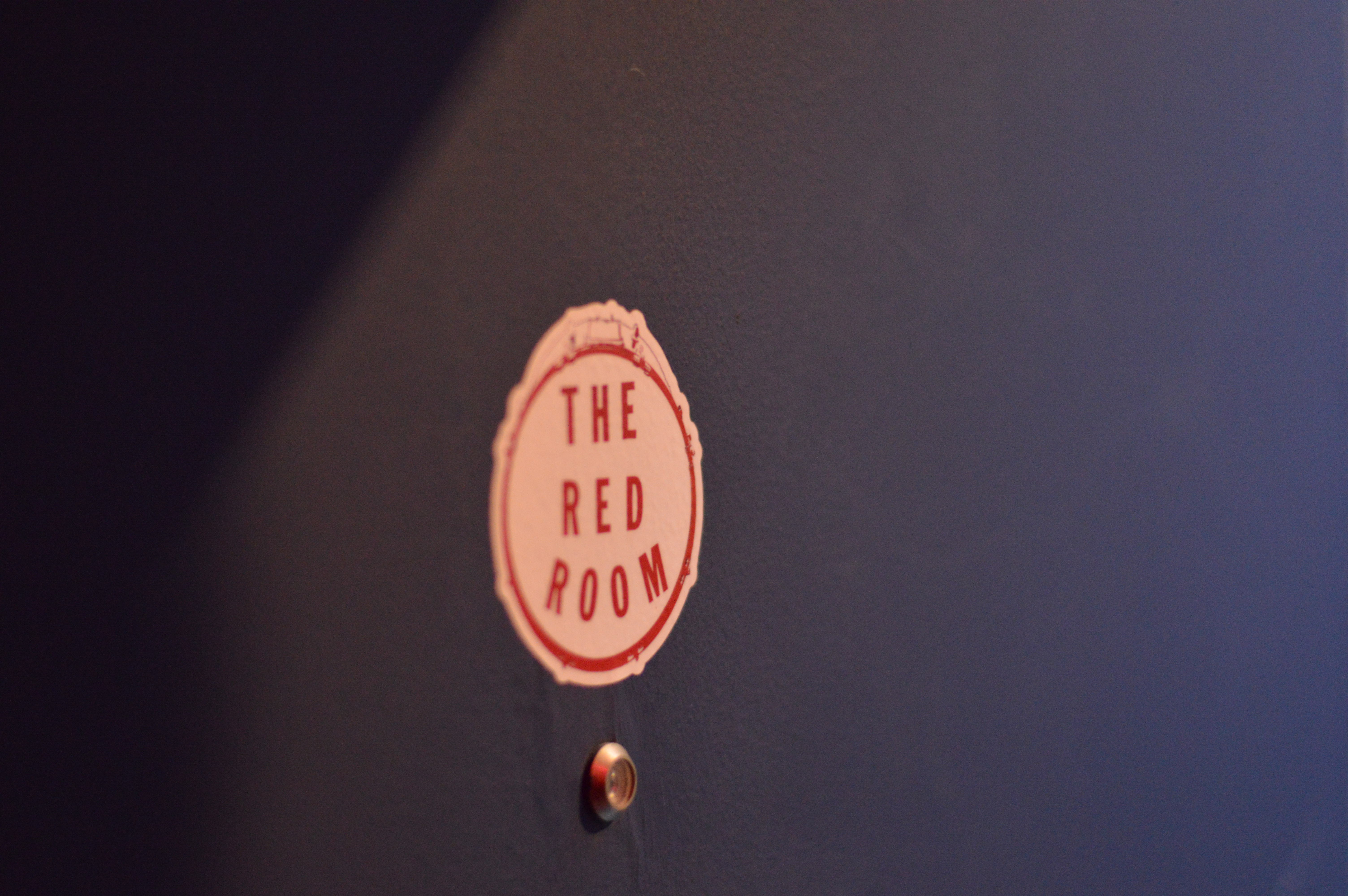
Walking into The Red Room, after acknowledging their joke that the main entrance is a solid blue door, I’m struck by how small it is. Eight chairs arranged in two rows, a pair of benches, and a 10x10ft standing area are all there is for the audience. It’s, at most, half the size of The Green Mill, which is saying something, with a bar about a quarter of the size of Dorian’s just a few blocks away.
I can’t even get half the room with my usual camera lens. I did have another I could switch to, but that one wouldn’t work in the incredibly low mood lighting that’s drenching the venue in a deep red. Redder than The Whistler. So much so, I color corrected the red out of the photos in this article, just for a little more clarity.
Paul at the door. Corey at the “bar.” And Joe as master of ceremonies. The joint is run pretty much like a cooperative, though I should note co-op is a legal term, so emphasis on “like.” It’s also technically not a bar, but there are drinks, and that’s where I’ll stop potentially spilling secrets. It’s an intensely intimate venue with extremely friendly staff and great taste in music.
As Joe took to the mic to open the night, he described the upcoming music as a “hellfire of sexy jazz,” which got a laugh out of the crowd, but would wind up being dead-on in the way a fire burns bright before simmering.
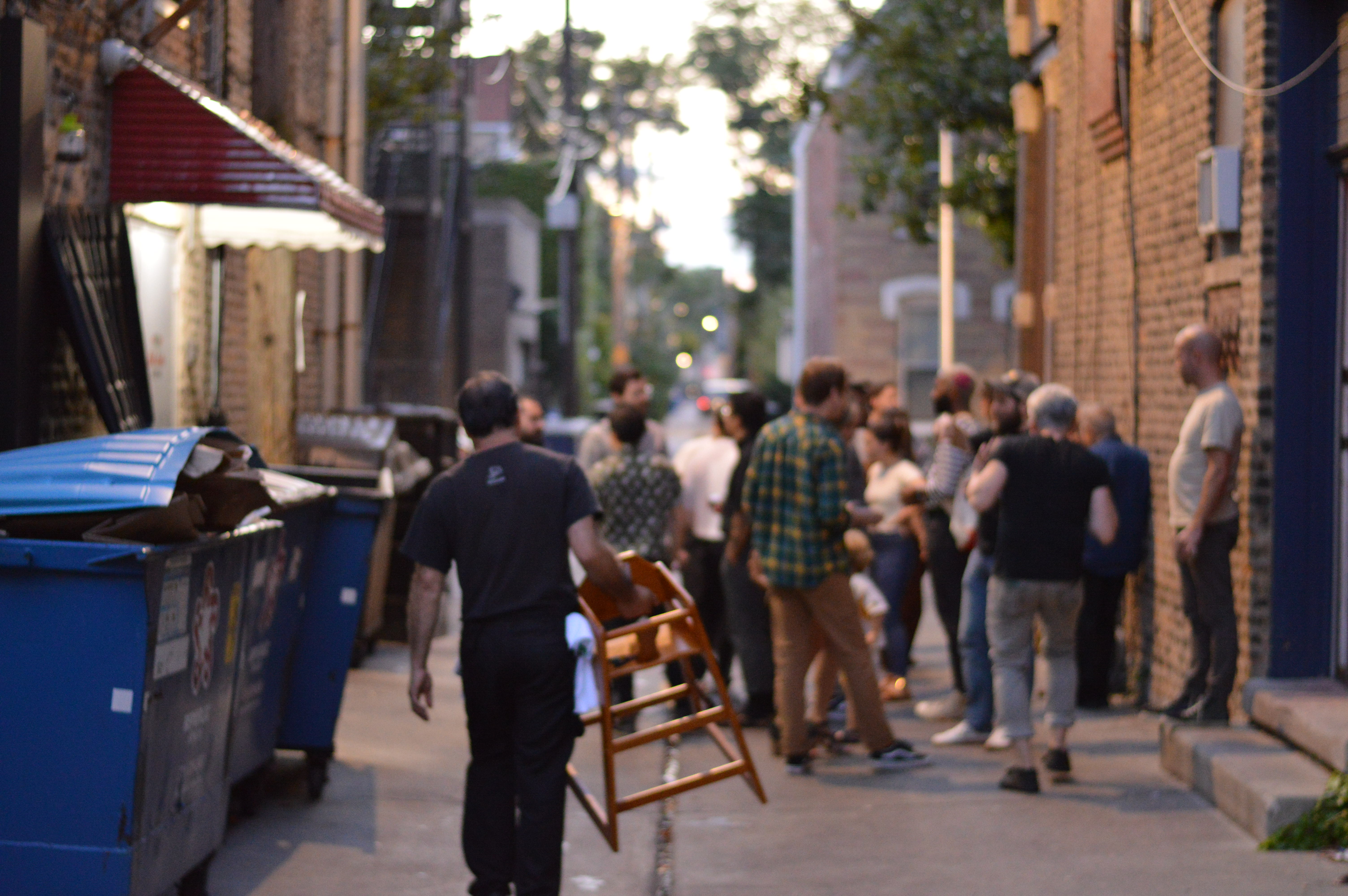
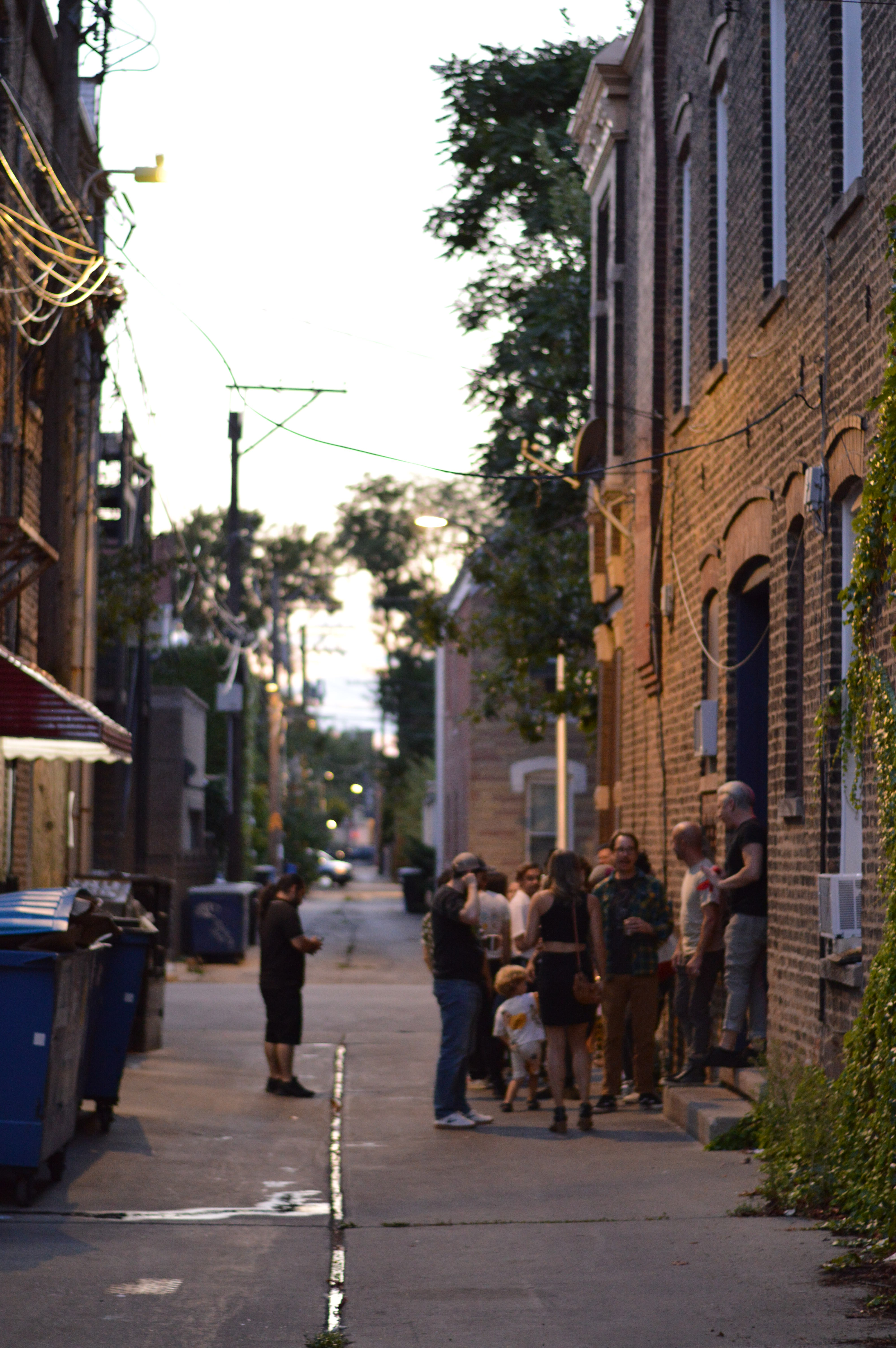
Alleyway behind Club Lucky (left side of the alley) and entryway to The Red Room (right side of the alley), 8/17/23. Photos by Dominic Guanzon.
The trio opened with an improvised song, with bassist Jeff Wheaton using his intro as an in-head. Time and rhythm held looser, with the occasional two-second burst of acceleration, though not enough to call it avant-garde. Still, Wheaton anchored the tune hard, as drummer Alex Santilli took free reign to play up and down his kit and around Leary’s keyboard solos. It’s a style of drumming that’s unafraid to be inconsistent and hide the downbeat. I adore that level of playing when at least one other player can plant themselves as a port in the storm for the listener. Wheaton did just that, and recognizing it, the trio had me.
Flying Lotus’ “MmmHmm,” originally featuring Thundercat on bass, is a dreamy piece from 2010 that sits on the cosmic side of things. Fitting, since Lotus’ great-aunt is Alice Coltrane. Even more fitting, the trio before me took the song head-on. Leary’s solos come straight out of the bop tradition, and have that kind of clarity of melody in the undertow; the cyclic tension-release of bop to blues to simple that I crave.
“Need a breather after that,” Leary sighed. The room chuckled as if to let out a sigh as well.
An original song closed this opening trio set. What began as a slow build up exploded into a swing solo section, and finally back to a hopping funk shuffle that again accelerated onward. I took a moment while taking photos to sit on one of the two benches directly facing the band, and I hadn’t realized how such intense communal sitting would inject the pocket into my bottom half. I hadn’t felt a crowd feel the beat that effectively since Snarky Puppy played Millennium Park in 2015, two days after playing City Winery, when the entire front half of the packed audience was headbanging in near-unison. It’s the closest one can ever get to a mosh pit at a jazz show (though maybe I’m not going to the right jazz shows).
The Pat Leary Trio has got a lot of energy ready to pounce, and you can find their debut EP “TRIO.” Conversely, you can find the keyboardist’s debut album of solo improvised piano music in “VOL. 1” It’s a complete tonal shift from the trio work, but a welcome one. I know I’m not writing an album exploration, but “Billows” instantly reminded me of Jerry Martin’s “Buying Lumber” from The Sims 1 soundtrack, and I can’t help myself when something brings me back to it.


Alex Santilli (d), Jeff Wheaton (eb), Pat Leary (key). The Red Room, 8/17/23. Photos by Dominic Guanzon.
There could not have been a greater contrast in sound to the trio than Livia Gazzolo and Reynaldo Certain, but if there’s going to be one, I’m glad it’s something distinct. Bossa nova, like the jazz music it married, is an art that has seen its last days of American mainstream superstardom. The last time it even approached the outskirts of that spotlight was the Antonio Carlos Jobim tribute at the 2016 Rio Olympics. It was a beautiful 90 seconds, and we were lucky to have it. Maybe I’m missing some other moment, but it doesn’t really matter. Bossa has also proven itself to be so pivotal to human expression, it cannot fade away.
So the question becomes: How close do you want to get to the source material? It’s easy enough to find a bossa beat or a João Gilberto composition being played somewhere in the city, but if you’re looking for something closer to the Brazilian spirit, and into the depths of true tropicália music, you can find it with Gazzolo and Certain.

Reynaldo Certain (left) and Livia Gazzolo (right). The Red Room, 8/17/23. Photo by Dominic Guanzon.
A Portuguese interpretation of The Beatles’ “Eleanor Rigby” works remarkably well, tapping into the “saudade2” that’s present in so much Brazilian music. As an opener, it’s even better, setting the stage for practically anything. The twist here isn’t just in the language, but in the lyrics themselves. Other than the name “Eleanor Rigby,” the pair replaced the lyrics with some stanzas from the Noel Rosa samba “Fita Amarela.” It’s an intentional and international synergy both Lennon and McCartney likely would have cheered, depending on the year.
Gazzolo’s voice is delicacy made manifest, her legato working astoundingly well with Certain’s comping on the classical guitar. The latter cradling the guitar between his legs like the style demands, as opposed to resting it over his thigh.
Several songs later, they’re covering Jobim’s “Insensatez (How Insensitive).” Despite singing in Portugese for most of the night, Gazzolo did sing this bossa standard in Norman Gimbel’s English lyrics after Vinícius de Moraes’ original set of words. In nearly every song, her right hand held the mic, as the left weaved alongside her notes with the same conviction as a puppeteer. Her voice behaves almost as if it pierces through the air to a specific point in space first, before expanding to fill the room, utilizing a warble at the end of certain phrases.
“We perform in loud restaurants,” she tells the audience between songs, alluding to her parents’ restaurant in the southwestern-most corner of Michigan, “this is the first time we’ve heard ourselves. Not many people clap unless it’s my mom!”
In another tribute to the Brazilian tradition, the duo performed João Bosco’s “Coisa Feita.” The samba showed Gazzolo’s presence has a hidden slyness to it that heals as much as it haunts Here, she’s attacking the notes just a little more with an alto approach, which is an all-out assault compared to the overt lushness of the earlier songs, but entertaining nonetheless.
She also mentioned filming a music video with the tune that she’s since teased on social media.
“Mambembe” is a composition by Chico Buarque originally released in 1972, and has been covered a number of times over the decades, including by the composer himself. That’s hardly any surprise. It’s fun and playful, featuring a distinct clarinet slide and musical figure that’s so damn catchy. Gazzolo and Certain’s take on the tune does it supreme justice, with Livia’s pin-point glissando such a mind-bogglingly obvious choice, you’ll find it missing in other vocal versions. Their version is fun, playful, catchy, and if I may be so bold, lead single material.
It’s at this point I’m reminded of why the music of Brazil, in particular bossa nova, made such an imprint on me in college. It’s the auditory snapshot of a life overlooking a warm beach, with all of its fruit and fiesta, draped in the raw beauty of a people that have been seasoned with their own brand of suffering, from slavery to the saudade. In a way, it was always jazz, but more importantly, jazz was the lucky one to have bossa. Knowing Livia in what small ways I do, it’s still no wonder the music made an imprint on her too.

Reynaldo Certain. The Red Room, 8/17/23. Photo by Dominic Guanzon.
Reynaldo began to talk more as the duo continued. Before going into a waltz, he explains the song’s story of three men in the life of a woman.
“The first one simply gives her everything. The second is a slob that treats her poorly. Finally, the last man comes from nothing, with nothing to his name, but he knows her name, and little by little she finds him occupying her heart.”
It’s an enchanting folk tale told by an older artist that appears to live simply, and it’s an introduction that is as critical as the song itself.
The second story he used as a song introduction went much quicker.
“In Venezuela, they sing this song to the cows to calm them down,” explained Reynaldo.
“We’re the cows,” Joe said from the crowd, to everyone’s amusement.
Livia may be the headliner, but Reynaldo’s presence grounds her performance in the spirit of Brazilian music naturally, making him the perfect mentor. It’s to the point that you may be fooled into thinking she was brought up in that culture. The next set would reveal otherwise.

Ari Lindo (left) and Livia Gazzolo (right). The Red Room, 8/17/23. Photo by Dominic Guanzon.
After a brief intermission, Livia returned to the small stage with a different guitarist. Ari Lindo is a younger artist whose modern troubadour sound blends just as well with Gazzolo’s artiste aesthetics. Playing more kinetically on a guitar laid across his lap versus Certain’s more classical style, the duo began a series of originals.
I’ve always known Livia in the jazz context both in and out of college, often seeped in the bossa sensibilities. In this particular set, she laid into a more traditional folk feel while keeping that same aura of grace. Two of those songs would come from a deep, cultural heritage.
“Gül,” or “Rose” when translated from Krudish, is a ballad she wrote lyrics for over the melody of Nelson Cavaquinho’s “Flor E O Espinho.” Her lyrics were inspired by Chapter 21 of “The Little Prince,” when the Fox tells the Prince (with Lindo playing over Livia’s recitation):
“To me, you are still nothing more than a little boy who is just like a hundred thousand other little boys. And I have no need of you. And you, on your part, have no need of me. To you, I am nothing more than a fox like a hundred thousand other foxes. But if you tame me, then we shall need each other. To me, you will be unique in all the world. To you, I shall be unique in all the world . . .”
And like the novella it was inspired from, it came and went with the magic of matter-of-factness that makes the crossroads of Livia’s music familiar, but fresh.
Digging further into her own heritage, Livia also sang “When I Close My Eyes,” which she again put original lyrics over the Kurdish song “Narin” The blue notes come out in full force in the intro and eventually the A section, as the words “no one understands what I have been through,” seep out of Gazolo’s microphone and into the room. It’s a song styling straight out of the João Gilberto School of Hauntingly Awesome Compositions.
As that first A section comes to pass however, Lindo’s guitar drops out with the ring of a few remaining notes, and Gazolo surrenders acapella to the melodic minor melisma of the Kurdish song she had mentioned earlier. This goes on for about a minute, as captivating as she has been the whole night, before the guitar comes back to finish the song.
Livia’s Kurdish heritage is a critical part of what fuels the saudade in her work. I don’t have the expertise to even begin to parse that kind of pain, but its history does involve repression, displacement, conflict, and genocide. Still, art allows us to feel in a few minutes what you’d need to read in many a volume, and the pain of a people can be seen wrapped in the reverb of Livia Gazzolo.
On a more personal note, but still very much tied to the culture, her entire life has had a looming dread hanging over it. Her father, Ibrahim Parlak, is a Kurdish rights advocate who fled Turkey in 1991 after being “arrested, tortured, charted with the crime of separatism, and sentenced to death.” He has been living in the US since 1992, but also under the threat of deportation back to Turkey since at least 2004, where Parlak will likely face unjust retribution by its government. That threat has crescendoed again, and again, and again, and again, and again since the 90s, and his daughter has not known a life without this threat. It’s to the point where a search on Michigan’s WWMT results in at least 15 stories on the man over 8 years.
Livia and her father are victims of the post-9/11 state terror most have moved on from, with the added influence of Turkish authoritarianism constantly lurking in the corner. And still, Brazil provides a template for thriving amidst suffering. Much like how Brazil’s 1964 military dictatorship greatly influenced its music, Livia’s original compositions performed at The Red Room incorporate Kurdish melodies and ideas. Those songs may not be overt calls to resist, but mere existence is defiance with a history like hers, and it has been the fight of her life.
For now, Parlak runs Cafe Gulistan in Harbert, Michigan, just as he has since 1994, and where Livia makes regular appearances. For more information on Ibrahim Parlak’s constantly evolving story, visit https://www.friends4ibrahim.us/.

Livia Gazzolo. The Red Room, 8/17/23. Photos by Dominic Guanzon.
In a fourth set that can be better described as an epilogue, the trio returned to the stage to join Gazzolo in a rendition of “Can’t Take My Eyes Off Of You,” originally performed by Frankie Valli. She opened the song right on the first verse with just Santili’s funk groove on drums, before Leary and Wheaton joined on the second. The cover isn’t quite the Lauryn Hill version, which wouldn’t have been Gazzolo’s vibe anyway, but it does take its funkiness. It also sprinkles in a switch to swing in the last 8 bars of the refrain to make all the difference. For her part, Gazzolo was still meek on the mic, but beaming, joyous, and defiant, even taking a rare section of solo for herself.
Wicker Park “these days” can be a little too clean according to some of the commentary I’ve heard and read. I wouldn’t know, I’m from the suburbs, but there is something about The Red Room that’s very much DIY. There’s also something essential about Livia, her guitar guests, and the Pat Leary Trio that also make the room complete. Something Antoine de Saint-Exupéry might call invisible to the eye.
It’s music, obviously, but there’s a specific strain of vitality that comes with a shot of the trio’s fusion fun, chased by the bohemian aesthetics of Livia. For now, I think I can conclude it’s Chicago’s arts scene at its most exciting: intimate, humanist, and just enough funk to bring all your friends.
The group is:
Livia Gazzolo (voc)
Reynaldo Certain (g)
Ari Lindo (g)
Pat Leary (key)
Jeff Wheaton (eb)
Alex Santilli (d)
1. “The Tony Bennett/Bill Evans Album” was released in 1975.
2. “Saudade” is a unique word in the Portuguese-speaking world that goes by several definitions, including “a melancholy nostalgia for something that perhaps has not even happened.”
![2025: “The State of Police [3/3]”](https://scontent-iad3-2.cdninstagram.com/v/t51.82787-15/627640066_17978556137968438_2806764077457133725_n.jpg?stp=dst-jpg_e35_tt6&_nc_cat=111&ccb=7-5&_nc_sid=18de74&efg=eyJlZmdfdGFnIjoiQ0FST1VTRUxfSVRFTS5iZXN0X2ltYWdlX3VybGdlbi5DMyJ9&_nc_ohc=glypP9JY77UQ7kNvwGaSxHm&_nc_oc=AdkGhkIo0P3DRRTxSdpONG8-6cFHs1zatSG2GIeo9ejRv99qKR-lmydO67NcmGjH13Y&_nc_zt=23&_nc_ht=scontent-iad3-2.cdninstagram.com&edm=ANo9K5cEAAAA&_nc_gid=HYKG0LF0Luz9JypljSulgw&oh=00_AfvZ0nksKlHTuNyWGjc6aU97WPLOlVN9i2BOVwNBWcrlvQ&oe=698C3C4E)

![2025: “The State of Police [2/3]”](https://scontent-iad3-1.cdninstagram.com/v/t51.82787-15/625263264_17978345426968438_6650543167155262326_n.jpg?stp=dst-jpg_e35_tt6&_nc_cat=108&ccb=7-5&_nc_sid=18de74&efg=eyJlZmdfdGFnIjoiQ0FST1VTRUxfSVRFTS5iZXN0X2ltYWdlX3VybGdlbi5DMyJ9&_nc_ohc=WFVR4tRltoUQ7kNvwEd6jVB&_nc_oc=AdnUw6yhgYFKD0zv6wFyifL70Qdc5uhsHiALcLjJYP0NcWU8orBHi78ktP7n8oKrgCo&_nc_zt=23&_nc_ht=scontent-iad3-1.cdninstagram.com&edm=ANo9K5cEAAAA&_nc_gid=HYKG0LF0Luz9JypljSulgw&oh=00_AfsNqoD2aIf8PDKk9IeUHhwGFNRn_2vNsD_B85bgi8TCcA&oe=698C162B)

![2025: “The State of Police” [1/3]](https://scontent-iad3-1.cdninstagram.com/v/t51.82787-15/625736470_17978294381968438_1658866238848817013_n.jpg?stp=dst-jpg_e35_tt6&_nc_cat=109&ccb=7-5&_nc_sid=18de74&efg=eyJlZmdfdGFnIjoiQ0FST1VTRUxfSVRFTS5iZXN0X2ltYWdlX3VybGdlbi5DMyJ9&_nc_ohc=WwwH2UcXi8AQ7kNvwFRoKc6&_nc_oc=AdmqJvUtu_Tk3WLLexBMYaTo2bJI3PrY4kIyDLxp-Wdb7cBMAH-Bu642UDCLyuO0Y4E&_nc_zt=23&_nc_ht=scontent-iad3-1.cdninstagram.com&edm=ANo9K5cEAAAA&_nc_gid=HYKG0LF0Luz9JypljSulgw&oh=00_AftsNITJzdnsKCv1-aVR8VMRV8DMuDWgGRzJ6yxVv3qYkA&oe=698C39DD)

![2025: “The Art of the Protest” [4/4]](https://scontent-iad3-1.cdninstagram.com/v/t51.82787-15/624720468_17978019269968438_3559672502445276893_n.jpg?stp=dst-jpg_e35_tt6&_nc_cat=107&ccb=7-5&_nc_sid=18de74&efg=eyJlZmdfdGFnIjoiQ0FST1VTRUxfSVRFTS5iZXN0X2ltYWdlX3VybGdlbi5DMyJ9&_nc_ohc=ERhoST8NZ5EQ7kNvwFVVeux&_nc_oc=Adn_z2Mmy-MHt5Wj9b3--vcwnhKEzXSz2k78C41uS5GMOwmD57-eqFrJ3TcmHjn-Qh4&_nc_zt=23&_nc_ht=scontent-iad3-1.cdninstagram.com&edm=ANo9K5cEAAAA&_nc_gid=HYKG0LF0Luz9JypljSulgw&oh=00_Afue7uuQxsbgMSeKpRujcUDwAxrsGh1io5UurHCEGlw-rQ&oe=698C29A6)
![2025: “The Art of the Protest” [3/4]](https://scontent-iad3-2.cdninstagram.com/v/t51.82787-15/624260646_17977924625968438_1289302925798587658_n.jpg?stp=dst-jpg_e35_tt6&_nc_cat=106&ccb=7-5&_nc_sid=18de74&efg=eyJlZmdfdGFnIjoiQ0FST1VTRUxfSVRFTS5iZXN0X2ltYWdlX3VybGdlbi5DMyJ9&_nc_ohc=xZbR-S6dLMQQ7kNvwGxQdEn&_nc_oc=AdkyW9ik3dvHImhmWjH4GQ_Km9DZO-0e5FhVdufp6EClj3uiJSdL2hn4drqVxH8kMV0&_nc_zt=23&_nc_ht=scontent-iad3-2.cdninstagram.com&edm=ANo9K5cEAAAA&_nc_gid=HYKG0LF0Luz9JypljSulgw&oh=00_AftMsFCDq1sDvTTRzmk95EY_1hAErMTjZl4ZYY0pi7KKPQ&oe=698C2D77)
![2025: “The Art of the Protest” [2/4]](https://scontent-iad3-1.cdninstagram.com/v/t51.82787-15/622382761_17977712390968438_6643898277803608658_n.jpg?stp=dst-jpg_e35_tt6&_nc_cat=104&ccb=7-5&_nc_sid=18de74&efg=eyJlZmdfdGFnIjoiQ0FST1VTRUxfSVRFTS5iZXN0X2ltYWdlX3VybGdlbi5DMyJ9&_nc_ohc=0wJdMYngAIIQ7kNvwGqIjRL&_nc_oc=AdnpcL5yjxifozJarA4SjywIragNcE_Orat5ItFQfCsEqAQoKEAJQmL55fojNRCeLF0&_nc_zt=23&_nc_ht=scontent-iad3-1.cdninstagram.com&edm=ANo9K5cEAAAA&_nc_gid=HYKG0LF0Luz9JypljSulgw&oh=00_AftLOSjpL01QlUuC4uJDAcbWYhWrvaS0oCOkqnUvKK-NjQ&oe=698C1F70)
 Blue Collar Jazz
Leave a comment