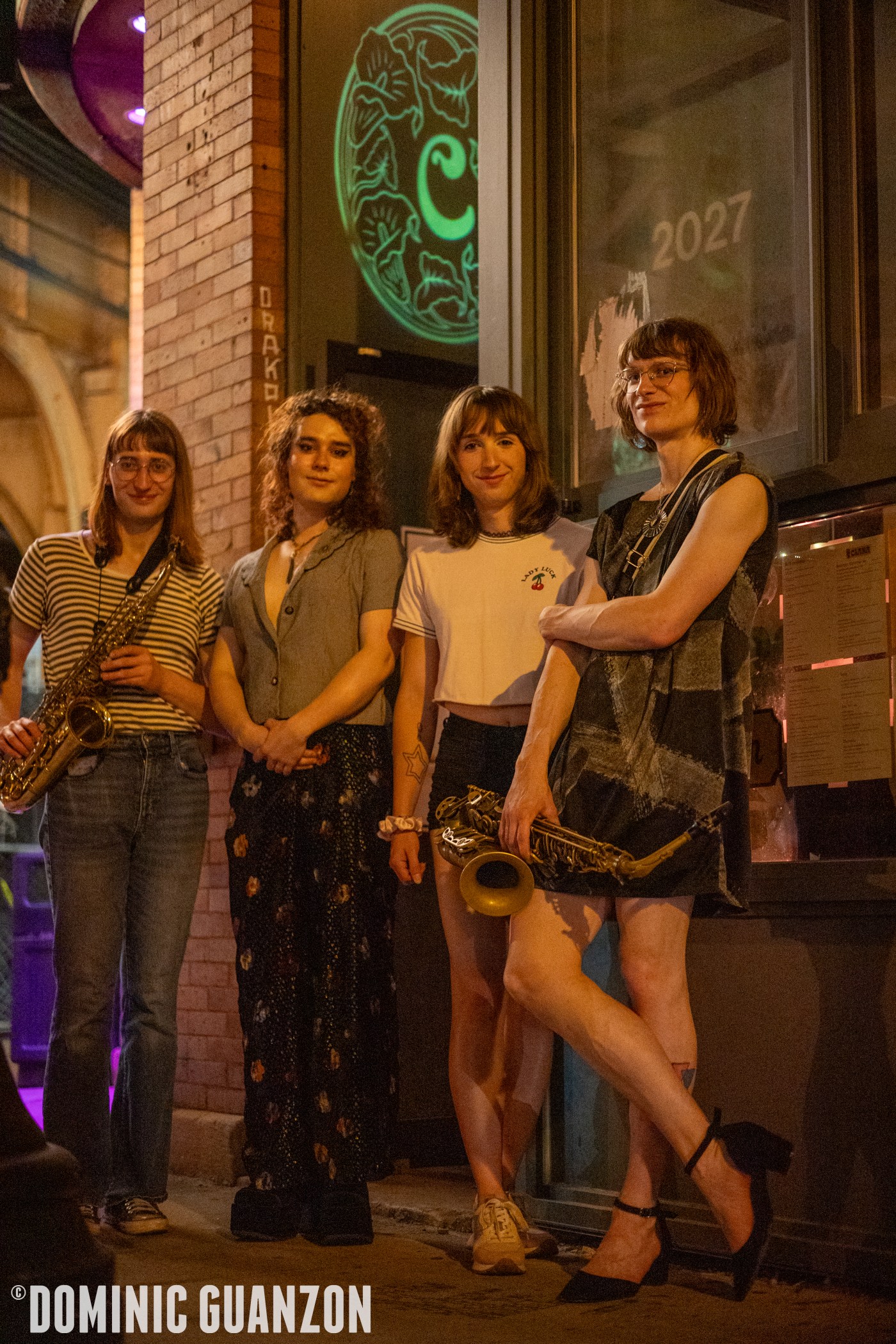
(Left to right) Bea Lynn, Millie Ahearn, Jamie Demeny, Maggie Cousin. Clara, 7/02/25.
By Dominic Guanzon
Wednesday 6/18/25
Thursday 6/26/25
Wednesday 7/02/25
The following is an amalgamation of multiple visits to Clara, as well as separate interviews with the artists.
“I don’t care. It’s my music.”
It’s raining as I get off the Damen stop, the droplets whipping into my face as I fast-walk past Milwaukee and North Avenue. I didn’t bother looking at my phone’s weather app once today, assuming it was gonna storm, and yet I still had the audacity to leave my umbrella in the car.
I’ll still maintain the right to be annoyed if the showers depress turnout for this mid-June edition of the Clara jam. Wicker Park isn’t exactly close for me, resulting in a rain-soaked, rush hour park-and-ride lasting two hours.
Twelve hours ago, the Supreme Court upheld a Tennessee ban on gender-affirming healthcare for trans youth in its United States v. Skrmetti ruling. My phone is still lighting up. I put it away.
Jazz percussionist Jamie Demeny has just ordered a pink lemonade from the Clara bar. It matches her pink dress, but has no alcohol. She needs a clear head for her house set before Millie Ahearn kicks off the jam.
“I look after my dad’s cat so much while he travels, Fuzzy might as well be my cat,” Jamie tells me in her casually-sarcastic, contralto voice. I dare not bring up, or worse, deliver, bad political news a mere 10 minutes before she performs. “He’s a 17-year-old tabby. A thin one! White socks. Beard. He’s sweet.”
Just three months ago at Fulton Street Collective, she proudly announced that her new Illinois driver’s license finally reflected her true self: an unassuming, little “F” that tells the world she’s she. A validation in the eyes of the state, wherever she can get it.

“I came to [transitioning] a lot later than other trans people that I’ve met. A lot of them have been dealing with these feelings since childhood. And for better or for worse, probably for worse, many of those feelings were snuffed out of my childhood. Not deliberately. Just in conservative kinds of ways from the people I grew up with. It’s been a lot of slow realizations and decisions and figuring out I have had to rediscover the person that I am, which is a woman.”
After stepping onto her completely homemade tap board, and with no drummer on the house kit, her feet provide the percussion that completes her jazz quartet.
“It looks a lot harder than it is. Or maybe it is as hard as it looks, but it doesn’t feel like that. I’m biased.”
The plywood board, no larger than 2×3 feet, sits a couple inches off the ground through a series of stacked and glued foam squares in the four corners. It bounces, bends, and flexes so as to both give off a bigger sound and provide literal give so her knees don’t take as much of a beating.
A series of metal plates are glued to the board before her, each one shaped differently to provide a different sound texture. Using both the board and the plates, she supplies the standard swing beat you’d find on the typical drum set.
Cymbals hover at foot level. Four of them, hanging upside down from metal fixtures that splay out and around from the plywood like a rainbow. There may be a fifth on the horizon, she tells me.
She hits them with her tap shoes in quick strikes to accent her trumpeter’s melody and launch into the song’s B section.

I have seen tap dancers on YouTube perform with, say, Post Modern Jukebox. Chicago’s own Sidewalk Chalk have been known to invite dancers to their sessions. Their bombast and sparkle entertain, but I’ve never really heard the music make it past the spectacle.
The only other person I’m aware of who performs at jazz gigs with regularity is Chandler Browne. Chan coincidentally also frequent Clara, at one point hosting “The Frē Jam” there, but it has since moved. As of this writing, it’s gone to The Owl, further along the Blue Line in Logan Square. I have yet to hear Chan’s reportedly fiercer form of footwork in person.
When the mention of Post Modern Jukebox begins to exit my mouth, I can almost see the glint of a switchblade emerge from Jamie’s eyes. My cheeks grow flush, but I’m not sure if it’s embarrassment or the glass of red blend finally hitting me.
On Jamie’s website, she makes sure to put “JAZZ MUSICIAN” right under her name. Other than the name of her degree, a 2020 minor in Dance Education from Elmhurst University, the word “dance” never shows up on the site.
“There’s no room for flash. I don’t want there to be flash,” she says plainly, nodding her head, “I have made very conscious efforts to not let myself become a gimmick, or a novelty, or something that can just as easily be written off as, ‘oh, this is a feature for just that.’
“There are a million tap people that can dance circles around me. I don’t care. It’s my music.”
Indeed, compared to her contemporaries, her feet don’t hit as hard, and her arms don’t go out as wide. Whereas any dancer will stretch the widest smile possible while part of a troupe, Jamie’s face is cerebral, nigh-blank with focus.
Maybe it’s that she’s still getting the mechanics of tap in her bones, considering she picked up dance while in college, a later age than most career professionals, with no prior experience. Even then, she specifically sought out lessons not from a dancer, but local jazz drummer TJ Thompson, whose high energy and random “Rock With You” fills I’ve personally witnessed on The Whistler stage.
Considering she teaches lessons, the much likelier reason is small-group jazz’s reliance on conversation. Every song, acts of instantaneous composition taking place. A snub towards the routine, dance or otherwise.

That evening at Fulton is when I first met Jamie. I was one of ten people in the audience.
“Yeah, my calendar is not as full as horn players or drummers or piano players, and that’s fine,” she sighs. “I have absolutely made my peace with that…It’s a lot of waiting tables and eating a lot of hundred dollar, two hundred dollar bills [total] at the gigs where the venues don’t pay me enough. But I still got to pay my people. Always pay my people.”
The money question is one every musician has to face, and it’s a different answer every time.
Transgender women working full time are paid 60 cents for every dollar the average worker is, according to a 2022 report from the Human Rights Campaign. That report still has deficiencies in its sampling, likely underselling the gap, but it may be the best we have since the federal government doesn’t collect wage data for LGBTQI+ people.
Wage gaps are already a difficult number to understand in totality, but to be a part time server and a musician?
“It’s not easy,” Jamie says, putting it lightly, “but I find my joy in it.”
Many of the musicians in this club are educators. The lucky ones have work as a school teacher. Most do lessons. Rarely, usually the students, have nothing but the music.
It has yet to be seen if Jamie’s unique take on the music truly hurts or helps her bottom line. But while she’s at it, she piles on another niche on top of the tap: her love of video game music (VGM).
“Ever since father bought me my first Game Boy Color, to the chagrin of my mother…video games have always been important to me. It’s always been Pokémon and Kirby and Smash Bros and Minecraft. Not a ton of memorable music in Minecraft, but it’s still good stuff.”

Her stare trails off, as if going through the OST in her head at warp speed to see if she truly meant that. Raindrops smack the cars parked in front of the club like a shoulder tap. She snaps back.
“Yeah, I never had proper musical interests until 2007 when I played Pokémon Diamond and Pearl. Then my stepdad gave me my first iPod and I was like, ‘I don’t even know what to put on here.’ And one of, like, three songs that I did have was ‘Cynthia’s Battle Theme.’”
She smiles, “it means about as much to me now as it did then.”
Of the handful of times I’ve seen her perform, I casually surveyed the crowds to hear their reaction.
“I’ve never seen anything like it,” an older woman told me at Colvin House, sipping her tea.
For the under-40s, they’d focus on the VGM aspect.
“Dude,” a man at Fulton smiled, “I just heard the Pokémon Red/Blue/Yellow theme in tap dance form. Like, what?”
For her fellow queers, well…
“The LEGS!” one young woman joked, probably.

Jamie Demeny + Friends. (Left to right) Morgan Turner, Demeny, Emily Kuhn. Clara, 6/18/25.
Back at Clara, the bar sits on a higher elevation than the initial landing, where the entrance and performance area are. The lights are turned lower than I remember, compensating for the new floor LED lights that are drenching the musicians from below in a slowly-churning carousel of neon, bisexual colors.
Taking photos is gonna be a lot harder thanks to the flash I don’t have.
But for Jamie Demeny + Friends (a rotating roster of young, local players), it’s a literal spotlight that highlights the special occasion. It’s the one-year anniversary of the LGBTQ-friendly Wednesday jam at Clara, founded by British-born trumpeter Millie Ahearn (“[a-HEARN], like you’re clearing your throat”).
“It was an ‘I dare you’ kind of thing.”
Millie’s South London accent makes the rounds, eventually greeting me and every other player that comes through the propped-open door, shaking off the rain on their jackets and instrument cases. We start talking in the back-most room near the server prep area.

After moving to Chicago in 2021 on a student visa for a Master’s at Northwestern, Millie got to work, jamming and picking up gigs around the city as a side player. One of the earliest Chicago mainstays to embrace her as a musician was trumpeter Marques Carroll.
“Marques Carroll was one of my first true mentors in the city. He would have me sit in at his Trumpet Summits at Andy’s, and I would go in there – full beard, skirt, dress. He would get me on stage and be like, ‘hey, listen to this person play! This person is serious about this.’”
She places her hands upon the table and at their sides.
“And being able to stand there with one of the best trumpet players in the city, one of the biggest innovators right now…to give a space to a visibly trans person was a risk he didn’t have to take. But he did.”
These days, she’s pursuing another degree, this time at DePaul. Right now, to the week, she’s celebrating the jam itself.
According to Millie, drummer Kabir Dalawari was first offered the job, but he was busy with another at Easy Does It just up Milwaukee Avenue, in Palmer Square. Given the opportunity to pass it to someone else, he turned to Millie.
“He wanted to give the opportunity to a woman, specifically a trans woman, to give that voice more presence in the scene. When I got that opportunity, I thought about it for about 20 minutes. ‘Do I want this responsibility, do I want to do this?’” She quickly leans in, “and obviously it was ‘yes,’ but it’s going to be tricky because I’m going to be in charge of a space which I feel needs to be created, and therefore laden with risk.
“I don’t see many women, non-binary people, gender non-conforming people, and otherwise trans musicians, at a lot of [jam] sessions for a variety of reasons. I wanted to develop something for us. Partly for me so that I can meet all of them,” she laughs. “I was a little more present at [other] sessions as an openly-gender/queer person, and I wanted to create a space that could be a kind of home for everybody.”
It seems to have paid off. The density of (presenting) women, as well as (openly) gay/queer and (avowed) trans musicians at this joint far exceeds every other jazz jam I’ve been to.
“The club has been absolutely wonderful to me over this time, giving me the space and the opportunity to do this. [I have] free rein in terms of who I book for the house artists, which is really nice, and that has put me in touch with a lot of beautiful people.”

Millie Ahearn (center) and Jesse Lear (left). Clara, 6/27/25.
The featured artist for the opening house set rotates. From mainstays such as Alyssa Allgood and Juliette Gardiner, to up-and-comers like Carmani Edwards, Ellie Ruiz, and Marion Sly Mallard.
Chicago bassist Crystal Rebone headed up the last one I went to, which featured a slate of video game music (VGM) done in the modern jazz style. That night’s focus was on Japanese RPGs like Persona and Final Fantasy, and she’s thinking about expanding on the project.
For Jamie Demeny, her song choices fall squarely in the classic Nintendo camp: the Super Mario Bros 2 theme, “K.K. Crusin’” from Animal Crossing, and of course, the Wii Shop Channel Theme. The subgenre is spreading in Chicago, thank goodness.

Crystal Rebone. Clara, 11/8/25.
Amidst the twirl of shoes and legs and skirt, a drizzle comes and goes outside, sprinkling the Clara windows behind Jamie and her all-female band, as if poking and prodding an angle to get in. If you peer into the window from the sidewalk as a passerby, or a photographer, you might see the purple floor lights twinkle through the droplets.
With the Damen Blue Line stop just around the corner, the Forest Park-bound train comes in at just the perfect angle, but I miss the shot. The framing is so picturesque, and coveted by so many other posts on socials, I’ve started calling it the “Clara shot.” It’s an iconic backdrop that not even Le Piano’s Morse Red Line background can compete with, so I become fixated on it like a Super Mario 64 speedrunner.
I pull up the Ventra app to see when the next train is due. I miss it again during a cover of “Secret Level” from Kirby’s Return to Dream Land. I blame the app for being confusing before realizing there’s a literal performance happening in front of me.
After “New Donk City” from Mario Odyssey, Jamie tells the story of how, after progressing so much during her transition, her phone’s face recognition software doesn’t even recognize her anymore.
An annoyance for most. An accomplishment for her.
“It’s…well, it’s nice,” she verbally stumbles, to a wave of affirmations from the crowd. Her eyes move to a blank space on the floor. Her foot quietly fiddles around on the board. She takes a brief moment to soak in the positivity before pivoting to that heartfelt, lesbian sardonicism.
“It’s great, I can really start identifying with more of the biblically accurate pride flag,” she jokes, pointing to the large pride flag hanging on the accessibility elevator door, with its trans, and black/brown, and intersex garnishes.
She closes her set with the “Athletic Theme” from Yoshi’s Island, which she released as her debut single, complete with music video, reflecting a different presentation of her since passed.
“It’s who I was at that time. I prefer who I am now, of course, but I’m not ashamed of it.”

The musicians begin switching out under Millie’s direction as jam host. She warms up her trumpet, preparing to kick things off. Millie has progressed past the photos you find of her on Google, as of this writing. In them, she sported a chinstrap beard. Well-groomed as it was, it’s not her style now.
She also doesn’t seem to mind, however.
“For a long time, having the beard was-” she pauses. “It was an ‘I dare you’ kind of thing, you know? I feel like at every point in my life so far, at least as an adult, I presented myself with authenticity and arrogance. A sense of ‘screw you’ to it.”
Some might even call that pride.
One of her many trumpet gigs has included “The Fly Honey Show,” an annual, limited run “queer punk” and “all-body-loving” performance featuring drag, burlesque and pole dancing set to live music. One of my favorite images from this year’s show is of a dancer leaning against a pole, proudly holding a sign with the Dog Park Dissidents’ lyric, “QUEER AS IN FUCK YOU.”
“I grew up a socialized male,” Millie continues, “and I had known from age six this body didn’t quite feel right. But I got pushed down,” she rests her palm on the table with a delicate firmness, “and pushed down, and pushed down, and pushed down.
“And then I started doing drag during my undergrad in 2017. I had a short back and sides [haircut], and a beard, and I was experimenting with dresses. I was very secretive because I couldn’t put that on social media, since some of the people I had on there I couldn’t show that to.”
She gently waves her hands around with an exhaustion that’s already been conquered.
“And then, just following the joy at every point, up until COVID where I realized something in the isolation that I really needed to understand myself, and know myself. Because there’s only so much-” she pauses again. “I feel like it’s very easy to mask for other people. Masking to yourself is incredibly difficult and detrimental to [yourself]. I had had the beard for years, I dressed a little femininely, I used a little makeup, but it was nothing out of the ordinary.

“Until I started to really think about it, and understand that my identity had always been both assumed and dictated by people who needed a certain thing from me. They expected a certain thing. And I never actually had the space to see the world through the eyes of the girl that I wanted to be. This fantasyland that I had locked away from the physical and emotional violence.”
In so many ways, Millie’s immigration story is typical of so many who arrive in America, particularly the part about making a name for herself. The previous generation of my Filipino family did this literally, having immigrated to Chicagoland in the 80s and 90s. “Eugeño” became “Gene,” “Maria-Isabel” became “Maribel,” “Ardennis” became “Dennis,” and “Loisa” became “Louie.”
But in Millie’s case, as is the case with countless other trans people, the name change is less fitting in with Western culture, and more fitting into herself.
“So when I moved here, I said, ‘screw it.’ Nobody knew me. I was new here. I could just completely reset. I went to a vintage consignment store in Evanston called ‘Classy Closet [Consignment].’ I met my now-ex, an absolutely wonderful woman, who was the first person to see me as…as…as beautiful. To make me feel like I was seen as beautiful, as a gender non-conforming person.”
Millie has been exploring her gender presentation for seven years now, while physically transitioning for two. In 2022, while in England, she released her album “Octagyn,” which puts her emotional journey to jazz composition and stylings.
“I would go to all of these sessions in all of these extravagant clothes and the beard. I’ve been told that it challenged a lot of people.”

“I just trusted that it would be a great thing for me.”
As we finish up our talk, Millie is quick to note how lucky she’s been thus far as an immigrant in this environment, even as a white one. It’s a hell of a time to not have citizenship in this city.
Passing by the bar to head to the restroom, I pass by a woman mid-drink order. “Yes, ice. Well, fuck ICE. But yeah, ice please.”
Even more musicians are arriving. One horn player’s case is adorned with stickers from, “FREE PALESTINE” to pro-abortion messages.
Walking into the unisex bathroom, I hear a pair of female voices sharing their thoughts about dumping one’s boyfriend because he was “toxic, like internet toxic.” I can only imagine which bro-tuber he listens to. Tim Pool? Charlie Kirk? Nick Fuentes? (Fun fact: those three were born and raised around Chicago, Arlington Heights, and La Grange Park, respectively.) Or maybe just good ol’ Rogan.
They switch to debating how to get home, the rain being the main factor in their decision-making.
I step back into the bar.

Millie starts the jam with “What Is This Thing Called Love?” played at “Hot House” speed. Beside her, acting as the Bird to her Diz, is Beatrice Lynn.
Looking back at the crowd, it has swelled to capacity. “Who’s-who” is often written about in the advertisements of many jams, but it holds up tonight.
Bea [BEE] can come off as an enigma. At least, if you see one of only a handful of uploads on her socials, as of this writing. In one video, she spends six minutes sitting on her bed, stoically machine-gunning notes on her alto saxophone, her face engulfed in shadow from the window behind her.
“For me, this felt like how life was kind of coming at me during this time,” Bea tells me. “Everything was new, and before now, a lot of life felt dissociative.”
The Wisconsin transplant of one year started off listening to Johnny Hodges, before Charlie Parker and Jackie McLean showed her bebop. These days, her new life as an open trans woman has brought forth a whole new avenue of emotion.
“That video was an improvisation just kind of building on the anxieties of the unknown. For most of my life, I felt like feeling uncomfortable was an indicator that a decision I am making is correct. It was made around [the time] I started medically transitioning, and although there is quite a bit of information on this, there is not nearly enough research in transgender medical science. I just trusted that it would be a great thing for me.”

Millie Ahearn (left) and Beatrice Lynn (right). Clara, 6/18/25.
If being a a full-time independent artist is already a leap of faith, medically altering your body is a jump with the legs of Superwoman. Trans healthcare has not received nearly enough attention from the research field due to stigmatization. You can’t really oversell the gaps.
According to the “What We Know” project at Cornell’s Center for the Study of Inequality, “it is difficult to conduct prospective studies or randomized control trials of treatments for gender dysphoria because of the individualized nature of treatment, the varying and unequal circumstances of population members, the small size of the known transgender population, and the ethical issues involved in withholding an effective treatment from those who need it.”
In other words, it’s difficult to do long-term science for a minority that’s unique to each person, spread out, and in desperate need of care right now. And there’s evidence as to why.
A Kaiser Family Foundation and Washington Post survey found repeated feelings of isolation and discrimination in the realm of trans healthcare. With one result finding “around three in ten trans adults say they’ve had to teach a doctor about trans people to get appropriate care.”
Meanwhile, “about half of trans adults say the health care providers they come into contact with know ‘not much’ or ‘nothing’ about providing care for trans people.”
As the Cornell page states plainly, “transgender outcomes research is still evolving and has been limited by the historical stigma against conducting research in this field.”
Something as common as cardiovascular diseases are still fraught with knowledge gaps and unknown risks to the transgender population.
In Chicago, a slew of hospitals have suspended gender-affirming care for trans youth in advance of the Trump administration’s executive order. These include Lurie Children’s Hospital, Rush Medical, and UChicago Medicine, and have prompted protests in front of the aforementioned hospitals.
It even prompted one nurse to raise the historical parallel of very targeted Nazi oppression of the emerging trans science coming out of Germany at the time.
Regardless of all the unknowns, the Cornell page still found trans healthcare to be overwhelmingly a positive. Of the 55 studies between 1991 and 2017 they could identify concerning “the effect of gender transition on transgender well-being,” 51 concluded that “gender transition improves the overall well-being of transgender people.” Meanwhile, four found “mixed or null findings.”
Most importantly, “we found no studies concluding that gender transition causes overall harm.”

Millie Ahearn (left) and Beatrice Lynn (right). Clara, 7/02/25.
But most unknowns can only stay that way if you let them. While moving to the big city is hardly a unique story, for Bea, that self-discovery is intensified by her trans journey.
That’s probably why that video is labeled “on moving away and changing your name” [sic] on YouTube. It’s pertinent too, since she changed her name in October, only three months into hormones.
Talking to her in passing, she speaks in total inverse to her playing: quietly and succinctly, in nods when she can help it, clutching and hiding behind her saxophone. Via email, she opens up.
“Being a transgender woman is just another example of the many ways we transition in life: new job, move, love/loss, etc. I think those experiences are universal. Feelings of intense euphoria, doubt, isolation, and hope are all commonly felt emotions, and I think these come across musically in my playing and composing just as another musician brings with them everything they’ve ever lived.”
While reading these words in my inbox, I try to imagine what it’s like hearing Bea speak them. There’s an endearing reservation, dare I say aloofness, to her cadence when you first meet her. She’ll run her hair behind her ears and furiously nod her head while you talk, responding with just a few words after making sure you’ve finished.
For now, back at Clara, Bea is simply destroying the changes.
Almost every soloist gets applause when they’re done. Bea gets cheers in the middle of the chart. When she finishes, she immediately turns away to quietly slink back to the wall, but the applause from the club forces her to quickly turn back and smile, acknowledging the joy she just shared with the crowd.
“A coworker and friend recommended that I visit Millie’s first session [at Clara]. I have been going every Wednesday I can ever since then. I really found community and sisterhood…so many hard-working and passionate women and gender-queer individuals who have inspired me and shaped my view of the woman I want to be.
“What I think is just the most beautiful thing is that, just like me on the first session, Millie greets every person new or a regular with so much love and happiness. This has been a space for me to feel comfortable and appreciated and I cannot be more grateful for that.”
“I’m just playing. I’m just making sounds.”

Bea had a house set of her own at Clara back in April. In two weeks, it’ll be Maggie Cousin on her alto saxophone, bass clarinet, sopranino sax, and a small studio’s worth of cables going into a looper.
Her band for that particular evening comprises Lyn Rye on upright and electric basses, Tommy Carroll on drums, and Ben Zucker on the vibraphone, which, combined with Maggie’s electronics, leads to a funky dreamscape of a sound. Like a sharper, more pointed, in-your-face Marquis Hill pre-New York era when he still had Justin “Justefan” Thomas on vibes.
In one standout moment while going full post-bop on her sopranino, she hits a trill which she loops and isolates to the point where it becomes less of a trill, and more of a jagged signal from a radio wave.
“It felt good to play on the horn, so I wanted to do it. Once I was doing it, it was like ‘how can I play this with people?’”
She speaks flatly, but with an urgency. Almost a staccato. A rapid point-and-click of a talk. An old drummer once told me people talk like they play. There’s a high energy that flows out of Maggie. Scattered, but not manic. Almost muted.
“I liked the way I could create a groove on that figure.”
The St. Paul native first started learning how to make beats at Walker West Music Academy from Solomon J. Parham.
“[Walker West] really taught me the foundation for what I know and what I’m doing. So yeah, I’m very much tied to St. Paul and especially that neighborhood. Really, where I was…starting out musically, was right in that area…It’s thought to be the oldest community school in the nation that was founded by African-American musicians…It’s always been rooted in the black tradition.”

Walker West was founded by a pair of gospel musicians, but while there, she also learned hip-hop beats.
“Once I had the technical wherewithal in the DAW (digital audio workstation), I was kind of seeing all these different possibilities. For as long as I’ve been playing saxophone, there have been jazz musicians who are at the highest levels of the art who have been doing this.
“Chris Potter at the Dakota [Jazz Club in Minneapolis]…he had some samples loaded up and he was doing some stuff. And it wasn’t a huge part of his set or anything, but this is Chris Potter. He’s gonna be playing the horn and shit. But it made me think, maybe, like, something new at the time, as if some Downbeat critic would have gone and, like, wrote about it or something.”
I laugh, knowing many music writers’ penchant to treat every new thing they’ve seen like it’s the first time anyone on Earth has seen it. Not me, of course.

“But, I mean, for me, [sampling, electronics] have always been a part of music as long as I’ve been consuming it. I remember hearing some of my dad’s old CDs that I remember being, like, ‘oh put this one on, put this one on,’ when I was a kid. A lot of the things I was gravitating towards were these electronic sounds with modulations going on…[Solomon Parham] got me put on to J Dilla. I think he’s the best.
“That doesn’t even get into the whole free improv and noise and stuff like that. It’s not so much any one particular person made me get into that, but I want to find out how to make different noises when I hear stuff.”
This particular lineup of Maggie’s made their first-ever outing while at Clara. Their freer, all-encompassing improv stands in stark contrast to D’funk and the Grease Monkeys, a group she joined in 2019. The even funkier, hip-hop group features full-on rap verses. She doesn’t need to work hard when switching between the two, however.
“Not to be overly cryptic, but I kind of don’t think there is a difference [between free improv and backing hip-hop]. I’m just playing. I’m just making sounds. All that stuff you heard [at Clara]? That could also be a hip-hop beat. So it might be a hip-hop song, but I might still be doing extended techniques or playing in cells, or whatever, because I think that’s just what helps build up, you know?”
“They will have to prove themselves again and again.”

Asha Egmont (left) and Beatrice Lynn (right). Clara, 6/18/25.
With the house set over, the jam opens up. The rain has stopped briefly. People begin cycling in and out of the bandstand, but not as much as they are swirling between conversations and the bar altogether. The flow is flying now. All at once, the room becomes a cacophony of style and character, of pride with no prejudice, steeped in color and music, joyous in its many blended acts of singular daring.
It’s a pretty gay time.

Trombonist Asha Egmont calls “Little Suede Shoes.” She loves the Clara vibe, commenting how it’s not cutthroat like other places. When Asha is finished with her solo, Bea takes over, planting herself as still as a statue while her fingers churn out chromaticism like a computer’s keyboard getting stuck and spamming out a string of “Fs.”
I happen by an aspiring vocalist. Currently, she’s a waitress, one year removed from college. She loves jazz, but didn’t get as much tutelage as she liked during her time in academia.
“It was a lot of men in the jazz combos,” she explains. “I had a professor who said he’d never written one lyric in all his years of playing. I don’t know if that’s something you should brag about! I don’t think he liked vocalists that much.”
But at this club, she’s able to take the lead, even if she has yet to nail down exactly how to end her tunes, especially “Night and Day.”

I mention the gaggle of singers doing their best to be vocalists when talking to Millie.
“Vocalists get a very bad rap because…instrumentalists will kind of throw away the melody because they’re trying to get to the solo section where they can ‘do their thing.’ And we forget that vocalists are carrying a narrative.
“This is Black American Music. A lot of the time, the narrative is heavy, and it takes a lot of control and education and balance to bring justice to melody and to lyrics. Getting up and singing is the hardest thing I’ve ever done. I play trumpet every day, and I hate it! But it hates me,” she laughs. “But vocalists have a completely unique challenge.”
Millie shakes her head.
“I will never criticize a vocalist for getting up and singing, even if they forget the words. There’s that stigma around them, especially female vocalists. Or you know, not even vocalists. Women will go to sessions and are assumed to be the singer. They will assume they are not very good. They will have to prove themselves again and again to a room of men…to a room of people who are waiting for them to fail.”

Saxophonist Neil Carson went to his first protest last Saturday, which just so happened to be the “No Kings” march that numbered as many as 75,000 people. Greeting each other at the jam with the usual pleasantries about his latest New Nostalgia album or Blueshift Big Band arrangement, I poke and prod his reactions to this emerging political side of him.
Neil is a whirlwind of a man when he’s on the stage. He’s the type to squat like a gremlin to the lowest notes of his alto, then leap, with both feet of the ground, in anticipation of a big hit. But tonight, he’s more reserved. I’ll find an all-text post on his Instagram later, discussing the fear of merely being one of many “privileged white people who just want to perform their support so they look good.”
“When I was at Daley Plaza surrounded by a sea of people listening to impassioned speakers and chanting ‘No Kings’ as loud as possible along with the crowd, I was surprised to feel these insecurities subside in myself. I began to trust my own intentions as good and that others trusted me as well.”
Neil takes to the jam behind a vocalist, taking their cues on a songbook standard. When the pianist takes a chorus, Neil and the rest of the frontline move out of the way and towards the wall, collaborating on a horn line to play behind the solo from the sidelines. It’s beautiful music.
He continues his writing, “I think the guilt/existential confusion a lot of white folks feel is understandable, and while it’s def uncomfortable [sic] ideally it’s the first step in developing compassion and awareness. Maybe after guilt, the next steps are: kindness/patience toward yourself in those moments of guilt > education on issues > action.”

Tap percussionist Chandler Browne arrives, unfolding a a slab of wood that barely bends as a tap board, and nothing else. Chan’s feet attack the rigid wood on a tune I can’t even remember, because during the pickup, my attention was snapped to the sheer ferocity of what was before me.
Chandler is having a full workout. Chan’s eyes are closed, their face appearing to be in the midst of a spiritual experience. Each slam of the foot pierces through the air, sharper than anything, music or otherwise, I’ve heard in a while.
Chan may have also been the most polite person I’ll meet at the bar that night, further putting the “people play like they talk” theory to the test.
One wallflower I get talking to didn’t bring their instrument on purpose. Bereft of an answer, I ask, knowing I’m wrong, if it’s because they wanted to exercise their ear without the pressure of actually playing. They shrug. I sense a weight emanating from them, but I don’t prod any further. Maybe we might get a great song or album down the line. For now, they’re next week’s possibility.
Pianist Brandon Harper jokes that I should put all these jazz musicians I’m talking to in a spreadsheet. “Like a Pokédex,” he laughs.
I’d have to be a real autist to do something like that.
Can’t get diagnosed for ADHD if you keep forgetting to make the appointment.

Meghan Stagl. Clara, 6/18/25.
Jamie returns to join in, swiftly setting up her board with the quickness of a woman on time. The brass form up next to her, and the frontline is established. For this tune, however, she’s playing with a drummer behind her.
“[When playing with a drummer], maybe I’ll throw in a little rhythmic supporting thing the way other horn players do off to the side. Maybe I’ll match them, or I’ll throw something else in there. Maybe I’m playing along exactly with the melody. Or maybe I’m just staying out of the way.
“For other people’s solos…I almost never do anything. My instrument is very limited in what it can musically contribute. If I don’t have a setup that’s prearranged with the drummer, for us to say ‘hey, I’m going to keep time during this person’s solo and you’ll keep time during that.’ There’s no reason for me to play the same swing beat or the same clave.
“I come from a different school of thought. I grew up playing trumpet. I’ve never been much of a dance person. It was always just music for me.”
Jamie rounds things out with a trade of fours, using every part of her board to match the energy of the drummer behind her. It’s a mish-mash and smash, of so many cymbals and beats, across the two musicians.
Her with her back towards him. Him with his eyes closed. She goes for one of her cymbals, before jerking to another one, preferring the other’s tone when she hears what she hears. He rolls upward on his snare drum, moving to hit a rack tom before deciding to go back. Those brown eyes of hers look upwards, as if solving an equation. A smile explodes across his face, locked in.
They swell their sounds in tandem, as the rest of the horns reform before them.

All The Very Gay Places
The jam closes out a little past midnight on a tune I don’t recognize. I’m sure someone will call it some other time. Or maybe not.
Just on the other side of the six-way is Dimo’s Pizza. It’s one of the few places in the post-pandemic to stay open late on weekdays. The Spyro the Dragon soundtrack is playing overhead, specifically the “Dark Hollow” theme from the Artisan’s World section. In my tired state, my mind clinging to anything for conversation, I drop my favorite Spyro factoid to the man standing in line with me: Stewart Copeland, the drummer from The Police, did the soundtrack for the first three Spyro games.
“I never played Spyro,” he responds. “Actually, I don’t really listen to The Police.”
He orders a slice of the BBQ beef pizza and leaves.
A gaggle of six or seven players I saw at the jam are practically throating Dimos’ large slices in near-silence at one of the booths, their encased saxes and trumpets on the floor right next to the end of the table.
I dare not bring up, or worse, deliver, the bad news that it’s been seven years since the Spyro remakes, meaning if the studio finally decides to make a new one, then the 72-year-old Copeland may not be around to do the soundtrack.
I get the last slice of prosciutto pizza and leave.
I had asked around at Clara if anyone wanted a slice, including Jamie. She declined, since she opens for her restaurant day job in five hours.
“I didn’t have to pick up that shift when it became available, but I did. Didn’t even think twice about it.” Her eyes widen briefly, stopping mid-wrench while disassembling the eight sets of nuts, washers, and screws on her tap board, “then I realized two days ago.”
She quickly sighs, “I’m young.”
The rain picks up again.

Evan Kopca’s clarinet. Clara, 7/02/25.
As I make my way back up the steps of the Damen stop, I turn my head towards the hyper-reality of my phone, alight with notifications from local organizations’ press releases calling for emergency protests in response to the Skrmetti decision. This, amid “Know Your Rights” seminars from immigrant rights groups, and the third day of a hunger strike for Gaza at Federal Plaza.
I wonder how much of it is possible, what with the storms.
I walk into a near-empty train car during my 01:30 transfer to the Green Line at Clark/Lake. Someone wrapped in the comfort of coat and cloth lies beneath a blanket on the other end, their head resting on the pole. In these fleeting moments of late night communal sequestering, where the aesthetic of loneliness hangs heavy over my head like a fermata, my mind always falls back on Billy Strayhorn’s “Lush Life.”
I used to visit all the very gay places/those come-what-may places/where one relaxes on the axis of the wheel of life/to get the feel of life/from jazz and cocktails.
Nearing the end of the Green Line, the rider emerges from their dry cocoon and steps off. The rain crescendos to let off one last blast of a furious sky, but a long, hot summer still lies ahead.
Rapid response networks across Chicagoland are on high alert for ICE, and are weighing the drastically-increased risks of physically attending mandated court hearings and check-ins. The Chicago Immigration Court, just a block away from the Art Institute, has turned into daily civil disobedience. The city is bracing for an assault from the Administration like the one in L.A. during the winter.
Back in the suburbs, Naperville’s very own SPLC-designated hate group of Karens is still scouring school board meetings across Cook, DuPage, and Will counties for the perfect trans-friendly policy to make their national anathema. They’ll probably find another 7th grader’s face to plaster all over Twitter before the end of the summer.
I want nothing more than the dreamscape of “Lush Life’s” first stanza, but at this rate, I may get the second.
The girls I knew had sullen grey faces/with distingué traces/that used to be there you could see where they’d been washed away/from too many through the day/twelve o’clock tales.
There has been a distinct feeling of mass anxiety in the air, more palpable than ever. All around, a gargantuan system that is, at all times, profound, cruel, and sustained. As deceptive as a surgeon cutting into a piece of you doused with only local anesthetic.
It’s a sentiment shared by many musicians and protesters in the city, particularly the at-risk. It is, once again, becoming increasingly more possible to watch people get kettled by law enforcement, before taking a 20 to 40 minute L ride to see people enjoying themselves. Lord knows I’ve had that experience at nearly every jazz club in the city at this point. It can feel like the most gaslit, lucid dream you want to wake up from. Sometimes, knowing how little control you have, you don’t want to wake up from it.
But in this ongoing fight of their lives – the fight that is their lives – the musicians of the Clara jam dig in on the homefront. Every time, a rotating cadre of shes and hes and theys who refuse to rot with the rest/with those whose lives are lonely too. It feels defiant. Correct, even. As if to declare, “this is what it’s all for.”
Pride. Joy. A celebration in music.
I think Millie said it best: “People keep coming back and saying to me that this is needed…It’ll be a nice day when this is not.”
Another round of Israeli bombs has hit Iran, following the ones still hitting Gaza. Trump is weighing his options. Local orgs are passing around anti-war protests for a bigger presence in The Loop.
The train stops at Oak Park, its cheap parking a decent consolation for the drive ahead of me. I step off onto the station. I step off onto the street. The rain has settled some, but even in the dark, I can still see the anger in the clouds. I’m not sure what it will look like tomorrow.

Clara, 7/02/25.
Special thanks to Veronica Popp for her critique.
Gallery


![[3/3] “Scenes From A Trip To The Philippines For A Family Wedding In Manila And A Reunion In Bacolod”](https://scontent-dfw5-1.cdninstagram.com/v/t51.82787-15/653093588_17983099598968438_2592926441996763080_n.jpg?stp=dst-jpg_e35_tt6&_nc_cat=110&ccb=7-5&_nc_sid=18de74&efg=eyJlZmdfdGFnIjoiQ0FST1VTRUxfSVRFTS5iZXN0X2ltYWdlX3VybGdlbi5DMyJ9&_nc_ohc=CsPoQvkFyoEQ7kNvwF0-aNn&_nc_oc=Adp0fkfNFkfstuFh7OYhnQAXUEmD0WziCGIcUEgC0FSkDd-enfnfGfckZIvrzJ8tnV8&_nc_zt=23&_nc_ht=scontent-dfw5-1.cdninstagram.com&edm=ANo9K5cEAAAA&_nc_gid=hTshKutnZeeV8Dr7gtqsxA&_nc_tpa=Q5bMBQFRIhV4n7BWuTTwmx65KNgBZDBVeZxcnTsjsEObfDY5GaQEDlIZHxxcx9Ll579g3EL9SgQ1MOilVA&oh=00_Afwb-tn9T3LR0RFVv2Kj85ZhUyLfixwda3Xpz54sX-KElA&oe=69C19F8E)
![[2/3] “Scenes From A Trip To The Philippines For A Family Wedding In Manila And A Reunion In Bacolod”](https://scontent-dfw5-1.cdninstagram.com/v/t51.82787-15/652115319_17983098269968438_1420457237146189277_n.jpg?stp=dst-jpg_e35_tt6&_nc_cat=111&ccb=7-5&_nc_sid=18de74&efg=eyJlZmdfdGFnIjoiQ0FST1VTRUxfSVRFTS5iZXN0X2ltYWdlX3VybGdlbi5DMyJ9&_nc_ohc=a82kdwoR_jIQ7kNvwFFVVct&_nc_oc=Adq20f8PwLbANCZcDqPR4ZLiHXSjpzVqYzjrUgY-Bcsfdf2yR9V6J3PBJuazPe9mk_4&_nc_zt=23&_nc_ht=scontent-dfw5-1.cdninstagram.com&edm=ANo9K5cEAAAA&_nc_gid=hTshKutnZeeV8Dr7gtqsxA&_nc_tpa=Q5bMBQFFcywkur6V7Lr2sG2RZ16VKgmbfslA5ptUPkSok4iIKoBzxcuiL60L1-STmgOoifB70h9PsQ463g&oh=00_AfyJAbJnO8d7Yk2UBlbfDbkY9c3LuZvw1bkQeXNxMkx7BA&oe=69C1B008)
![[1/3] “Scenes From A Trip To The Philippines For A Family Wedding In Manila And A Reunion In Bacolod”](https://scontent-dfw5-2.cdninstagram.com/v/t51.82787-15/653994441_17983092077968438_2167869577442551897_n.jpg?stp=dst-jpg_e35_tt6&_nc_cat=100&ccb=7-5&_nc_sid=18de74&efg=eyJlZmdfdGFnIjoiQ0FST1VTRUxfSVRFTS5iZXN0X2ltYWdlX3VybGdlbi5DMyJ9&_nc_ohc=0p2rZnMyErAQ7kNvwGkubxT&_nc_oc=AdpNlqVGUVjtL5AXEZE4Y371OUBansiQufwMkJmJP5a81v5BxHshLtuEyoI2nPoCmdk&_nc_zt=23&_nc_ht=scontent-dfw5-2.cdninstagram.com&edm=ANo9K5cEAAAA&_nc_gid=hTshKutnZeeV8Dr7gtqsxA&_nc_tpa=Q5bMBQEUshJXpqAfPsp58CPg3-dtB2PchM014KgeZv-7lY0B0-jQvbQ4qnyw8MuC76ucKALakQFZ2z14qw&oh=00_AfxviYCdxcyyT2fop9TMO4wPtno2gXILJLQHnG0ovLyy2w&oe=69C1AEB6)


![[2/2] BROADVIEW, IL, 2/28/26, 1PM-2:30PM – After their scheduled program, ~50 protesters moved from the designated protest zone on Beach St, down 25th Ave, and to the Harvard St approach to the ICE facility in a seemingly impromptu occupation of the intersection.](https://scontent-dfw5-1.cdninstagram.com/v/t51.82787-15/641803666_17981473718968438_580148578517965678_n.jpg?stp=dst-jpg_e35_tt6&_nc_cat=109&ccb=7-5&_nc_sid=18de74&efg=eyJlZmdfdGFnIjoiQ0FST1VTRUxfSVRFTS5iZXN0X2ltYWdlX3VybGdlbi5DMyJ9&_nc_ohc=_0Ee7-_ni44Q7kNvwHU-xnj&_nc_oc=Adq6jj4jXXqlbMtE5pV3kwAXKaaGBkTLZwpJOnfb1K8-zY1NFC_2jNlGLJApvfPHT1w&_nc_zt=23&_nc_ht=scontent-dfw5-1.cdninstagram.com&edm=ANo9K5cEAAAA&_nc_gid=hTshKutnZeeV8Dr7gtqsxA&_nc_tpa=Q5bMBQHYy9rrOZH1xxnOg_kvBCfothviYzIHvQSe6t0QTG1vxjW3imwAFIDeNhcWpL2NyLwxav2tuQL7_A&oh=00_AfyJByUZoZ0GCIfVGh5_uP7i_BFFeR0p5BVDiwQPRqdV1w&oe=69C1B3DF)
![[1/2] BROADVIEW, IL, 2/28/26, NOON-1PM – About 75 protesters came out for the “Salt Melts ICE” rally within the designated protest zone of the ICE Staging Area/de facto detention center. The theme centered around the salt/ice pun heavily, making extensive use of Morton Salt imagery, a company founded in Chicago.](https://scontent-dfw6-1.cdninstagram.com/v/t51.82787-15/642548769_17981419820968438_7452416072177783532_n.jpg?stp=dst-jpg_e35_tt6&_nc_cat=103&ccb=7-5&_nc_sid=18de74&efg=eyJlZmdfdGFnIjoiQ0FST1VTRUxfSVRFTS5iZXN0X2ltYWdlX3VybGdlbi5DMyJ9&_nc_ohc=KTqOnTrRk7kQ7kNvwHvOYSQ&_nc_oc=AdoTbiQFXM9p8bWElVOaEIbUCsQfDxsA1_K4_CkzHyuWhJZdsshEj0P-9pghEpPQH1o&_nc_zt=23&_nc_ht=scontent-dfw6-1.cdninstagram.com&edm=ANo9K5cEAAAA&_nc_gid=hTshKutnZeeV8Dr7gtqsxA&_nc_tpa=Q5bMBQE0pW7ENYs11ULgQKnzWjlJOxcNQr6R8mmzTZr6DtFLoWFnbqZPVX6x24Im-Gjl4EvE-VEL20PjdA&oh=00_AfxPDqRIongXDacg-q0tFThN861MubiJLH-O7okAAz98VA&oe=69C19E56)

 Blue Collar Jazz
Leave a comment