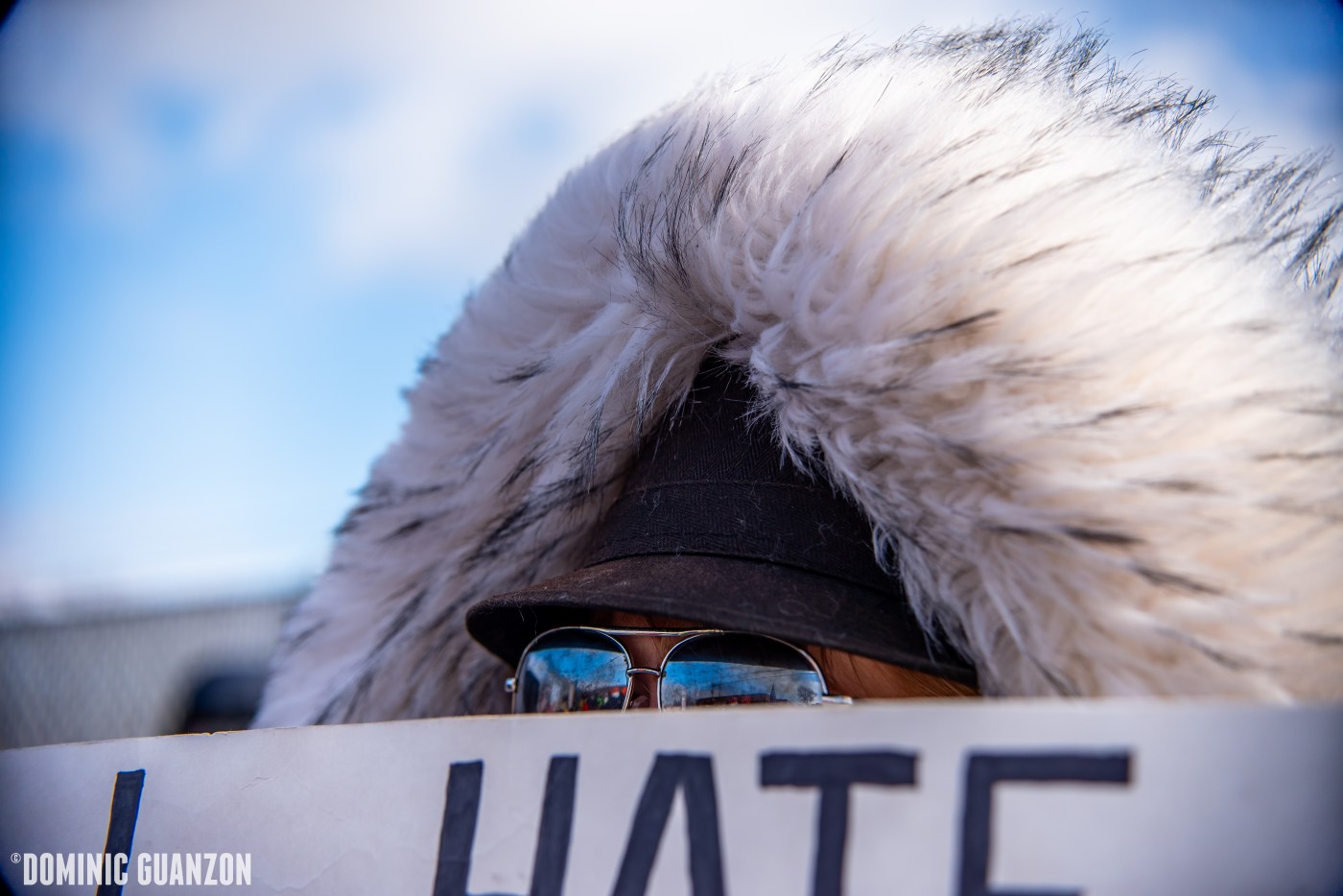
A protester in shades, a trilby (meant to mimic The Blues Brothers), and a thick hooded coat holds a sign up to their face to protect from the wind: “I HATE ILLINOIS NAZIS” [out-of-frame]. Broadview, 1/17/26.
By Dominic Guanzon
Saturday, 1/17/26
UPDATE 1/20: Photos and video show a protester in a physical altercation with the female instigator. The section has been updated.
BROADVIEW, IL – Over 300 protesters endured freezing temps and high winds to hold a rally at the Broadview ICE facility/de facto detention center, featuring speeches by several local organizers and political candidates, followed by a seemingly spontaneous march.
The day before, however, a set of short-notice communications from Broadview’s local government kept organizers on their toes.
Confusing Village Orders

Two dumpster trucks and a police vehicle block the I-290 18A exit leading to the ICE facility. Broadview, 1/17/26.
At about 10:15AM, on 1/16, the Village of Broadview put out a press release on Facebook, but not the Village website. The release detailed how it was anticipating “between 2,000 and 5,000” protesters, and would be redirecting vehicle traffic beginning at 7AM. These included:
-The closure of the I-290 18A exit to vehicles. This was confirmed with a police vehicle and two dumpster trucks blocking the exit.
-The one-block closure of Lexington Street between Beach St and 25th Avenue to vehicles.
-The vehicle closure of Indian Joe Drive, the extremely short street going under the railroad bridge that turns into Beach Street.
All of these were confirmed.
The release also directly reiterated the use of Unified Command (UC), including the Village’s local police, county sheriffs, state troopers, and the Northern Illinois Police Alert System’s Mobile Field Force.
Later in the day, the Village of Broadview sent word of a set of bans to at least one reporter, Chicago Sun-Times’ Violet Miller, but the Village did not appear to release it publicly on their media channels. Miller posted screenshots to Bluesky at 3:20PM on 1/16, saying it was emailed to her by Village spokesman David Ormsby.
This caused confusion in protester channels, as the bans would have likely caused incidents and flashpoints with protesters and press. These included bans on:
-“Shields, body armor, helmets…or gas masks,” all of which have become the norm at the protests to protect against federal and UC violence.
-“Large-sided coolers, backpacks, or bags larger than 4×4,” which have been employed by street medics, press, and mutual aid volunteers.
-“Metal poles, boards, or sticks thicker than ¾ inch in diameter or with sharp ends,” which would have potentially counted sign-holders. That rule did make an exception for signs that had ”hollow cardboard or similarly flexible material,” which would have been difficult to handle in the day’s high-wind weather.
-“Firearms,” which contrasts with the dismissal of federal charges on October 10th against a couple arrested for lawfully carrying loaded pistols outside the facility.
The notice ended with the threat of removal or arrest if the rules were not followed.
However, by the morning of the protest at 9AM, Miller (thanks to a protester notice) reported the removal of the bans on protective equipment and carrying devices, but keeping bans on firearms, a list of weapons, and the poles, boards, and sticks.

Dozens of police vehicles from the Unified Command, including at least 16 large transport vans and a Bearcat armored car. Broadview, 1/17/26.
The day of the protest, the UC was noticeably pulled back, staying in their vehicles (likely to stay warm) or around the corner in the parking lot directly north adjacent to the ICE facility. Surveillance camera towers were still present.
Regardless, the UC was ready to deploy, with dozens of vehicles parked at the Missionary Baptist Church nearby on 25th Ave, where they have staged numerous times before. On top of the usual squad cars, these vehicles included at least 16 large transport vans and a Bearcat armored car, likely used by Illinois State Police (ISP).
An increase in police vehicles was also spotted at an empty lot at the corner of Gardner Road and Indian Joe Dr, a popular juncture for protesters leaving the area, notable for its isolation from media and protest organization.
A Cold Landscape

A pair of Igloo cooler dispensers filled with warm liquid (likely coffee or cocoa), propped up on upsidedown down buckets, adorned with signs: “BEAR DOWN – FUCK ICE.” A cardboard box sits in the middle for trash. Styrofoam cups are stacked below. Broadview, 1/17/26.

A mutual aid volunteer sits by their table outside the protest zone, wrapped in multiple layers of jackets and their legs wrapped in a thermal blanket. Broadview, 1/17/26.

The designated protest zone appeared salted and clear of snow, though it wasn’t confirmed if this was done by volunteers, as was done before, or by the Village.
The primary barricade bordering the protest area was the lighter, slotted metal barriers, as had been seen towards the end of 2025. The concrete barriers were still present further down Beach St and sparsely at Beach St/Lexington St.
The average age of the protest skewed older adults to elderly, with several costumes on display.
As protesters gathered, the mutual aid volunteer group set up their table by the Ironworker’s Local 63 building at Beach St/Lexington St, as they have been doing since their encampment was removed last Fall.
A large bucket of handwarmers and other supplies were provided, their presence maintained for the duration of the protest.

Andy Thayer, leader of Chicago’s Gay Liberation Network, records a video at the front of the designated protest zone, which has been bordered by slotted metal barriers (far right). Broadview, 1/17/26.
With the UC pulled back, staying warm became the top concern among the sideways-falling snow. Multiple protesters noted the game of balance between keeping insulated, comfortable, and safe in the event of rapid escalation.
Masks proved useful both to keep sneezes in, faces warm, and identities safe. Some used their signs and costumes to block the wind, while others huddled up amongst the crowd.
About a dozen protesters in black bloc, protective gear, and identical High Density Polyethylene (HDPE) sheets were present. The HDPE sheets were used as shields, and had “WE KEEP US SAFE” cleanly stamped on the front.
They placed themselves at various points throughout the protest zone, particularly the front nearest the ICE facility, pointing out police movements amongst themselves. They did not appear to have offensive weaponry. They declined being part of a named group, suggesting a more secure, closed-door structure.
Legal observers from the Chicago branch of the National Lawyers Guild were present.

A group of about a dozen organized black bloc, equipped with protective gear (helmets, visors, respirators, etc) and identical HDPE sheets with “WE KEEP US SAFE” cleanly stamped on the front. Broadview, 1/17/26.

A protest drummer holds up one of their drum sticks during chants at the edge of the designated protest zone. They are standing on top of a mobile car blocking device. Broadview, 1/17/26.
“The only thing ICE needs is accountability. Trials.”
Speeches began at about 10:15AM.
“Once a nation decides that humanity is conditional, the line protecting all of us disappears,” said Carlos Álvarez-Aranyos, founder of American Opposition, and one of the event organizers in contact with Broadview according to the aforementioned press release. “We are here. We are united. We are going to be a fucking problem,” he screamed, to cheers from the crowd.

Kat Abughazaleh, with raised finger, speaks at the microphone with the facility behind her. She has been attacked multiple times by federal agents last year, and faces federal charges as part of the “Broadview Six.” Broadview, 1/17/26.
“Abolishing ICE is our moral and legal imperative,” said IL-9 candidate Kat Abughazaleh, her first appearance at the facility since her federal indictment for allegedly “impeding” an agent, and becoming one of the “Broadview Six.”
Abughazaleh described the manhandling and chemical attacks she and others have experienced this past year at facility protests, before arriving at her final point.
“ICE does not need more training, they are doing exactly what they were trained to do. They do not need any more funding. They are a leech on the working class. The only thing ICE needs is accountability. Trials.
“And to anyone that listens to this: if you serve with, if you work with ICE, we will make sure that happens. We will make sure you are held accountable. We will unmask you, and you will be tried by a jury of your peers…Your time is running out. Save your soul, and quit your job.“

Two webbed signs on tall poles: “HE’S A DYING PEDO” and “FKG NO!” A large American flag flies in the foreground. Broadview, 1/17/26.

A crowd in winter clothing cheers. A protester holds up a makeshift sign: “SALT MELTS ICE & WE THE PEOPLE are the SALT OF THE EARTH.” Broadview, 1/17/26.

Baltazar Enríquez, president of the Little Village Community Council, and a frequent patroller in his neighborhood, also spoke, his calmly jovial voice contrasting with the rest of the speech-makers.
“[Little Village] got the best tacos, and they got good margaritas by the way,” he opened, to laughter.
“We knew [federal agents] were coming. We began our patrol on January 20th [Trump’s second inauguration], in the shitty cold like today. In the summer, we began our campaign, ‘Blow the Whistle on ICE,’” Enríquez explained, holding up the orange whistle around his neck. “At the beginning, people said, ‘what the fuck is a whistle gonna do?’ But they didn’t know there was a system, a form of communication.”
Enríquez then described learning about stingrays during federal raids in LA in the spring, and the potential for federal power to leverage chaos via their vast arsenal of tech.
“We knew they were gonna use technology against us. We knew they couldn’t turn off this whistle,” he said, bringing a cheer out of the crowd. “Nowadays, this whistle is being used nationwide, and we’re proud that it started in Little Village.”

A protester in layered clothing, including a denim jacket. They are wearing a button with a picture of Renee Good, with the word “MURDERED” underneath. Broadview, 1/17/26.
Instigators Attempt Victimhood

A female instigator (left) sheds a single tear after leaving the protest zone, being followed by protesters blocking her sign (“WE ❤ [love] ICE) and yelling at her. “You wanted this! You wanted the attention!” Says Baltazar Enríquez, president of the Little Village Community Council. Broadview, 1/17/26.
Throughout the day, at least two third-party instigators, one male and one female, were present (names withheld primarily to avoid giving them exposure). Both have been frequent visitors to protests at Broadview and elsewhere, repeating their attempts at instigation and likely weaponized victimhood.
Neither instigator appeared to be filming, in contrast to far-right influencers, but instead appeared to be relying on the heavy media presence already there.
The male held a large American flag, and made repeated attempts to debate protesters, employing runaround logic. These included comparing the closed-off nature of Native Americans/Indian communities to what ICE is trying to do with the whole country, ignoring the comprehensive historical differences between both.
He was later seen with the top corner of his American flag unhooked from the pole, asking various media if they “noticed [protesters] tore my flag down.”
The female held a sign saying “WE ❤ [love] ICE,” which she had brought several times before to Broadview. She slowly made her way to the front of the crowd towards the microphone, but was blocked off by protesters at the final stretch.
She noticeably began heckling at the start of Kat Abughazaleh’s speech, after remaining quiet at the front for others. This led to her sign to be blocked out by protester signs.
“You may love ICE, but ICE doesn’t love you, baby,” said Abughazaleh during her speech, to cheers from the crowd.
Shortly after, a Cook County Sheriff’s Office (CCSO) commander further down Beach St came out of the parking lot to observe the crowd, but it can’t be confirmed if this was because of the instigation, or routine.

(Center, far back) The CCSO commander and sheriffs handling a K-9 appear during heckling and counter-heckling. Organizer “healthcare_should_be_free” makes a speech in the foreground. Broadview, 1/17/26.

A protester blocks out an instigator’s sign (“WE ❤ [love] ICE”) with their own: “IT SHOULDN’T HAVE TO HAPPEN TO YOU FOR IT TO MATTER TO YOU.” Broadview, 1/17/26.
A couple of protesters attempted to snatch the sign out of the female’s hands, as well as successfully taking her American flag-patterned beanie hat, revealing a thin helmet underneath. Other protesters stepped in to prevent a spiraling situation, returning the beanie, and saying to keep things “peaceful.” Some expressed concern it would bring out the UC.
In both cases, no direct attacks on the instigators, by protesters, were personally observed.
UPDATE 1/20: However, photos from photographer Meridian Ren Eck, and video from Chris Sweat of Graystak media show another instance of a protester taking the female instigator’s beanie. This time, the instigator reacted physically, and it escalated to a 20-second altercation involving the instigator’s helmet being knocked off, and the protester pulling the instigator’s hair. Nearby protesters intervened to break up the altercation. Both parties walked away from the scene.

A protester (left) gets in close to yell at the male instigator (right). Despite heated words, it did not devolve into physical violence. Broadview, 1/17/26.
A March Fronted By Shielded Black Bloc

A spontaneous march of about 100 people, with organized black bloc at the front. An African-American flag, flown by Rabbi Michael Ben Yosef, flies in the background. Broadview, 1/17/26.
At around noon, about 100 protesters from the march held an impromptu march from the designated protest zone to 25th Street. One of the marchers was Rabbi Michael Ben Yosef of the Chicago Activist Coalition For Justice (CACFJ).
Using his personal audio system in a pull cart, Rabbi Yosef began blaring music at the march’s start, beginning with Michael Jackson’s “They Don’t Care About Us.”
“The battle is won in the streets, and this is the time Dr. Martin Luther King walked the streets,” said Rabbi Yosef in one-on-one interview, in reference to the upcoming MLK Day on Monday. “We can’t be complacent. We can’t be unapologetic.’”
Last Fall, on the night of 10/4/25, Rabbi Yosef was arrested by ISP while participating in an almost identical march, down to its spontaneity, initial route, and even the playing of “They Don’t Care About Us.”
On that night, the march lasted about 10 minutes, but was turned back by ISP troopers in riot gear when it attempted to occupy the overpass. Eventually, the march cleared the street and moved to the sidewalk. After a few minutes more, he was dogpiled to the ground by troopers while on the sidewalk, arrested, and whisked away in a CCSO paddy wagon. He was released that same night, but is still facing down the legal system.
“I gotta go to court next month,” he said, referring to his October arrest, “but this still doesn’t stop. When I think about the human rights violations being done to our people, it causes me to act…I gotta stand up in here because [immigrant] voices are being silenced.”
This time on 1/17/26, however, the march moved south on 25th.
Riot police, likely NIPAS MFF based off of their black riot gear, began to assemble on 25th Ave to prevent the march from going north to the I-290 overpass, and turning some isolated protesters away. This was the closest action to an escalation, based on personal observation.
The organized black bloc group quickly moved to the front of the march line in formation. What UC were around cleared off of 25th Ave, but did make a small formation at the Harvard Street approach to the ICE facility, where numerous episodes of federal and UC violence have taken place.
At least four ISP transport vans followed slowly behind the march, ready to deploy with its troopers, but did not.
The march stopped at the intersection of 25th Ave/Roosevelt Road, as some cars honked in support, including one driver who held up protest signs out their window. Rabbi Yosef made brief remarks and led chants for a few minutes, before guiding the march back up 25th Ave. He later cited a funeral procession as the reason for the quick occupation, which, as a religious leader, he felt obliged to let through.
The ISP vans quickly turned around to move out of the way.
Eventually, the march returned to the designated protest zone. No arrests were personally observed.

A driver holds up two protest signs out their driver-side window in support of a march stopping them at 25th St and Roosevelt Rd. Broadview, 1/17/26.

Rabbi Michael Ben Yosef alongside organized black block, leading chants while occupying the intersection of 25th Street and Roosevelt Road. Broadview, 1/17/26.
After the march, despite reduced numbers, protesters continued to chant and dance to music, particularly reggaeton played from Rabbi Yosef’s system.
Personal observation ended at 1PM.

Street chalk protest art in the designated protest zone: “ICE = SMALL PEE PEE.” A box of sidewalk chalk sits next to it. Broadview, 1/17/26.
Gallery


 Blue Collar Jazz
Leave a comment