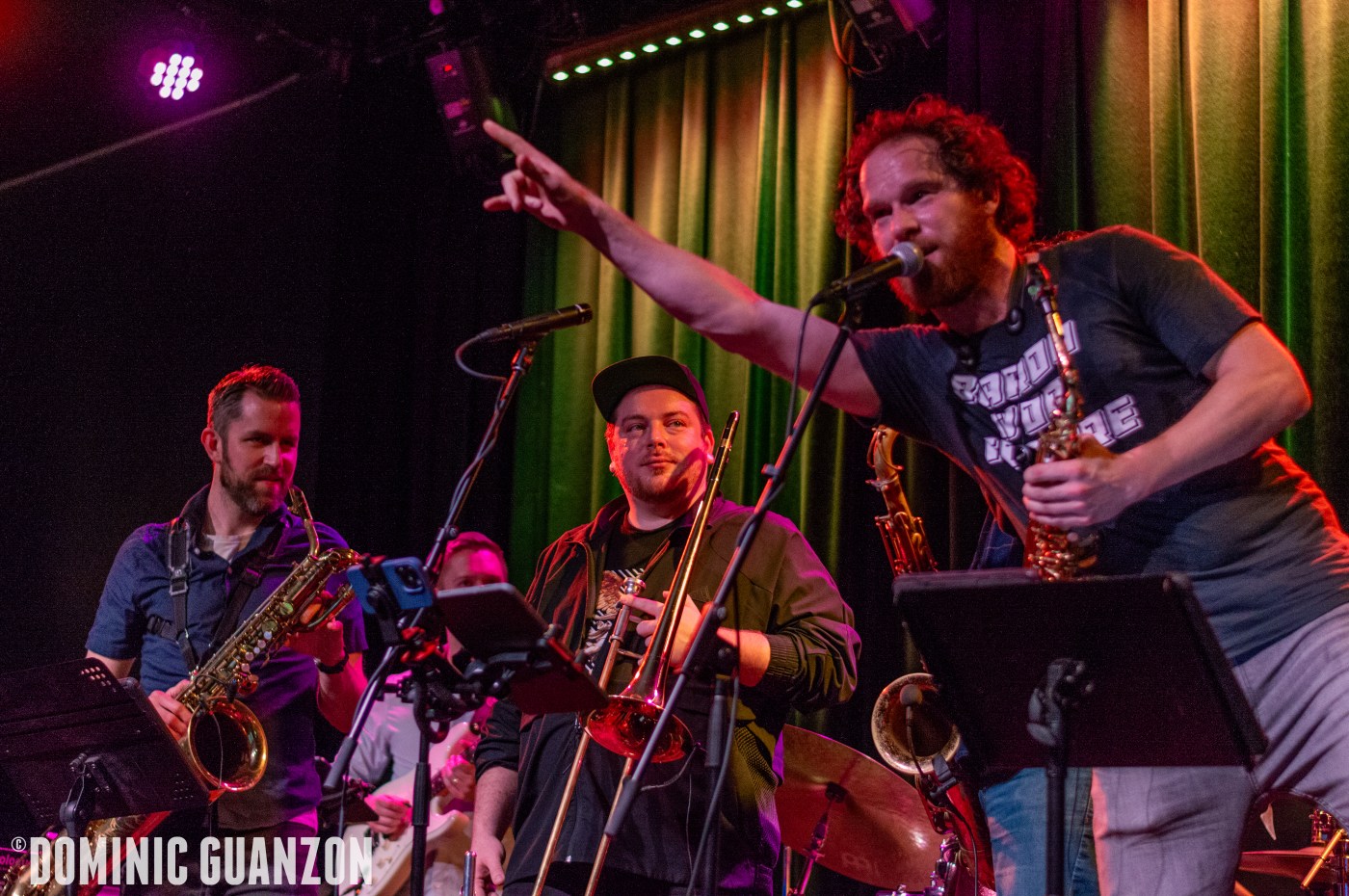
Neil Carson (right) hypes up the crowd as his bandmates Andy Schlinder (left) and Matt Kowalski (center). Robert’s West Side, 3/13/25.
By Dominic Guanzon
Published 1/24/26
This interview has been edited for clarity.
New Nostalgia makes music you could remember a Saturday morning cartoon to, reminiscing on that energy and innocence like a montage in your memories. As if they were the real soundtrack all along.
In so many ways, watching them live in front of you, they ARE the Saturday morning cartoon, blasting horns with an unabashed, in-your-face rock sound, but with the important caveat to not be too obnoxious about it.
Because Neil Carson has too many ideas, too much reverence for the music he grew up with, to be obnoxious.
“We try really hard not to sound like jazz,” says the nonet’s bandleader and primary arranger, who I had a one-on-one interview with. “We try really hard. Like, I’m doing my best possible impression of a 90s rock band.”
“I try to make the saxophones not sound like saxophones. I try to make the trumpets not sound like trumpets. I try to make the trombone sound like a guitar playing power chords on the bottom, you know?
“We’re a jazz band trying to be a rock band, and even that kind of trying to be something else can be a form of performing. It’s like a costume. Not saying it’s not authentic or anything. It’s just, that’s how you get there.”
New Nostalgia is a smorgasbord of local Chicago talent, from pianist Andrew Lawrence and drummer Zack Marks’ part in Bonzo Squad, to trombonist Matt Kowalski’s part in the LowDown Brass Band. There’s a lot of punky energy brewing in a group like that, but Carson is a large part as to why the band has as much heart and shameless honesty as it does.
That can be tough to find in the world of cover bands, of which New Nostalgia is technically a part of. About half of their sets can be covers of pop music from the 80s onward. The other half being their original compositions. Their second eponymous album, released on Bandcamp 12/5/25, and on streaming 1/13/26, is just that.

Neil Carson (right) on the alto sax. Robert’s West Side, 3/13/25.
“All Wrong”
For the past several years, I’ve been watching the band grow and refine their sets and charts, taking a few photos along the way (a couple of which, full disclosure, have made their way onto the vinyl release). Each time, they’ve always got something new up their sleeves, but often closing a number of their shows with a cover of Morphine’s 1993 song “All Wrong.”
But on their album, they open with it – a mighty door kick announcing they’re back, and they’re right at home.
“We were asked to play a Morphine tribute show at Montrose Saloon here in Chicago,” says Carson, “and we couldn’t even all fit on the stage, so we had to go without piano and without guitar. And when you take the piano and the guitar out, that’s a lot of the harmonic content. So I tried to put that harmonic content into the horn writing. What you get is a very direct kind of…it’s a lot of power chords. It’s about as straight rock as we ever get.”
You’d think Neil would have more of a manic energy when talking to him, especially seeing him jump around and headbang like he’s about to get into a mosh pit with his own front line. But in conversation, it’s clear he’s more thoughtful about his music.
“When it comes to covering songs, my attitude has changed. I used to think more like recomposition. Just take the song and then really twist it and turn it, and it ended up being something that nobody recognized.”
One example of this is Tracy Chapman’s “Fast Car” off of New Nostalgia’s 2019 debut album (also eponymous). The chords are all there, and so is the core vibe, but you don’t get Chapman’s rapid-fire lyrics in horn form.
“Now,” Carson continues, “I tend to be a little bit more conservative. It depends on the song. Some songs are perfect just as they are. I’m like, ‘I still want to play this,’ so I keep everything about it because it’s perfect. But some songs I just hear something different. So it’s a mixed bag. Overall, I think the thing I like about this album is there’s a lot of different temperatures.”

“So Hot, You’re Hurting My Feelings”
“I put out a post on Facebook and I was like, ‘New Nostalgia needs songs to cover. What should we cover?’ Some people wrote back, and I came across [the 2019 Caroline Polachek song]. I sat at the piano playing it for, like, half a year just because I loved it. And I was thinking ‘how can I make this work for a horn band?’
The original song’s music video features Polachek mischievously dancing through hell with synth accents. New Nostalgia matches that with playful flutes, before going full throttle.
“My hope is that anyone who listens can appreciate it even without knowing the original. And then you go back and listen to the original and that adds another layer of appreciation.
“I like art that you can appreciate without having to know the backstory. You know sometimes when you read old literature, you have to read another book about how to read that book? Art that is awesome on its own is kind of what I’m going for.”
“We Are Pilots”
“Yeah. Synth rock/pop. I think my brother showed me [the band Shiny Toy Guns], and I became obsessed with them kind of privately, and like, nobody else really knows them.”
In the 2006 original, there’s a type of Tears For Fears-esque build and swell into its refrain, a clear nod to that era. New Nostalgia swaps out the synthesizer with a bed of a rolling piano figure, before elevating it into pure joy, ending with a beautiful horn layering of the refrain’s melody.
“I didn’t select [the album songs] so they would be memorable, or so people would know them. They’re kind of off the beaten path. Maybe that’s not effective marketing, but who gives a shit?”
“Portrait of Tracy”
“Yeah, Tim [Siesser] arranged that. He brought that one in. I love ‘Portrait of Tracy.’ Those chords are so good. I had not heard ‘Rain’ before, which is a cover by a band called SWV. A girl group from the 90s, and they sampled ‘Portrait of Tracy.’ I mean, there’s no better hands for that project to be in than Tim Siesser.
Listening to them, calling New Nostalgia’s songs “covers” is almost like a disservice. They’re more like tributes. As if a film director wasn’t content with just licensing a song for their movie, but just had to have an original version of it.
SWV’s producer heard that magic in the Jaco Pastorious song, a sacred one by my standards, and it’s clear bassist Siesser felt the same way with both.

Andy Schlinder (left) and Matt Kowalski (right). Robert’s West Side, 3/13/25.
On Yet Another Eponymous Release
“So Peter Gabriel also did the same thing,” says Carson. “His first four solo records after he left Genesis were all called ‘Peter Gabriel.’ Peter Gabriel 2 (known as the ‘Scratch album’ among fans), 3 (Melt), 4 (Security). They didn’t even have numbers. It was just his name. And he also went further. He just wanted the artwork. He said that any text distracted from the artwork.”
“I feel like for us, this album isn’t like it doesn’t have a central theme. It’s not about something per se. It’s the next step in our development.”
Another band to do the same thing is legendary jazz-rock horn band Chicago. Shockingly, Neil hasn’t listened to them very much, something he hopes to change in the future. But the tradition is there, and Neil has thoroughly made it his own.
“I think the music speaks for itself. It’s like a deeper version of what we’ve always been trying to do, which is take music, take influences from the past, and bring them into the present. I will be proud, as our catalog builds, if listeners say, ‘oh, I like the first record. Oh, I like the second record.’ Or if you want, you can call this one ‘Freight Elevator.’ Because we took this photo in a freight elevator. The music is all that I care about. It’s all that we care about. And, you know, maybe that’ll change down the line.
“Maybe we’ll start having lyrics,” he laughs.
“The good thing about liking jazz music and liking rock music, is that you end up with something in between. We are far from the first to do a fusion.
On Album Art
“My friend, Lily Furniss, is an incredible graphic designer that lives in Chicago. She did all the artwork. The photography in that freight elevator was done by Josh Beaton, who has a studio in Ravenswood. We went in there late at night when all the other tenants were gone. And he was like, ‘I think we can just use the whole building.’”
“We crowded into this freight elevator and he just took some shots of us. I’ve never been very visually skilled at determining what looks good. So, it was really helpful to have Lily and Josh, kind of taking the reins.”
Neil also reached out to me about using my photos for some real estate on the inside of the vinyl (and paying me for it), which I happily obliged.
“You were on there, and Josh, and then Janet Takayama did some as well. So it was cool to have a bunch of Chicago photographers involved, for sure.”
Funny enough, the inside of the album is purple, matching their debut’s color palette.
“I think we’re kind of settling on purple, which is weird because it’s certainly nothing we ever talked about. It’s not a color that was ever important to me. But I kind of like it. I’m trying to embrace a little bit more femininity. Not to be cliché or cheeky or performative.
“I mean, Maria Schneider did it. A lot of her early music sounds very masculine. She’s talked about it. Her early records sound very masculine and I love those. But then she kind of began to embrace more orchestral kind of stuff. I think we’re kind of trying to expand in both directions. I think I’m trying to get more masculine and more feminine, you know, and maybe more in between.
“We try to rock harder and we try to orchestra more orchestrally,” he jokes.
“A gender fluid kind of jazz-rock,” I say.
“Even though we’re all dudes,” he laughs.

Matt Kowalski (left) playing trombone, as Neil Carson (right, background) signals to bandmates. Robert’s West Side, 3/13/25.
On Something He Wishes Other Arrangers Did
Listen to just a few New Nostalgia tracks, and you’ll get their sound immediately, which stands out in the group jazz landscape – between the old school Basie-heads, and the fusion-forward modernists. The closest I can compare locally is the now-retired Chicago Yestet, who, while not rock-based, did have a striking, melodic clarity to bandleader Joel Adams’ compositions.
I didn’t bring up the Yestet to Neil, but I did ask what he wish other jazz and band leaders did.
“I wish there was more melody. And I wish there was more…just because I can’t come up with a more poetic word, tonality. I’m a bit of a traditionalist in terms of what I want to hear. I want to hear those four chords. I want to hear those four basic chords that the Beatles were using, or, you know, right around it.
“I don’t need to, or want to, hear a complex chord just because it’s complex. I don’t want to hear complexity for the sake of complexity. I want to hear simplicity because that’s where the heart is, so I guess I want to hear more heart in jazz arranging.
“There’s a lot of forces keeping artists from being honest about what they like and writing from that place. You hear a band that’s successful and you’re like, ‘okay, well, I should do that.’ Or maybe you should do what you want to do, and just embrace that and be real about it!
“And that is so completely, utterly subjective. The definition is different to everyone, and different music speaks to different people’s hearts. I can’t speak more confidently than that. I just think heart-on-sleeve is what has always moved me, you know? That’s what we’re trying to do.”
“Role Models”
Despite a name like New Nostalgia, a fantastic mission statement that continues jazz’s tradition of reinvigorating the old, they have a host of originals. Perhaps the most “Neil” original off the new album is “Role Models,” a song inspired by Carson’s canine companion, who passed on in 2023.
“Dale was my parents’ dog. We had three in succession, and Dale was the third. He was the one that I loved the most. He was the most well-behaved. He was the most gentle, the kindest. And he became a role model for me.
“I remember vividly, whenever I was stressed out with schoolwork, or when I had moved back to Chicago to start gigging. Whenever I would be overwhelmed with a lot of just life responsibilities of being an adult, I would look over at this dog who didn’t have any awareness of any of that shit and didn’t care. The most important thought to him, was just, like, ‘where’s the sunlight? I’m going to go in the sun for a little bit.’
“And that might sound cliche, but I would love to be like that. I would love to be so present in the moment, and to appreciate simple things. So I sat down, and I was like, ‘I want to write a song about my dog.’
“And I was very methodical about it. I took a piece of sheet music, and the first two lines, I was like, ‘whatever notes I put in here are going to be about his floppy ears, kind of floppy ears energy.’ And then the next two lines, I was like, ‘okay, let’s go a little deeper. Whatever notes I put in here are going to be about what a good friend Dale is, and just how present he is, how comforting he is, you know?’
“And then the next two lines are going to be about that living in the moment thing. Of course, when you listen to it, that might not make itself known, but, that’s how it was inspired.
“If you’re a music theory nerd, you’ll hear like that. It’s very major for the first line. And then it goes to minor, which is like a little bit deeper and more thoughtful, you know, so that kind of ebb and flow.”

Andrew Lawrence. Robert’s West Side, 3/13/25.
“Applause is Mandatory”
Andrew Lawrence, known as “Larry” so as not to be confused by Bonzo Squad bassist Andrew Vogt, contributed an original of his own to the second album.
“That was one of the later ones that we added,” says Carson. “He said, ‘I’ve got a tune that I’m working on for New Nostalgia,’ and he hadn’t named it yet. It was almost done by the time he sent it to me.
“He had worked it out in Logic. He was like, ‘okay, I wanted to have two solos because every New Nostalgia song has two solos.’ He wanted it to be high energy. He’s a very methodical writer, kind of like me. But I feel like Larry has a little bit of genius scientist in the way that he writes. He hunches over at his piano and just…the genius just comes out.”
“I will say, it’s been nice to expand and have the other guys writing. Larry is an incredible writer, and Tim [Siesser] is an incredible writer. Connor [Bernhard], our trumpet player, is doing some writing for us now, and I like that it’s more democratic. I like that our bandmates are getting more involved.
“Missing You”
“I think it’s the oldest song on the album. I’m not sure. Yeah, I think it is. When we had our first album released, we played a show at Martyr’s in Chicago. I wanted to play one new song for that, and so I wrote that one.
“At the time, I was obsessed with 1980s music.”
“Oh really?” I ask sarcastically. Neil laughs.
“Particularly, this artist named John Waite, who’s a singer-songwriter from the UK, and he has a song called ‘Missing You.’ I’ll be honest with you, I essentially stole a bunch of qualities and characteristics of that original song. I took a lot of the chord progression, put a new melody on it, changed the tempo, and added a trumpet solo. But if you go back and listen to it, you’ll hear it.”
“So you effectively contrafacted a John Waite song?” I ask.
“Yeah, I guess I did!” Carson smiles. “It still moves me. It’s very romantic.”
“Chicago”
Amid an album with plenty of covers, I noticed a track called “Chicago,” expecting either the jazz standard or the Sufjan Stevens song. I was surprised to find I was wrong on both accounts upon listening.
“That’s an original. It originally was called ‘Hymn No. 1’ A while back in college, I got into early American choral music. Specifically, there’s this composer, William Billings is his name.
“He was from the Revolutionary War era in Boston. He wrote these choral hymns that are very simple. He also just kind of named his songs after places. There’s one in particular called ‘Africa.’ It was just a placeholder. But it was this hymn that was just simple, and stately, and modest, and just kind of tugs at your heart strings.
“And so I kind of wanted to do that. I had always wanted to do something for just the horn section. We didn’t have anything like that. And so the title came last, honestly. I wasn’t thinking of Chicago when I was writing it, except I’m from Chicago, so I think it’s in there. But the recording itself, if you listen, it’s actually just the sound of the five of us getting together in [trombonist] Matt Kowalski’s attic, with my phone there as a recorder.
“I think it was like our first run through, or maybe our second. So it’s very off the cuff, but I’m just trying to capture that choral quality.
“There’s a million songs about New York,” I reply. “and there’s about 100 songs about Chicago and yeah, some of them are pretty good, but we need more.”
“Well, I’m glad to be on the list,” he smiles. “I am very proud to be from Chicago, for sure.”

Zack Marks. Robert’s West Side, 3/13/25.
“Kiss Your Friends On The Mouth”
“You wrote a song called “Kiss Your Friends on the Mouth,” I ask Neil. “What did you mean by that?”
“I don’t know where I came up with that,” he laughs, “but this song is a love letter to the band Green Day. I went through a phase of listening to their Dookie album, and if you listen to it, it’s super poppy, super catchy, but very, very sarcastic. Very venomous, very biting lyrics and biting titles. And so [his song] was that. This was ‘I want something that doesn’t take itself seriously.’”
“Kind of just eyebrow raising, you know? So, I don’t condone the message. Well, I should say, ask for consent first, and then kiss your friends on the mouth.
“That’s another one that I would say I’m the most proud of. It took the most work. I had major writer’s block on that for a while. I think the thing I struggle with the most, out of any part of writing, is coming up with a melody.
“I can do a groove easily. I can do a bassline easily. I can do horns, chords, and background stuff very easily. But just a single line, something that’s something singable and memorable, is really fucking hard. I left that for a couple months and then came back to it. I had to fight with that one.
Another song that inspired this original is Everclear’s 1997 “Sunflowers.”
“‘Sunflower’ is a song that’s really, really catchy. But if you listen to the words, it’s dark. I think it’s about a father speaking to his son, or maybe a mother to daughter.
“And it’s like, ‘I remember you painting sunflowers in your room, when you were a child. You were happy and free. You were my reason to live. I can still see you painting sunflowers in your room. Now, why do you want to be broken? Why do you want to be this? Why do you want to be that?’ I think it’s about an older person not understanding the angst of a younger person. So it’s very 90s.
“Have A Stroll”
The album closes with an uptempo J-pop song, which the band advertised as a “workout song,” notably adding a four-bar vamp for the band to flourish and solo on.
“I have to admit, I don’t listen to a ton of other J-pop, but I’ve seen Perfume do this live and [their act] is very, very choreographed. But a friend of mine, Evan Levine, bass player, we were heading to Ohio for a gig.
“And it was, like, 2AM or something, and I think we were both pretty slap happy. He put this song on, and I just became obsessed immediately because it’s such a driving groove. It’s infectious, like bubblegum pop, but with lots of jazz harmony.
“It’s like it goes to a lot of interesting places, you know? That’s actually an example of a song that I didn’t fuck with that very much. If it ain’t broke, don’t fix it for sure.
“I think of it as, sure, it’s a stroll, but it’s a very fast kind, like I’ve had too much caffeine. That one’s really fun. I still love playing that one.

On The Multi-Year Effort Of The Album
On the album’s Bandcamp page, it describes the effort as “years in the making, documenting our deep respect for sounds of our past, which we try to thoughtfully bring into the present.”
Documenting through the years, indeed. This album took three separate recording sessions to put out. Inefficient by most standards, but a reflection of Carson’s vision.
“I think this album could have come out a lot sooner. Except for a couple reasons. One, COVID, and two, I’m a perfectionist. I’m really hard on myself.
“I love my bandmates. They provide so much to this band musically. I can’t do it without them, you know? I have my bandmates’ help, but most of the movement of New Nostalgia as a project is still kind of on me.
“When you are only accountable to yourself, it’s hard. It’s tough. I’m not a super self-motivated person. I’m probably being too hard on myself, but the self-motivation has always been challenging. It’s something I never understood until I went through it.
“When you get out in the real world in college, they teach you how to play. They teach you how to write. They don’t teach you how to book a gig. They don’t teach you how to apply for a grant. They don’t teach you how to get money, you know?”
“That’s starting to change a little bit. but the process is really slow. Especially when you were spinning a lot of different plates, you have a lot of different stuff going on. So when I have a busy, busy day or a busy, busy week, it’s hard to remember to sit down for an hour.
On Keeping A Nine-Piece Band Together For Nine Years
Eventually, I ask when New Nostalgia was founded.
“2017. Wow. So yeah, like nine years. It’ll be nine this year. Shit,” he scoffs.
“How do you keep a project like that, with that many people, going?” I ask.
“Probably new music and new performances,” he answers. “Playing a lot of new material, keeping the material fresh, and then gigs to keep the performing fresh. Maybe that sounds obvious, but we’ve gone through long phases of not playing, or playing the same material. Things get stale that way.
“I personally think once you get past maybe four or five people, you kind of need to have a leader. I think you need to have someone making decisions. When you send a mass text to a bunch of people, even though you want each individual person to read it and respond, they’re not going to respond. So you need to message them individually.
“That’s why I really am jealous of trios” he laughs. “ That sounds amazing. I mean, like The Police. Are you kidding me? Oh my god.”
“I’m really proud of this record. I’m proud of how long it is. I think I’ve had a love affair with 12, 13-track albums for a long time. I think jazz albums are shorter because the songs are longer. I get that.
“But a Third Eye Blind record that’s 13 tracks, or an Alanis Morissette record that’s 12 tracks, or whatever. I’m kind of in a 90s phase right now. It’s nice to see all this music recorded after a long time, but a lot of these songs go back a long way, and it took us a long time to put it all together.
“This [album] is stronger than the first one in a lot of ways. It’s on vinyl. There’s more musical variety. I think it’s just deeper and more mature.”
Neil Carson (bandleader, as)
Connor Bernhard (tpt)
Alex Beltran (ts)
Matt Kowalski (trb)
Andy Schlinder (bs)
Brandon Hunt (g)
Andrew Lawrence (p)
Tim Siesser (eb)
Zack Marks (d)
Gallery

![[3/3] “Scenes From A Trip To The Philippines For A Family Wedding In Manila And A Reunion In Bacolod”](https://scontent-dfw5-1.cdninstagram.com/v/t51.82787-15/653093588_17983099598968438_2592926441996763080_n.jpg?stp=dst-jpg_e35_tt6&_nc_cat=110&ccb=7-5&_nc_sid=18de74&efg=eyJlZmdfdGFnIjoiQ0FST1VTRUxfSVRFTS5iZXN0X2ltYWdlX3VybGdlbi5DMyJ9&_nc_ohc=CsPoQvkFyoEQ7kNvwF0-aNn&_nc_oc=Adp0fkfNFkfstuFh7OYhnQAXUEmD0WziCGIcUEgC0FSkDd-enfnfGfckZIvrzJ8tnV8&_nc_zt=23&_nc_ht=scontent-dfw5-1.cdninstagram.com&edm=ANo9K5cEAAAA&_nc_gid=hTshKutnZeeV8Dr7gtqsxA&_nc_tpa=Q5bMBQFRIhV4n7BWuTTwmx65KNgBZDBVeZxcnTsjsEObfDY5GaQEDlIZHxxcx9Ll579g3EL9SgQ1MOilVA&oh=00_Afwb-tn9T3LR0RFVv2Kj85ZhUyLfixwda3Xpz54sX-KElA&oe=69C19F8E)
![[2/3] “Scenes From A Trip To The Philippines For A Family Wedding In Manila And A Reunion In Bacolod”](https://scontent-dfw5-1.cdninstagram.com/v/t51.82787-15/652115319_17983098269968438_1420457237146189277_n.jpg?stp=dst-jpg_e35_tt6&_nc_cat=111&ccb=7-5&_nc_sid=18de74&efg=eyJlZmdfdGFnIjoiQ0FST1VTRUxfSVRFTS5iZXN0X2ltYWdlX3VybGdlbi5DMyJ9&_nc_ohc=a82kdwoR_jIQ7kNvwFFVVct&_nc_oc=Adq20f8PwLbANCZcDqPR4ZLiHXSjpzVqYzjrUgY-Bcsfdf2yR9V6J3PBJuazPe9mk_4&_nc_zt=23&_nc_ht=scontent-dfw5-1.cdninstagram.com&edm=ANo9K5cEAAAA&_nc_gid=hTshKutnZeeV8Dr7gtqsxA&_nc_tpa=Q5bMBQFFcywkur6V7Lr2sG2RZ16VKgmbfslA5ptUPkSok4iIKoBzxcuiL60L1-STmgOoifB70h9PsQ463g&oh=00_AfyJAbJnO8d7Yk2UBlbfDbkY9c3LuZvw1bkQeXNxMkx7BA&oe=69C1B008)
![[1/3] “Scenes From A Trip To The Philippines For A Family Wedding In Manila And A Reunion In Bacolod”](https://scontent-dfw5-2.cdninstagram.com/v/t51.82787-15/653994441_17983092077968438_2167869577442551897_n.jpg?stp=dst-jpg_e35_tt6&_nc_cat=100&ccb=7-5&_nc_sid=18de74&efg=eyJlZmdfdGFnIjoiQ0FST1VTRUxfSVRFTS5iZXN0X2ltYWdlX3VybGdlbi5DMyJ9&_nc_ohc=0p2rZnMyErAQ7kNvwGkubxT&_nc_oc=AdpNlqVGUVjtL5AXEZE4Y371OUBansiQufwMkJmJP5a81v5BxHshLtuEyoI2nPoCmdk&_nc_zt=23&_nc_ht=scontent-dfw5-2.cdninstagram.com&edm=ANo9K5cEAAAA&_nc_gid=hTshKutnZeeV8Dr7gtqsxA&_nc_tpa=Q5bMBQEUshJXpqAfPsp58CPg3-dtB2PchM014KgeZv-7lY0B0-jQvbQ4qnyw8MuC76ucKALakQFZ2z14qw&oh=00_AfxviYCdxcyyT2fop9TMO4wPtno2gXILJLQHnG0ovLyy2w&oe=69C1AEB6)


![[2/2] BROADVIEW, IL, 2/28/26, 1PM-2:30PM – After their scheduled program, ~50 protesters moved from the designated protest zone on Beach St, down 25th Ave, and to the Harvard St approach to the ICE facility in a seemingly impromptu occupation of the intersection.](https://scontent-dfw5-1.cdninstagram.com/v/t51.82787-15/641803666_17981473718968438_580148578517965678_n.jpg?stp=dst-jpg_e35_tt6&_nc_cat=109&ccb=7-5&_nc_sid=18de74&efg=eyJlZmdfdGFnIjoiQ0FST1VTRUxfSVRFTS5iZXN0X2ltYWdlX3VybGdlbi5DMyJ9&_nc_ohc=_0Ee7-_ni44Q7kNvwHU-xnj&_nc_oc=Adq6jj4jXXqlbMtE5pV3kwAXKaaGBkTLZwpJOnfb1K8-zY1NFC_2jNlGLJApvfPHT1w&_nc_zt=23&_nc_ht=scontent-dfw5-1.cdninstagram.com&edm=ANo9K5cEAAAA&_nc_gid=hTshKutnZeeV8Dr7gtqsxA&_nc_tpa=Q5bMBQHYy9rrOZH1xxnOg_kvBCfothviYzIHvQSe6t0QTG1vxjW3imwAFIDeNhcWpL2NyLwxav2tuQL7_A&oh=00_AfyJByUZoZ0GCIfVGh5_uP7i_BFFeR0p5BVDiwQPRqdV1w&oe=69C1B3DF)
![[1/2] BROADVIEW, IL, 2/28/26, NOON-1PM – About 75 protesters came out for the “Salt Melts ICE” rally within the designated protest zone of the ICE Staging Area/de facto detention center. The theme centered around the salt/ice pun heavily, making extensive use of Morton Salt imagery, a company founded in Chicago.](https://scontent-dfw6-1.cdninstagram.com/v/t51.82787-15/642548769_17981419820968438_7452416072177783532_n.jpg?stp=dst-jpg_e35_tt6&_nc_cat=103&ccb=7-5&_nc_sid=18de74&efg=eyJlZmdfdGFnIjoiQ0FST1VTRUxfSVRFTS5iZXN0X2ltYWdlX3VybGdlbi5DMyJ9&_nc_ohc=KTqOnTrRk7kQ7kNvwHvOYSQ&_nc_oc=AdoTbiQFXM9p8bWElVOaEIbUCsQfDxsA1_K4_CkzHyuWhJZdsshEj0P-9pghEpPQH1o&_nc_zt=23&_nc_ht=scontent-dfw6-1.cdninstagram.com&edm=ANo9K5cEAAAA&_nc_gid=hTshKutnZeeV8Dr7gtqsxA&_nc_tpa=Q5bMBQE0pW7ENYs11ULgQKnzWjlJOxcNQr6R8mmzTZr6DtFLoWFnbqZPVX6x24Im-Gjl4EvE-VEL20PjdA&oh=00_AfxPDqRIongXDacg-q0tFThN861MubiJLH-O7okAAz98VA&oe=69C19E56)

 Blue Collar Jazz
Leave a comment