
By Dominic Guanzon
Saturday 04/29/23
I first met Take [TAH-kay] Yokoyama in 2021 at an all-mask jam session hosted by bassist Glen O’Fallon. He was working on his undergrad at our alma mater, North Central College, but with the slow rollout of the vaccine still making the city tricky to play in, we were forced to take the music to Glen’s backyard patio.
Take was one of three incredible Japanese players to come to the school, and throughout the pandemic it was a delight watching him plow into any tune the jam could throw at him. I distinctly remember him continuously taking charge with groove changes or grabbing the one random conga that was in the room.
Take takes no prisoners when he gets going, and it was that scrappy attitude everyone was tapping into during that time.
He was also the only one of the three that could scrape together the funds and paperwork to stay in the US. I miss hearing Kotaro and Umi dearly, but at least the city has the privilege to still hear Take. That being said, I hadn’t had a chance to see him play since the jams ended that same year.
This past Saturday at the Hungry Brain was finally going to correct that.

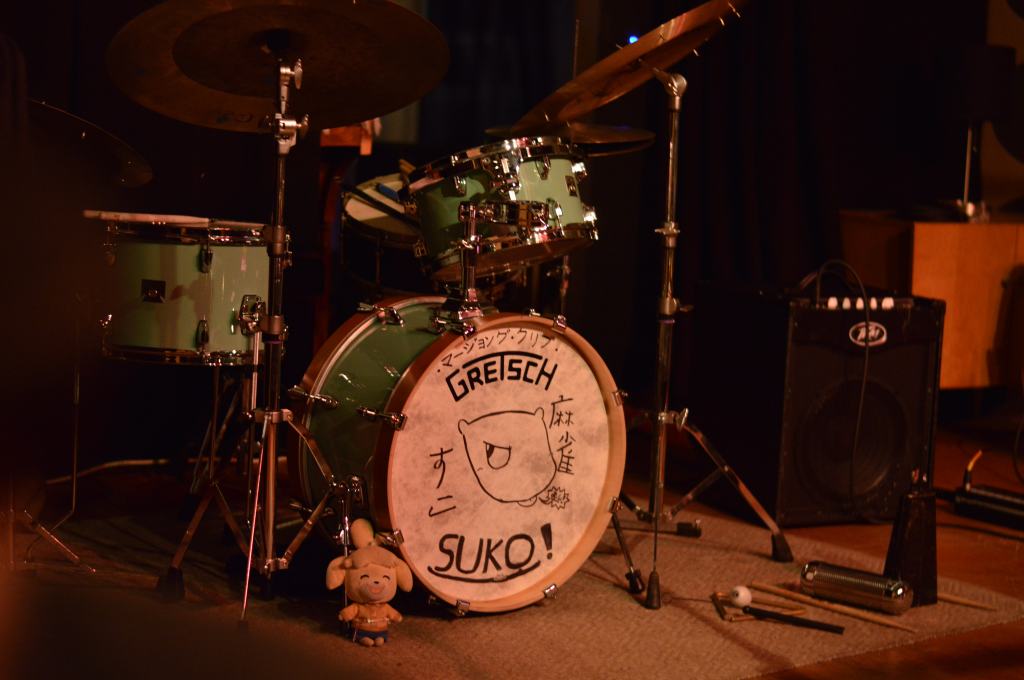
The Take Yokoyama Mahjong Crib keeps the post-bop sound alive and well. The quartet has been playing as a group for “about a half-year” according to the Japanese leader/bassist, and he was excited to be playing at his “favorite club”.
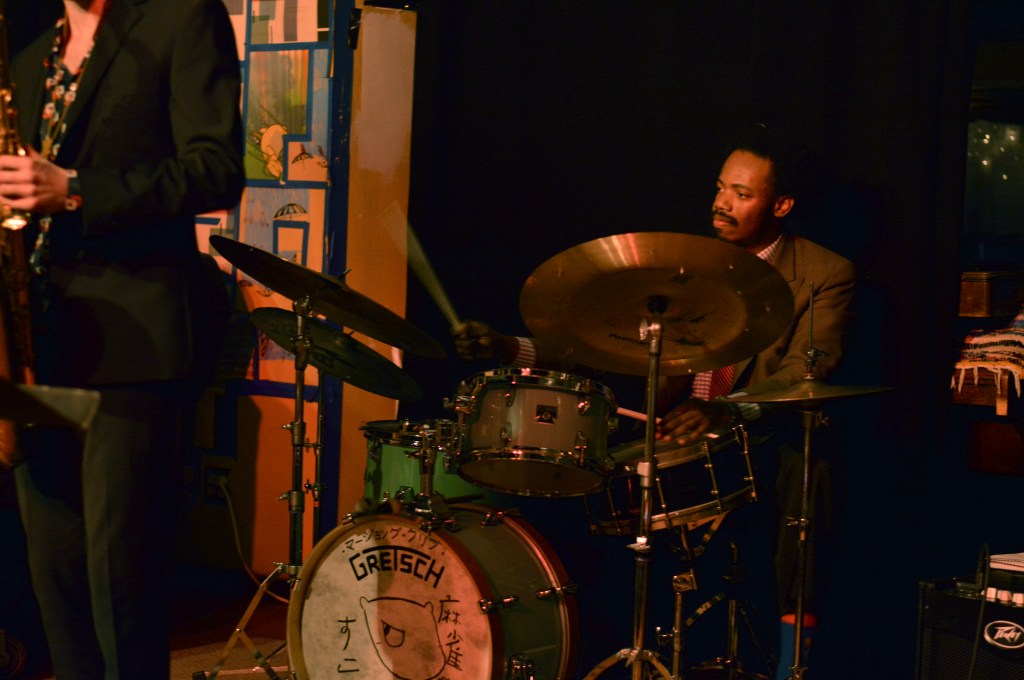
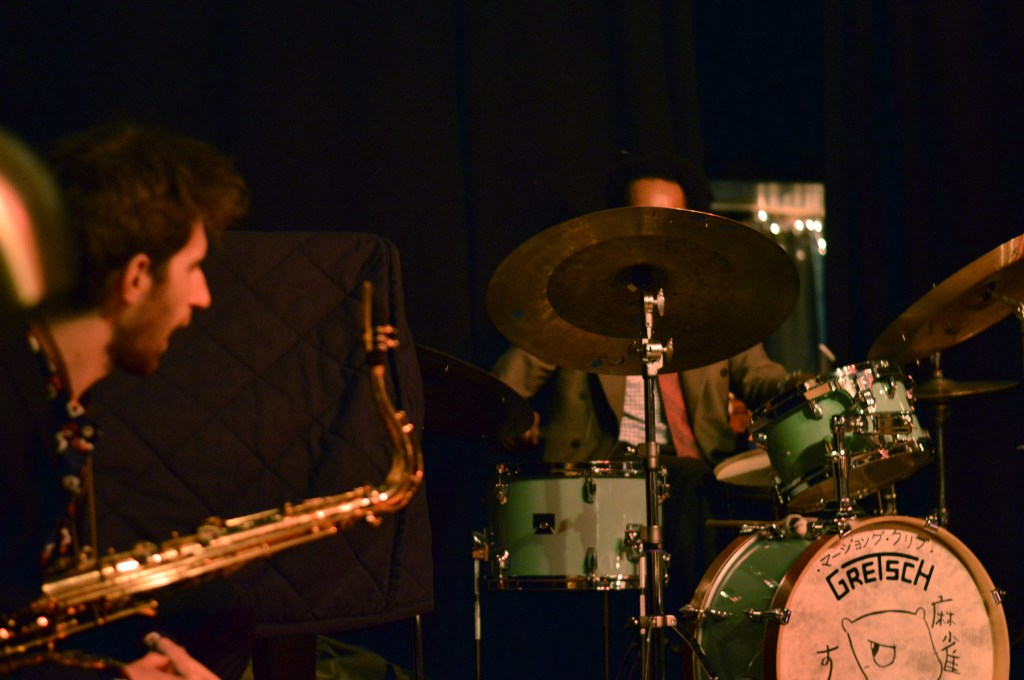
The group kept things interesting with plenty of changes to the rhythm on every song, averaging about two to three switches per tune from sambas, to Afro-Cuban 12/8, shuffles, half-time swing, and more. Drummer Isaiah Keith, with his stone-cold expression and two combs in his afro, at one point ravaged his kit to the point where he nearly took out his floor tom, though he recovered instantly.
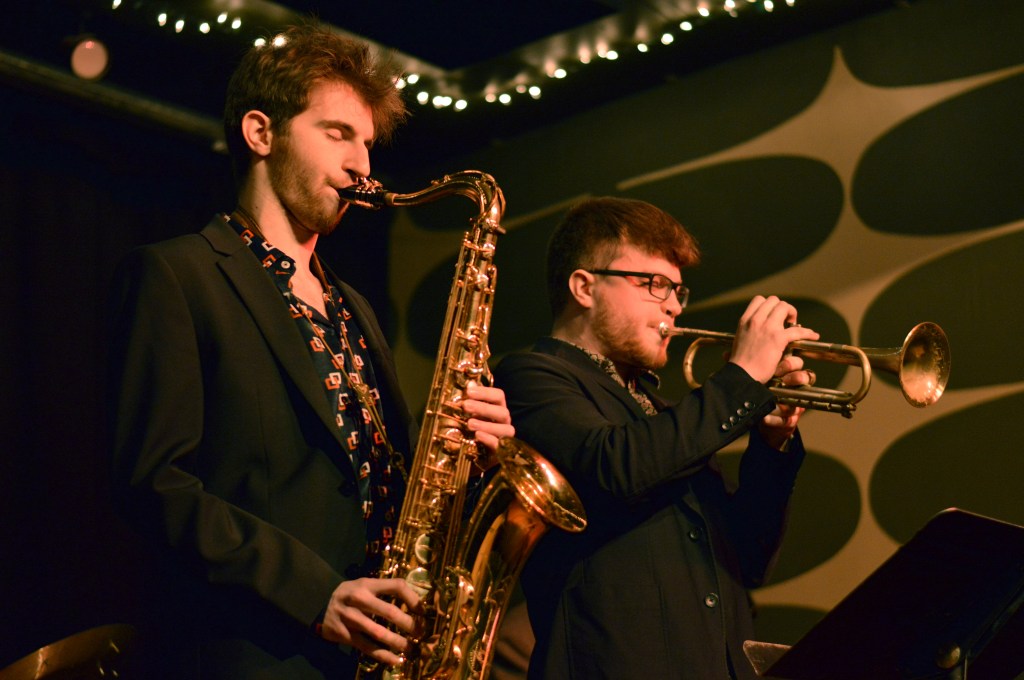
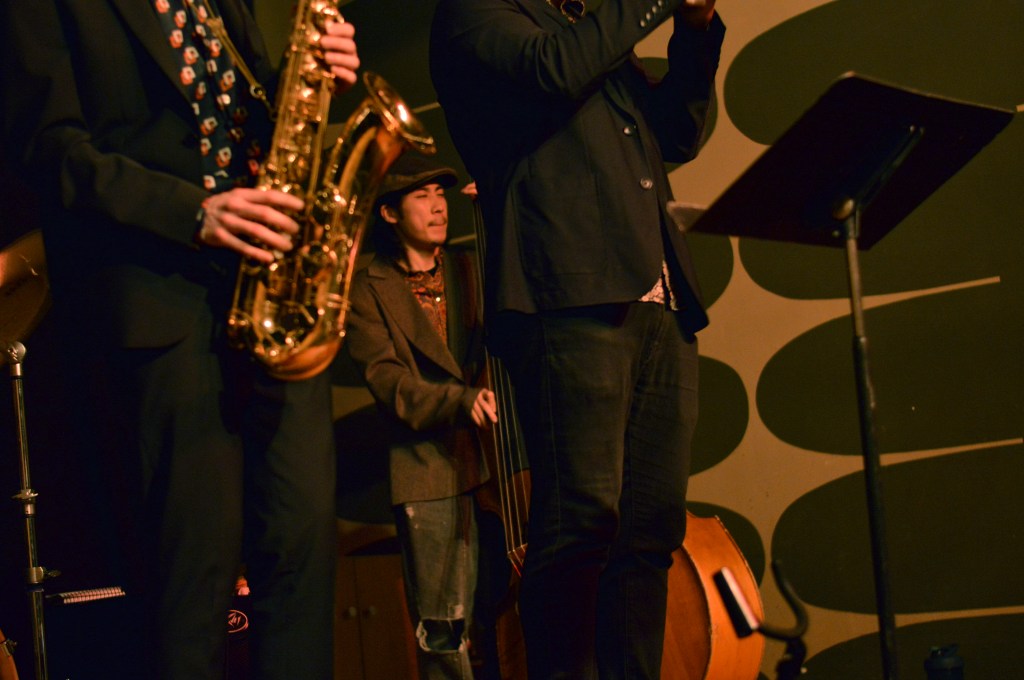
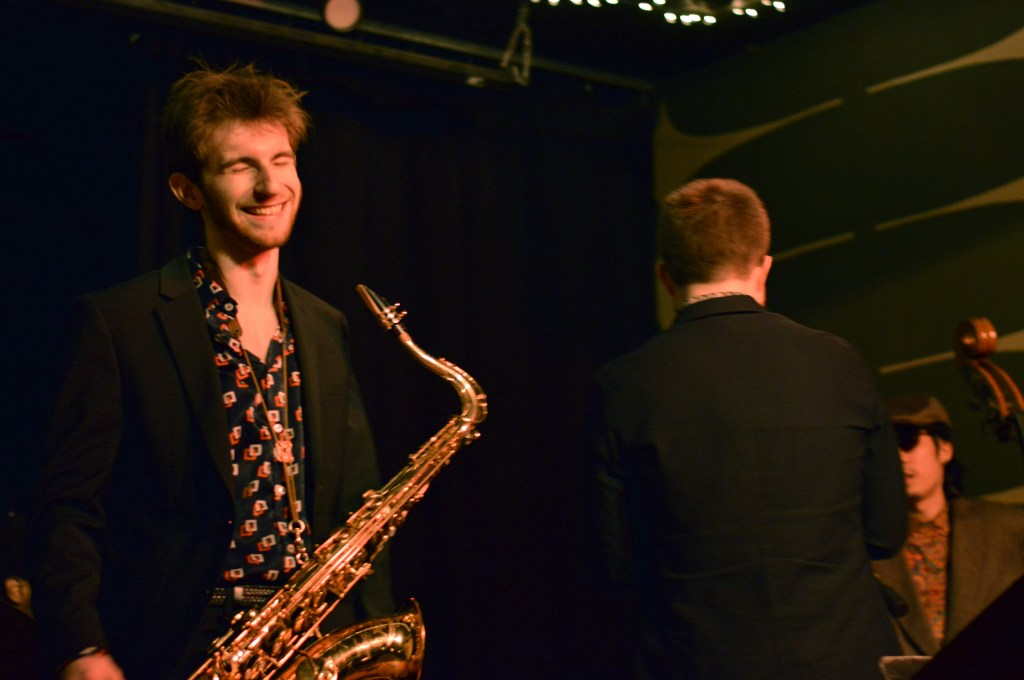
Will Mallard and Rufus Parenti tore it up as the two-person front line. Without a chordal instrument in the group, the pair commanded the canvas of tonality with a hurricane of notes free from any given context beyond the bass. Mallard repeatedly gushed triplet climbs and descents, while Parenti laid into the sweetness of the ballads in a low, Lester Young-like way. Together, solos passed in a layered fashion, almost never cleanly starting or ending their solos without the other joining first. If a tenor-playing Gerry Mulligan teamed up with Miles Davis again to form a Second Great Pianoless Quartet, that might have been the flavor profile.
On top of the numerous post-bop tunes the group covered, the group wasn’t afraid to break things up with a rendition of Jean Knight’s “Mr. Big Stuff”. Not to make things too comfortable however, the funk groove switched from full, to half time, and back with absolutely no care for a clean transition.
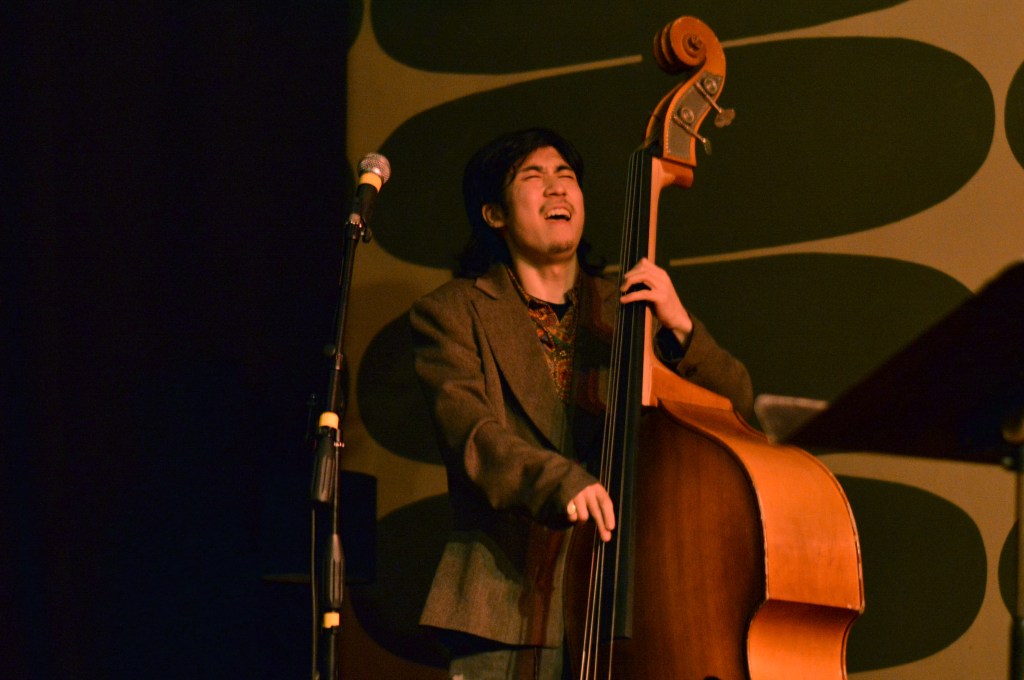
For his part, it almost seemed like Yokoyama was more fascinated with the overall sound of the night itself than his own playing. There were times wouldn’t pluck pluck a string for entire in-heads or solos, and taking only a couple solos himself. Sometimes the vamps were the solos, or at least were treated as such, and the crowd enjoyed it regardless. His technical proficiency on a walking bass line or groove need not be questioned, however, and his work with Keith on the dizzying amount of mid-song style changes is mesmerizing.
In another example of the communication on display, Parenti stopped mid-solo with his eyes closed and fingers open. Mallard, leaning against the wall, picked up his trumpet and threw him two quick notes as if it were a pen, which Parenti mimicked and unpacked into an entire phrase that spanned measures. The entire exchange happened in no more than three seconds.
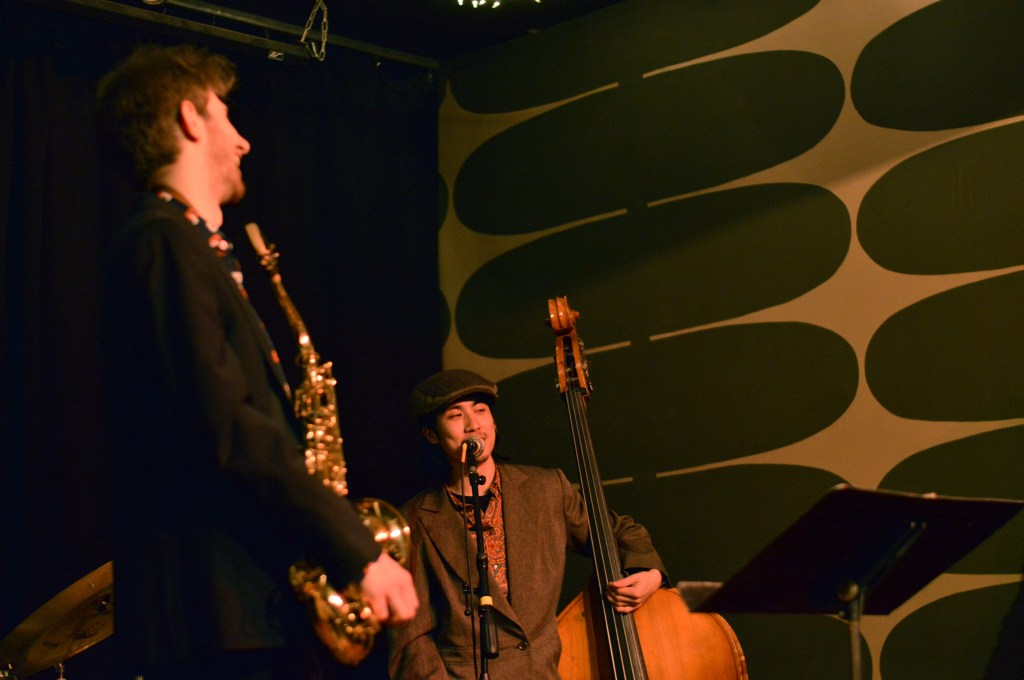
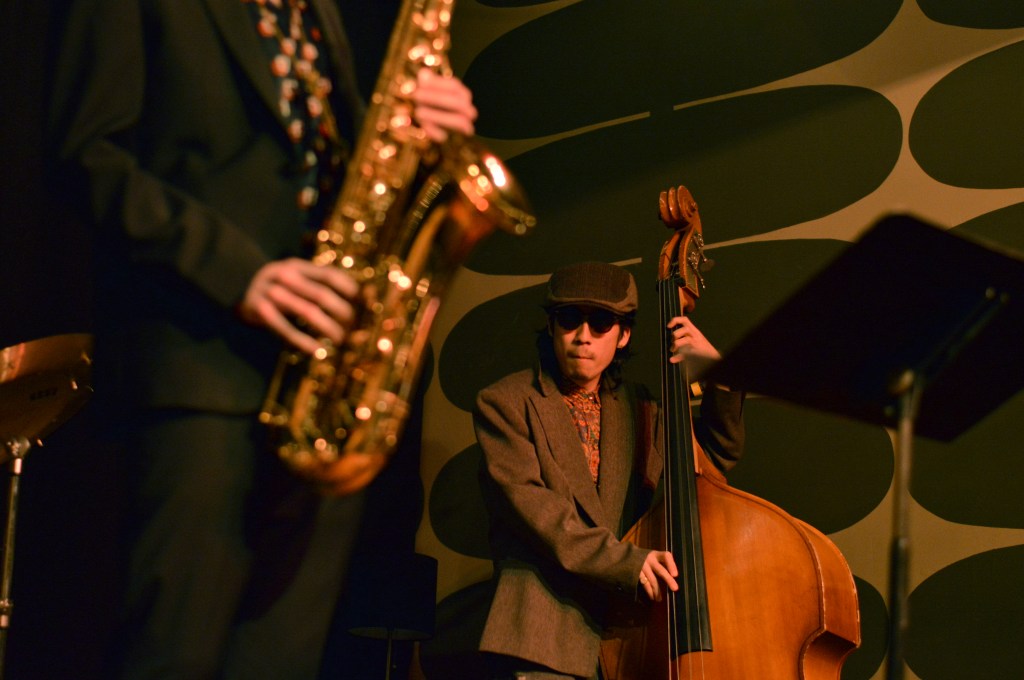
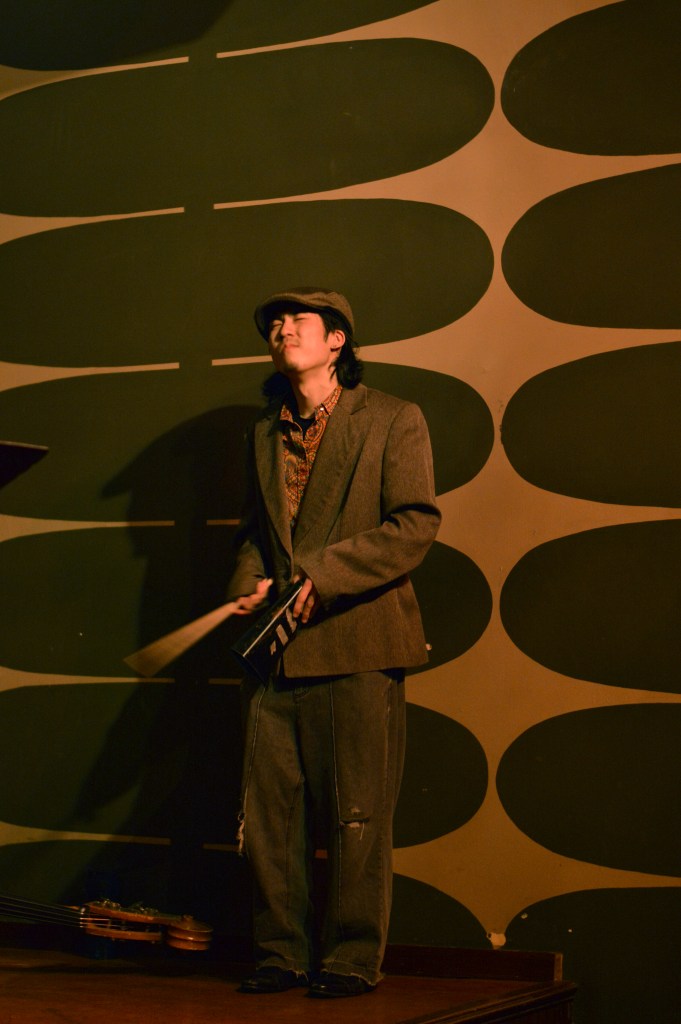
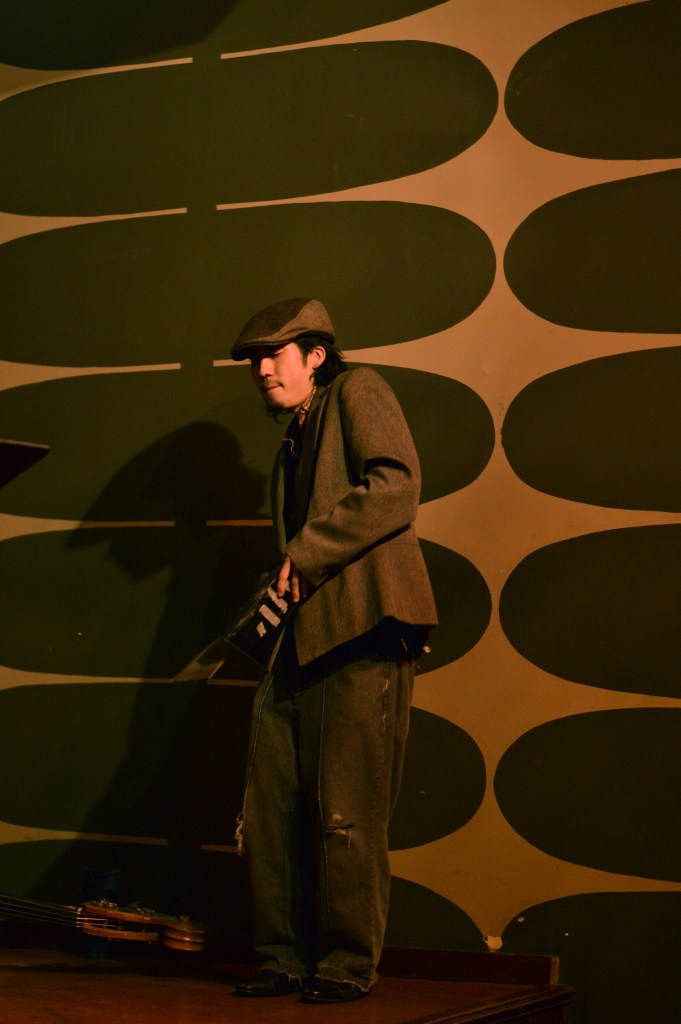
Perhaps just as important to the personality of the Mahjong Crib is Yokoyama’s unique charisma as a bandleader. The pair of rounded shades and shadow-inducing flat cap in the Hungry Brain’s already low-light room set one tone. The bassist’s hands, barely visible in the sagging sleeves of a jacket about two sizes too large for him, doubled it. Whatever mysterious façade he started off with, however, evaporated into a quirky, boyish emcee when he took to the mic between songs.
Yokoyama’s English is far from broken, and it’s 100% better than this author’s non-existent Japanese, but the stop-and-go phrasing of his jokes and story telling proved a lovable foil to the intensity of the music.
In one story, he explains the thought process of the naming behind “Al Pacino,” an original composition.
“Three gangsters are sitting at a bar when they see Al Pacino enter. They walk up to him saying ‘You’re fake! You’re not a real gangster, you’ve never dealt cocaine!’ And Al Pacino says: “Yes, but I’m Al Pacino.'”
The crowd let out a good laugh before Take punctuated the story: “That’s what I am. I’m Take.”
He would later introduce another original called “DeNiro”, and the breaks he took to swiftly drop his towering bass to jam on the cowbell added to the charm of it all.
After three hours and two sets, the players melted into the bar and tables to thank the patrons for coming. Yokoyama had told the crowd “the more people there are, the less nervous I get,” and with about 40 in the room at its height, he was as relaxed as can be. He had also told the audience to “drink a lot,” which may have reinforced the notion.
When asked the origin of the group’s name, he responded: “Do your parents like Mahjong? Yes? That’s why!”
I think I’m still unpacking that.
Take was making the most of the weekend with a gig every night in the city before visiting back home in Tokyo for two weeks. He assured me he was coming back. Chicago was lucky to have him, and as the quartet laughed their way out the back door of the club for a smoke break, I couldn’t help but be excited for what the bassist was going to pull out of that oversized jacket.
The Mahjong Crib is:
Take Yokoyama (b)
Will Mallard (t)
Rufus Parenti (ts)
Isaiah Keith (d)
The Take Yokoyama Mahjong Crib’s latest release “Tapenik” is available on Bandcamp.





 Blue Collar Jazz
Leave a comment