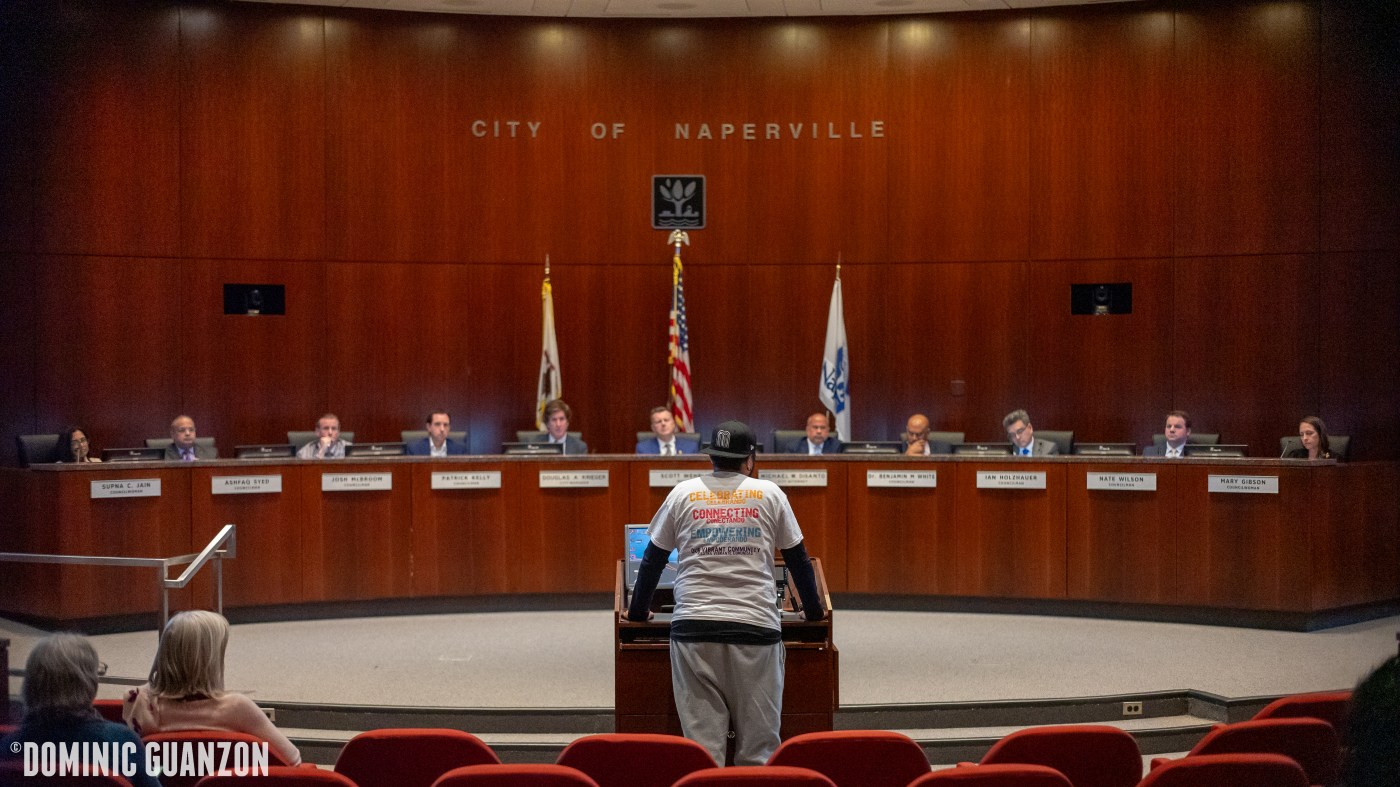
Jose Leon speaks before the City Council. Naperville, IL, 4/7/26.
By Dominic Guanzon
Tuesday, 4/7/26
NAPERVILLE, IL – A dozen public commenters, with a crowd in support, took to the lectern at the twice-a-month City Council Meeting to promote an ordinance that seeks to prevent federal agents from using city property as a “staging area, operations base, or processing site.”
The effort was spearheaded by the Alliance of Latinos Motivating Action in the Suburbs (ALMAS), a Latino cultural and civic representation group founded in 2023.
ALMAS and other ordinance supporters are calling it the “Due Process and Municipal Property Ordinance.” According to ALMAS, the latest draft was penned by “three Naperville residents,” edited by “several other community members,” and is available to view online.

Supporters of the ordinance, including members of ALMAS, stand in solidarity of speakers. One person holds up a sign: “PROTECT and SERVE IMMIGRANT COMMUNITIES.” Naperville, IL, 4/7/26.
“In all that time that I’ve lived here, I have never felt the kind of quiet fear that I feel now, today,” said Stefanie Harrison, a seven-year resident and first-time public commenter.
“Fear of bringing my mom, who’s in the audience here today with me,” she said, gesturing to her mother behind her, “and my children to community spaces, especially to celebrate our culture, and events like Día de Los Muertos. What should be moments of joy, now carry the weight of uncertainty, with the possibility that [ICE] could appear and strip away something as fundamental as due process.”
“Thousands of people have been detained, including children,” Harrison continued, her voice beginning to tremble, “which breaks my heart because my children are biracial. And it could be one of them that could have been taken.”

Naperville resident Stefanie Harrison gestures to her mother (out-of-frame) while discussing the chilling effect of ICE on her streets. Naperville, IL, 4/7/26.
Section 1 of the proposed ordinance would have Naperville re-affirm its duty to the “First, Fourth, and Fourteenth Amendments,” honing in on the ordinance’s place in constitutional law.
Section 2 would declare that “City-owned or City-controlled property shall not be designated, authorized, or made available by the City as a staging area, operations base, or processing site for civil immigration enforcement activities, to the maximum extent permitted by law.”
Section 3 bars Naperville employees from providing “onsite support for civil immigration enforcement activities,” a local re-assertation of the Illinois TRUST Act.
Section 4 calls for Naperville to “document observed violations of this ordinance when such activities are observed by City employees on City-owned or City-controlled property.”
Sections 5, 6, and 7 deal with state/federal compliance, administrative procedures, and the ordinance’s intent, respectively.
Similar policies have been pushed for in nearby Bolingbrook, where locals expressed confusion and anger after a local man was arrested while seeking refuge in the police department. Aurora passed an ordinance in November of 2025, after a Fall of questions surrounding local police protecting ICE and not assisting with ICE jail escapes.

A senior at Naperville Central High School speaks on the detainment of their family member. Naperville, IL, 4/7/26.

91-year-old Eugene Walston speaks in support of the proposed ordinance. Naperville, IL, 4/7/26.
The supporters were spread across the age spectrum.
“I am a proud first generation immigrant,” opened one senior at Naperville Central High School, “In late January of this year, my life was flipped upside down, like many immigrant families around the country, and in Naperville specifically, when I had to navigate life after the detainment and deportation of a family member.”
“Their detainment wasn’t based on criminal acts, suspicious behavior, or even a complaint, but merely on the basis of how they looked…In passing this ordinance, Naperville residents, regardless of background, can trust that their city government is working for them and with them, and not against them.
“No person should be scared to go to church or drop their kids off at school,” the high schooler closed. “No person should be scared to go to work or attend community based events.”
Meanwhile, Eugene Walston, “a Naperville resident for 48 of my now 91 years,” spoke to the history of racial profiling in America.
“The myth of a migrant crime surge is the basis for justifying the expense of ICE force, which has killed several innocent people. Chinese, Irish, Italian, Muslim and most. Chinese, Irish, Italian, Muslim, and Mexican immigrants have all been falsely accused of, and scapegoated, for bringing crime into the United States. Actions which typically happen at times of economic or political unease.”

The Naperville City Council (left) and supporting departments (right). Naperville, IL, 4/7/26.
Council Has Legal Concerns
The Council opened discussion with general support behind the spirit of the topic, but ultimately landed on legal skepticism surrounding the ordinance.
The Council did not appear to directly cite the ordinance draft, but the likeliest parts to receive the most scrutiny are Section 2 and 3. The latter states that any violations of the ordinance would be “addressed through existing municipal property management authority and applicable trespass laws.”
Mayor Scott Wehrli summarized the apprehension towards the end of the meeting.
“I’ve looked at the ordinances these other communities around Illinois have passed in. I don’t think there’s any city ordinance that can stop federal civil immigration enforcement. The Constitution is very clear on this. The Supremacy Clause, federal law, it’s the supreme law of the land, and cities don’t get that opportunity to override it.”
“Some of these ordinance proposals that other cities have put into place,” Mayor Wehrli continued, “they’re asking police officers, who are subject to the Illinois TRUST Act, to insert themselves into potential immigration matters for enforcement that is taking place by federal officials. And I think it really kind of puts them in a really difficult spot beyond what they’re already facing every day.”
Mayor Wehrli did re-affirm the Naperville Police Department’s commitment to the TRUST Act, citing that it was already “very specific” and “already in place.”
“I just don’t see an ordinance being an effective tool in achieving the goals that the speakers asked for,” he ended.

Mayor Scott Wehrli (left) confers with staff prior to the meeting. Naperville, IL, 4/7/26.
“I don’t want to give people a false sense of security,” said Councilman Ian Holzhauer, potentially alluding to the Bolingbrook incident. “If we put up a sign that says ‘this is an ICE-free zone’, and then we can’t actually enforce that, that worries me about somebody stepping into that zone thinking they are safe.”
Councilman Patrick Kelly said he has “specific concern about the resolution ordinance track. I’ve always been very hesitant to go down that road on federal and state type of issues, regardless of which side of the aisle or what the topic might be. I just think that’s a tough road to go down.”
Kelly did reference Naperville’s high-profile “assault weapons” (automatic weapon) ban, which was allowed to stay in effect after the Supreme Court refused to temporarily block it, though fresh challenges may be on the horizon.
“We did two specific things that made me comfortable with [the assault weapons ban], and give me concern here,” said Kelly. The first was how the assault weapons ban was “immediate” and “tangible,” in terms of sales of the guns.
Kelly’s second point had to do with potentially intense litigation, which the city had to undergo during the assault weapons case.
“We had pro bono representation from a major international law firm lined up, and it’s been mentioned that’s gone to Supreme Court. If we didn’t have that, that would have put the city in a very difficult and very expensive situation. Our in-house counsel probably couldn’t do that.”
“I’d rather see our city staff be able to be proactive and get communication out there,” Kelly continued. “Whether that’s ‘know your rights,’ documenting instances where ICE…is in the city, I feel like that’s been a little light, even for Council, let alone the public. Sometimes our city staff just flat-out doesn’t know.”
“This may be something that might be beyond our control,” said Councilman Benjamin White, “but what I do recognize is that you are our residents. As your elected official, I have a responsibility, I think we all have a responsibility, to address what’s happening to members within our community.”
“I’d like to see some legalities,” White said to staff.

Councilman Ashfaq Syed (second from left) shares his caution in taveling now that ICE activity has ramped up. Naperville, IL, 4/7/26.
The Council did express sympathy and moral support behind the proposed ordinance, with multiple members repeatedly thanking the speakers for giving tesitmony.
Councilman Ashfaq Syed recounted his hesitation to take a family trip to Canada, due to the uptick in ICE profiling.
“My younger brother, a legal citizen for 25 years…reminded me: ‘My brother. Do you want to travel now in this situation?’ I always forget…that I’m a person of color, immigrant, Muslim…I have to always carry my two IDs with me.”
Syed also said he “would like to support and see how legally the city attorney can work on this thing…how we can work on that legally to implement this thing…and definitely I’m going to support that.”
Councilwoman Supna Jain said “the fear is real, and anybody who claims otherwise hasn’t walked what many of our speakers have been experiencing.”
Holzhauer thanked a number of speakers, saying the fear and tragedy they expressed “should give all of us pause as leaders.”
Holzhauer continued, appearing to read from a prepared statement.
“I think one of the responsibilities of leadership is to speak up when something is wrong. Morally wrong…Some will say our actions might be unenforceable or outside of our control. But I think when it comes to making a moral statement, that’s not entirely the point. It’s just like calling out a bully. Even if you can’t stop the bullying entirely, speaking up and saying it wrong does matter.”
Councilwoman Mary Gibson admitted that “I don’t think we’ve done a great job, up here [on the Council] or as a city, addressing your concerns. I think there has been work behind the scenes. But we need to do better at communicating that.”

Councilwoman Mary Gibson. Naperville, IL, 4/7/26.
The council did not call up previous speakers to ask questions, as they did for speakers pertaining to other topics, but they did have copies of the ordinance draft before them.
Ultimately, the Council did pass a unanimous vote for staff to develop what Holzhauer called “a menu of options,” researching “current policies in the area, history of what our Council did previously, what we might consider now, ways we could educate the public…analyze specific language proposed by the residents.”
Naperville City Manager Doug Krieger, who sits on the dais besides the mayor, said staff would likely get back to the Council in May.
“All staff reports would be visible to the public,” said Holzhauer.
One member of the Council that did not comment on the topic was Josh McBroom, who, in a 2024 council meeting, mockingly suggested putting out a sign-up sheet for Naperville Biden voters to house undocumented migrants in their own homes. This received pushback from residents at the following meeting, and praise from SPLC-designated hate group Awake Illinois.
McBroom has made comments putting him squarely on the far-right, including posting anti-trans dogwhistles over “DEI” pertaining to a 7th grade track meet, and threatening to revoke funding for the local pride festival over a post about a Reverend commenting on Charlie Kirk’s death.
“I Would Like For This To Be The Foundation”

Dr. Lili Burciaga, President and founder of ALMAS, cradles a sign while listening to speakers: “PROTECT and SERVE IMMIGRANT COMMUNITIES.” Naperville, IL, 4/7/26.
Dr. Lili Burciaga, president and founder of ALMAS, expressed disappointment at the council’s apprehension.
“They were focused on other national issues, and the ordinance doesn’t try to supersede federal activity. It’s a little frustrating to hear comments mentioning that, when that’s not what the ordinance focuses on. So I do hope that everyone on the dais has actually read the ordinance before actually making a decision.”
The proposed ordinance makes use of the phrases “consistent with applicable law” and “to the maximum extent permitted by law” multiple times, but may not be enough to satisfy the Council’s concerns, especially on Sections 2 and 3.
Dr. Burciaga emphasized the ordinance comes in “two main parts.”
“One is identifying the limits of city resources and city property. The other piece is focused on documentation of violations of the ordinance. It isn’t meant to have police or anyone else get in the way of federal activity that is legal.”
Section 2 reads that “nothing in this section shall be construed to prevent access to City property pursuant to a valid judicial warrant or court order issued by a court of competent jurisdiction.” This is again repeated in Section 5, which is titled “Compliance With Law.”

A pro-ordinance supporter and local resident wearing an ALMAS shirt shares their story. Naperville, IL, 4/7/26.

An ordinance supporter holds copies of Tim Snyder’s “On Tyranny” and the Constitution. Naperville, IL, 4/7/26.
In reference to Councilman Holzhauer’s concerns about the undocumented fleeing to city property for refuge, Dr. Burciaga said that “the draft, as is written, is not meant to provide that safety. If it were to be passed, it would be the city’s responsibility to make it clear that, yes, the city would be taking a stance and would be saying no to illegal immigration enforcement activity, but that would not mean that they can actually keep everyone safe.”
“This ordinance was written by residents,” Dr. Burciaga continued, “but it was not meant to cover everything that the community would like to see. It’s not meant to cover, or try to make any community feel completely safe. That’s unrealistic. Why can’t it be the ordinance, and other steps, and other resources, and other communication with the city? I would like for this to be the foundation that started that conversation…I wholeheartedly support every council member who wants to see other action.”
Johan Salome, program supervisor for Illinois Workers in Action, was in attendance to support the initiative, holding up a sign for a majority of the meeting that read “PROTECT and SERVE IMMIGRANT COMMUNITIES.”
“We know one of the biggest oppositions to the bill is the city arguing that there’s no way to prosecute…It’s a matter of standing with the community and making your community feel safe, right? How can the community feel safe if even its own leaders and council members don’t want them here? So we fully support it. And we hope that the city council hears everyone’s petitions and how concerned the people are.”

Members of Illinois Workers in Action, including Program Supervisor Johan Salome (right), hold up signs: “PROTECT and SERVE IMMIGRANT COMMUNITIES.” IWA has pushed for similar policies in Bolingbrook. Naperville, IL, 4/7/26.
Locals Ramp Up Urgency

David Cannon, Aurora resident and political activist, speaks about the abduction of his neighbors by ICE. Naperville, IL, 4/7/26.
David Cannon, a political activist from neighboring Aurora, began by saying they were “here for my neighbors.”
“Two and a half weeks ago on Friday, March 20th, federal agents abducted a Naperville resident, our neighbor on 75th Street, in broad daylight. I know this because I saw it happen. I was driving to work eastbound on 75th Street when I noticed vehicles on the shoulder, masked agents in bulletproof vests with big yellow letters, moving quickly.”
“By the time I was able to circle back to the scene, they were gone,” Cannon continued. “The only thing left behind was an empty white work van, a sack lunch on the passenger seat, hot coffee still steaming in the cup holder. This man’s family was left to worry, and survive, and carry on without their loved one in confusion, and uncertainty, and precarity.”
“As far as I know, he is still in ICE custody, waiting in a cell somewhere, when he should be here in Naperville with his family. This is not right. This is not just. We must do everything within our power to protect ourselves, our families and our neighbors. That said, I kindly ask the council to please support the [ordinance].”
“You have power and privilege,” he ended. “Use it for good. You’re elected to lead. Now is the time.”

Human rights lawyer and author Qasim Rashid speaks in support of the ordinance. Naperville, IL, 4/7/26.
“We’re not asking you to solve all the world’s problems as it relates to ICE,” said Naperville local Qasim Rashid, a human rights lawyer and author with a large online following. “We’re asking you to simply adopt this ordinance, to say that when the federal government is failing to uphold due process of law.”
“It was the city of Naperville to set forth a firearms ordinance that went to the Supreme Court, and was challenged, and was upheld. That Naperville did things right. We led from the front, and we demonstrated to…the state and the country, that when we lead with our values to uphold truth, justice, and due process, we are successful.”
Rashid went on to cite sexual abuse reports in ICE detention centers, and how he witnessed first-hand ICE’s civil rights abuses against protesters at the Broadview facility.
“And so the ask of you, the power that we have invested in you, is to simply say that we will uphold the US Constitution. We will ensure that every person who lives in this municipality, in this city, will be protected by these principles guaranteed to every single person that the Constitution covers, which is every person in the United States of America, regardless of status.

Jose Leon speaks before the City Council. Their shirt reads: “CELEBRATING – CONNECTING – EMPOWERING – OUR VIBRANT COMMUNITY” in both English and Spanish. Naperville, IL, 4/7/26.
The meeting lasted nearly four hours, with about 75 people in attendance, though the crowd came for a variety of reasons. Topics discussed included affordability, sustainability, autism awareness, marijuana dispensary fees, investment in energy, India Day, e-bike classification, and even the celebration of a school robotics team.
“Earlier today we had the robotics team,” said Jose Leon, an ordinance supporter and volunteer soccer coach. “What do you think they represented? They didn’t come from one race…They came from various different cultures, ethnicities…and yet look how they represented Naperville. That’s why it’s important to pass this ordinance to show support.”
“And I say this on a personal level,” Leon continued, “and I don’t mean to attack when I say this. You don’t know what it’s like to walk the street and know that you can be harassed, and you can be detained simply because of how you look. I want you to look at me, because that’s what I have to do.”
“I was born in this country. I’m a U.S. citizen. But because of how I look, I can be treated other than. That is not America. That’s not Naperville.”
Gallery
![[Full story in bio link.] NAPERVILLE, IL, TUESDAY, 4/7/26 – A dozen public commenters, with a crowd in support, took to the lectern at the twice-a-month City Council Meeting to promote an ordinance that seeks to prevent federal agents from using city property as a "staging area, operations base, or processing site.”](https://scontent-lax3-1.cdninstagram.com/v/t51.82787-15/669700248_17986488566968438_8111440402024780053_n.jpg?stp=dst-jpg_e35_tt6&_nc_cat=104&ccb=7-5&_nc_sid=18de74&efg=eyJlZmdfdGFnIjoiQ0FST1VTRUxfSVRFTS5iZXN0X2ltYWdlX3VybGdlbi5DMyJ9&_nc_ohc=mBIonv6vxYkQ7kNvwF4pUpn&_nc_oc=AdrHfGwSxASNleVj2N51FAnyET1tH9rULufUe-l138MSrzJV7Kt2i175zBLpRqKZYLM&_nc_zt=23&_nc_ht=scontent-lax3-1.cdninstagram.com&edm=ANo9K5cEAAAA&_nc_gid=FA1gcNV7NwZ1Oakt1A8sZA&_nc_tpa=Q5bMBQHMYvX1XZD3bfBBKoCkDWvj8ibvHAPOeg1uCeQ97KvzFCct70C5eolvh4IoBSUz3uWLpoUV3tugwg&oh=00_Af3DzPBFrxRmaL0yBWqFzQ2nyanmRqSfFTpZg-IeN2TfsA&oe=69E041C8)


![[3/3] “Scenes From A Trip To The Philippines For A Family Wedding In Manila And A Reunion In Bacolod”](https://scontent-lax3-1.cdninstagram.com/v/t51.82787-15/653093588_17983099598968438_2592926441996763080_n.jpg?stp=dst-jpg_e35_tt6&_nc_cat=110&ccb=7-5&_nc_sid=18de74&efg=eyJlZmdfdGFnIjoiQ0FST1VTRUxfSVRFTS5iZXN0X2ltYWdlX3VybGdlbi5DMyJ9&_nc_ohc=zFZfPWDWwMIQ7kNvwEYvTVV&_nc_oc=Adr6OMoUmdiVqDwQuM0BgGfJJy43T4Rjm8vsbCYIcYQtIGqj-_KxPvJumVqN4jZPCcE&_nc_zt=23&_nc_ht=scontent-lax3-1.cdninstagram.com&edm=ANo9K5cEAAAA&_nc_gid=FA1gcNV7NwZ1Oakt1A8sZA&_nc_tpa=Q5bMBQGt4GvkDaeK5NDZ5OUQ0hupTBy5NvnY8lI-lAkNqXNkZb1EV8RERbwR4larVAsEzJ2ysRIvO07GZw&oh=00_Af3wTEDxOu8X5q4Hr0-SoqaZzNDwH7RVVoxKmqufmyjkqA&oe=69E02A4E)
 Blue Collar Jazz
Leave a comment